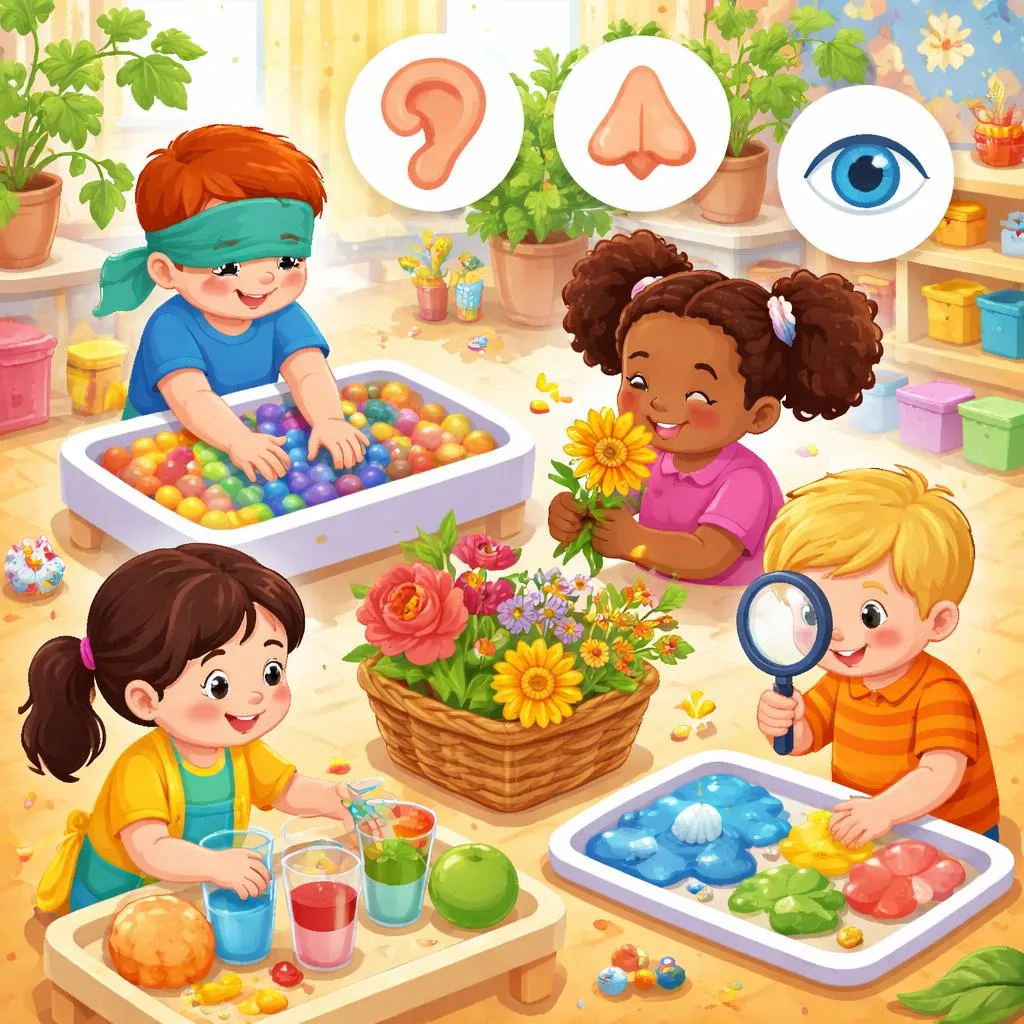

What is activities for five senses preschool?
Activities for five senses preschool refers to learning tasks that focus on sight, hearing, touch, taste, and smell. These activities help young learners explore the world in a structured way. They also support early language development and scientific thinking.
In a classroom setting, sensory activities connect words with real experiences. This connection strengthens memory and comprehension. It also supports emotional and cognitive growth.
Teachers often integrate sensory learning into daily routines. This approach keeps learning concrete and meaningful.
Meaning and explanation
The five senses are sight, hearing, touch, taste, and smell. Each sense helps humans gather information from the environment.
Sight helps with colors, shapes, and movement. Hearing helps with sounds, music, and language. Touch helps with texture, temperature, and pressure. Taste helps with flavors and food preferences. Smell helps with recognizing scents and safety signals.
In preschool education, sensory learning builds foundational concepts. It also enhances vocabulary and descriptive language.
When teaching English, sensory activities offer rich opportunities for sentence practice. For example, “I see a red apple.” “I hear a loud bell.”
Categories or lists
Sensory activities can be grouped by each sense. This organization helps with lesson planning and scaffolding.
Sight-based activities include color sorting, picture matching, and light exploration. Hearing-based activities include listening games and music sessions. Touch-based activities include sensory bins and texture boards. Taste-based activities include simple food sampling. Smell-based activities include scent jars and herb exploration.
Teachers often integrate multiple senses in one lesson. This multimodal approach increases engagement and retention.
Daily life examples
Daily routines provide natural contexts for sensory language. Morning circle time includes listening and seeing. Snack time includes tasting and smelling. Outdoor play includes touching and hearing.
In a classroom walk, learners observe colors and shapes. They hear birds, bells, and voices. They touch sand, leaves, and water.
During cooking activities, tasting and smelling become central. This real-world context makes abstract vocabulary concrete.
Teachers can prompt sentences like: I smell fresh bread. I feel cold water. I hear soft music.
Printable flashcards
Printable flashcards support sensory vocabulary development. Cards can show eyes, ears, hands, nose, and tongue.
Visual cards with real photos support comprehension. Word cards reinforce literacy skills. Sentence frames help build speaking confidence.
Flashcards can include descriptive adjectives. Soft, loud, sweet, sour, bright, and dark are useful words.
Teachers can use flashcards for matching, sorting, and memory games. This repetitive exposure strengthens word recognition.
Learning activities or games
Sensory guessing games engage curiosity. One object stays hidden. Learners touch or smell and describe the object.
Sound bingo builds listening discrimination. Different sounds play, and learners match them to pictures.
Texture walks encourage tactile exploration. Learners walk barefoot on grass, carpet, and sand. They describe how each surface feels.
Color hunt games strengthen visual perception. Learners find objects of specific colors in the classroom.
Taste tests introduce basic descriptive language. Sweet, salty, and sour become concrete terms.
Smell jars support olfactory recognition. Learners guess scents like lemon, mint, and coffee.
Teachers can integrate English sentence patterns. I see a blue ball. I hear a loud drum. I touch a soft teddy bear.
Role play activities expand expressive language. One learner acts as a scientist. Others describe sensory observations.
Art projects integrate multiple senses. Finger painting engages touch and sight. Music and rhythm support hearing.
Story-based sensory stations integrate literacy. Learners listen to a story and touch related objects.
Assessment can be informal and observational. Teachers listen for correct vocabulary and sentence structure.
Activities for five senses preschool form a strong foundation for language, science, and cognitive development. Through guided exploration, meaningful routines, and structured play, sensory learning becomes an essential pathway to early English proficiency and holistic growth.