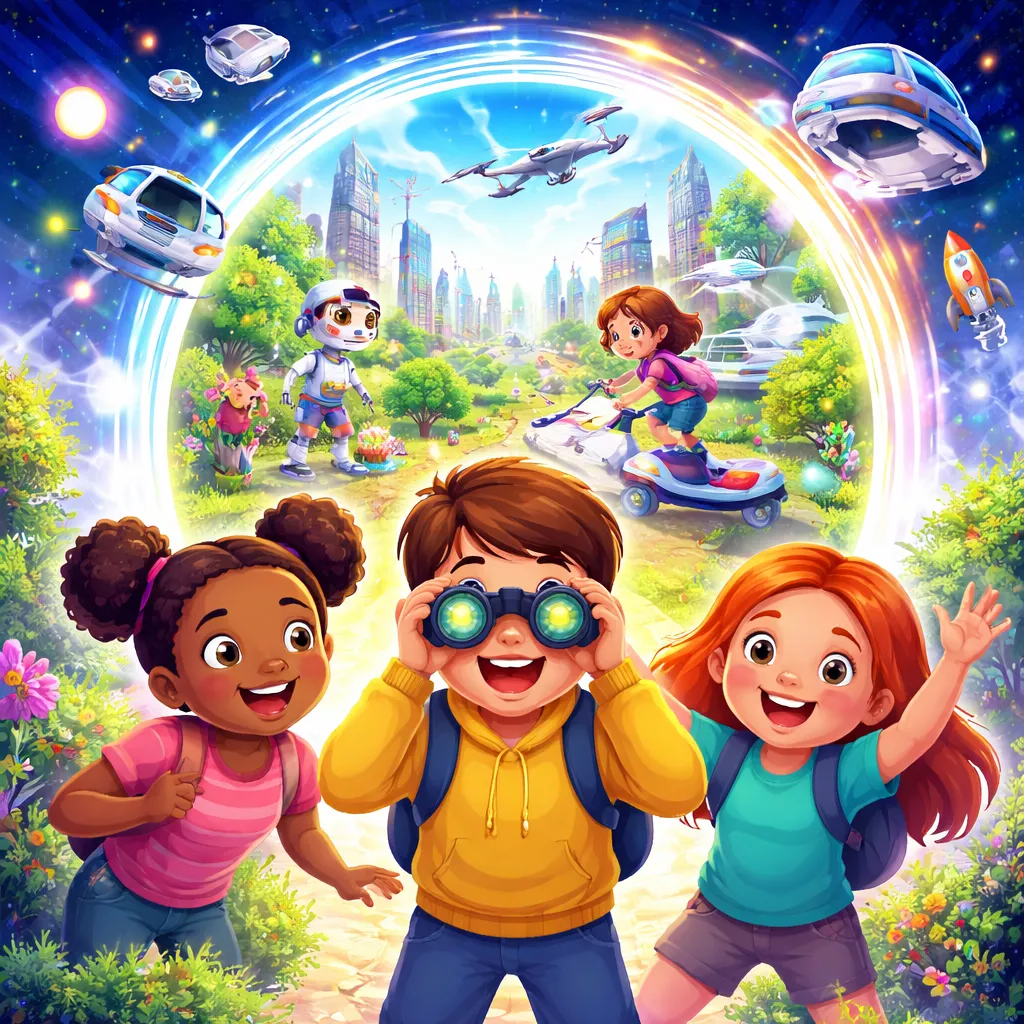

Have you ever wished for a magic telescope? This telescope would not show you stars. It would show you the future! Imagine seeing exactly what you will be doing tomorrow afternoon. What will you see? The future continuous tense is your language telescope. It helps you talk about actions in progress at a future moment. Let's learn to use this fantastic tool together.
What Exactly Is the Future Continuous?
Think about a normal Saturday. You play games. You read books. The future continuous is different. It zooms in on one tiny slice of time. It shows an action that is in the middle of happening at a specific future moment. It is not about the whole day. It is about one snapshot. Picture this: Tomorrow at 3 PM, your mom will be cooking dinner. The cooking starts before 3 PM. It continues after 3 PM. At 3 PM exactly, the action is ongoing. That is the future continuous. It paints a picture of a future scene. The squirrel will be hiding nuts at noon. Your friends will be playing soccer after school. You will be listening to a story at bedtime. It shows life in motion at a future point.
Why Should You Learn This Super Tense?
Learning this tense makes you a language superhero. It gives you powers in listening, speaking, reading, and writing. Let me show you how.
First, your listening power grows. You watch your favorite cartoon. A character says, "Don't call at six. I'll be flying my spaceship!" Now you understand. You know the character will be busy at that exact time. You catch the key detail. You understand the character cannot talk then. This happens in real life too. Your teacher might say, "Next period, we will be studying planets." You know what to expect. You get ready for a science lesson.
Next, your speaking becomes super clear. You can share your plans like a director. You tell your friends, "At 2 PM, I will be setting up the board game." This is much clearer than just "I will play a game." It tells everyone the exact time you start preparing. Your words become powerful and vivid. You can describe exciting future scenes. "This time next week, I will be riding a rollercoaster!" Your stories come to life.
Then, your reading gets a major upgrade. You read a chapter book. You see a sentence: "He knew that at dawn, the birds would be singing." You recognize the future continuous structure. You understand the sentence describes a future moment in the story. It helps you see what the character imagines. This "reading superpower" helps you follow the plot. You understand how characters think about the future.
Finally, your writing jumps to a new level. Your diary entries become exciting movies. Instead of writing "I will go to the park tomorrow," you can write, "Tomorrow at 4 PM, I will be swinging on the park swings." The second sentence is more vivid. It puts the reader right into the future scene with you. Your stories move from simple lists to colorful pictures. You can write about future adventures in amazing detail.
The Simple Formula of the Future Continuous
The future continuous tense is like a friendly robot. It follows a very simple recipe every time. The formula is easy to remember: [Someone] + will be + [verb-ing] + [the rest]. The word "will" is your time machine to the future. The word "be" is the engine that keeps the action running. The "verb-ing" is the action you can see happening. The best part? This robot works for everyone. It does not change for "he," "she," or "I." Look at these examples from our four favorite scenes.
At home, you can say, "My dad will be fixing the bike tonight." The word "fixing" ends with -ing. It shows the action in progress. At the playground, you might say, "My friend will be skating on the ramp." Again, "skating" is the -ing action. In school, "Our teacher will be explaining a new game." The action "explaining" is continuous. In nature, "The bees will be buzzing around the flowers." The buzzing is ongoing. See the pattern? "Will be" is always the same. Then you just add your action with -ing.
Sometimes, you talk about what will not be happening. The formula is just as easy. You simply add "not" after "will." It becomes will not be. You can also use the short form: won't be. For example, "I won't be watching TV at 7. I will be doing my homework." Or, "The cat won't be sleeping. It will be chasing a toy."
Your Detective Kit: How to Spot It
How do you find the future continuous? Be a grammar detective! Look for two clues together. The first clue is the phrase "will be." The second clue is a verb ending with "-ing." If you see both clues in a sentence, you have found it! Think about time. Ask yourself: "Is this sentence about a specific time in the future?" Then ask: "Is the action happening around that time?" If the answer is yes, you have likely found the future continuous. For instance, "This evening, I will be practicing the piano." The specific time is "this evening." The action "practicing" is happening around that time. Mystery solved!
How to Use Your New Telescope
Using the future continuous is fun. You usually use it with a time marker. This tells people when the action is in progress. Common time markers are: "at 5 o'clock," "tomorrow morning," "this time next week," "when you arrive," or "while you are sleeping." You put the time at the start or the end of the sentence. "At 8 PM, I will be reading." Or, "I will be reading at 8 PM." Both are correct. The most important job of this tense is to set a scene. Use it to describe what will be in progress at a future moment. It makes your listener imagine that moment clearly.
Common Missteps and How to Fix Them
Everyone makes mistakes when learning. Let's fix a few common ones together. The first mistake is forgetting the "be." Someone might say, "I will eating dinner." This is wrong. The engine is missing! The correct sentence is, "I will be eating dinner." Always remember your "will be" team.
The second mistake is using the wrong verb form. The future continuous needs the -ing form. Do not use the basic verb. Do not say, "She will be draw a picture." Say, "She will be drawing a picture." Add that -ing to show the action is ongoing.
The third mistake is confusing it with "will" for instant decisions. "Will" can promise a quick action. "The phone is ringing! I will answer it." The future continuous describes a longer action at a specific time. "At 9 PM, I will be answering my emails." One is a quick decision. The other is a scene in progress.
Ready for a Fun Challenge?
Let's test your new skills. Imagine it is Saturday afternoon. Your friend asks what you will do. You want to describe the scene at 3 PM. Use the future continuous. What will you say? Think about your family too. What will your brother or sister be doing at that exact time? Now, think bigger. What do you think the President will be doing this time tomorrow? Use your grammar telescope. Imagine the scene and describe it. Finally, make a plan with a friend. Use the future continuous. For example, "When you come to my house, I will be baking cookies." This tells your friend what to expect.
Putting It All Together
You have learned so much about this special tense. You know it is like a telescope into the future. It shows actions in progress at a specific time. Remember the simple formula. It works for everyone. Use it to make your speaking and writing sparkle.
You can learn many things from this article. You now know the future continuous tense paints a picture of the future. You understand it uses "will be" plus a verb with -ing. You can spot it by looking for those two clues together. You know it often needs a time word like "at 7 o'clock." You can use it to make your English more vivid and clear.
Try using your new skill in real life. Here are two easy ideas. First, make a "Future Snapshot" poster. Draw a clock showing 5 PM tomorrow. Write a sentence below it using the future continuous. For example, "At 5 PM, I will be playing with my dog." Second, play a guessing game with your family. Say, "This time tomorrow, I will be doing something. Guess what!" They must ask questions to guess your future continuous action. Have fun exploring the future with your words!