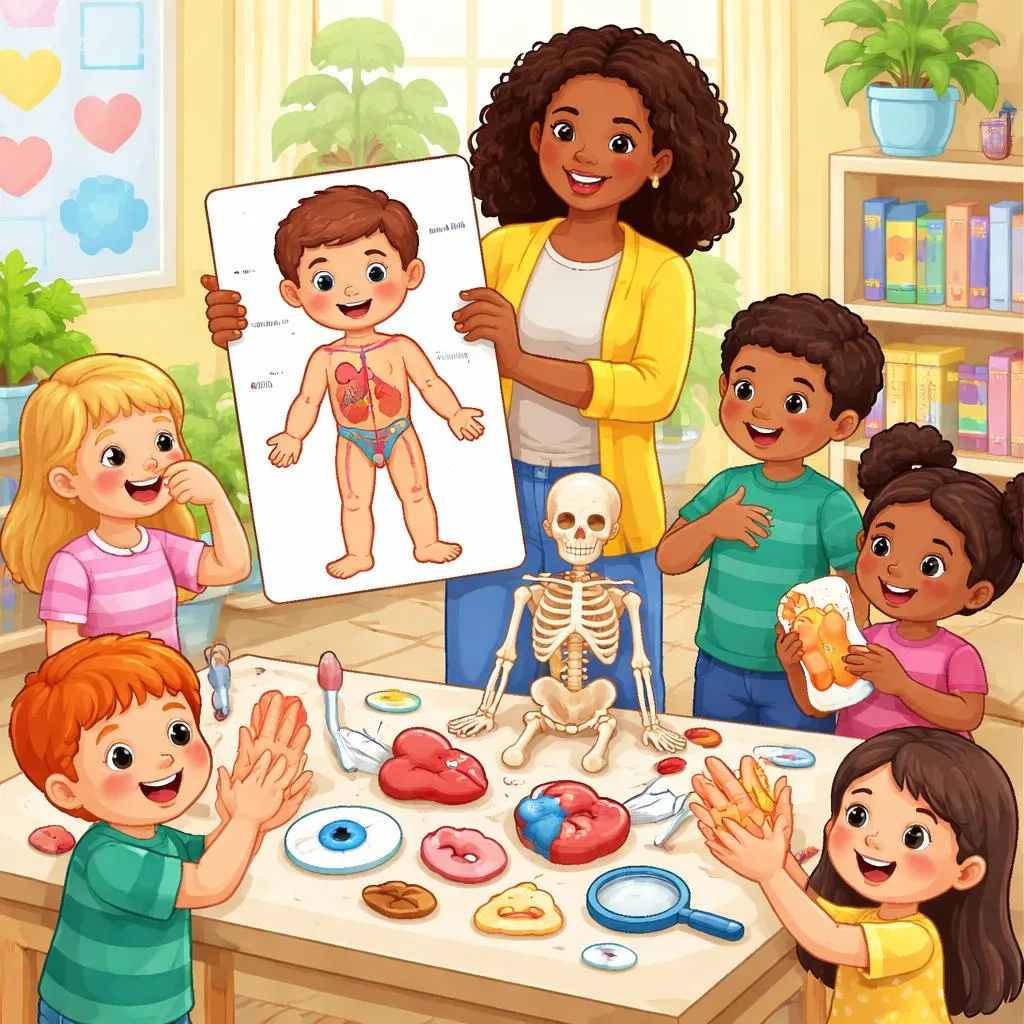

What is body parts for kids?
Body parts for kids refers to basic vocabulary that names parts of the human body in simple English. This topic often appears in early English learning programs because it connects language with real experience.
In class, body parts help connect words with movement, touch, and daily routines. This makes language learning concrete and memorable.
Teachers often introduce body parts with songs, gestures, and visual aids. This approach builds listening skills, speaking confidence, and basic science knowledge.
Meaning and explanation
Body parts are the names of different areas of the human body. These words describe what people see, touch, and use every day.
Examples include head, eyes, hands, legs, and feet. Each word links language to physical awareness.
In early language education, body parts vocabulary supports both English learning and health education. It also supports phonics practice, sentence building, and classroom interaction.
This topic often appears in beginner textbooks, ESL classrooms, and early childhood curricula. It works well with Total Physical Response methods, where movement supports comprehension.
Categories or lists
Body parts vocabulary can be grouped to make learning structured and logical. Teachers often introduce one group at a time to reduce cognitive load.
-
Head and face Head, hair, eyes, ears, nose, mouth, teeth, tongue, cheeks, chin, neck. These words help practice facial expressions and senses.
-
Upper body Shoulders, arms, elbows, wrists, hands, fingers, chest, stomach, back. These terms support classroom commands like “raise your hand” or “touch your shoulders.”
-
Lower body Hips, legs, knees, ankles, feet, toes. These words connect well with action verbs like walk, jump, and run.
-
Internal organs (basic level) Heart, lungs, brain, stomach. These terms introduce simple science concepts in child-friendly language.
Grouping vocabulary supports memory and structured review. It also supports curriculum integration with science and health topics.
Daily life examples
Daily routines offer many chances to use body parts vocabulary naturally. Teachers can model simple sentences that connect language with real situations.
“Wash your hands before eating.” “Close your eyes and listen.” “Stretch your arms in the morning.”
During physical education, body parts words guide movement and posture. In art class, drawing people reinforces visual recognition of body parts.
During health lessons, vocabulary supports hygiene and safety instruction. This builds practical life skills along with English proficiency.
Role-play activities also make vocabulary functional. For example, a doctor role-play introduces words like head, stomach, and leg in context.
Printable flashcards
Printable flashcards support visual learning and spaced repetition. Each card can show a picture and a word, such as “hand” or “knee.”
Teachers often use flashcards for choral repetition and individual practice. Flashcards also support memory games, matching tasks, and quick assessments.
Large flashcards work well for group instruction. Small flashcards work well for pair or individual learning stations.
Flashcards can include phonics cues. For example, “hand” highlights the /h/ sound and short vowel /æ/.
Including simple sentences on flashcards improves context understanding. For example, “This is my hand.” or “I can clap my hands.”
Learning activities or games
Learning body parts vocabulary becomes effective when paired with movement and interaction. These activities integrate listening, speaking, and kinesthetic learning.
Action command activities Teachers say commands like “Touch your nose” or “Shake your hands.” This method strengthens listening comprehension and physical coordination.
Song-based learning Songs such as “Head, Shoulders, Knees, and Toes” reinforce sequencing and rhythm. Music supports memory and pronunciation practice.
Drawing and labeling tasks Students draw a person and label body parts in English. This integrates writing, spelling, and visual learning.
Role-play and classroom dialogues Simple dialogues such as “Where is your ear?” “Here is my ear.” build speaking confidence. Pair work encourages communication and peer learning.
Guessing games One student describes a body part, and others guess the word. This activity builds descriptive language and listening skills.
Phonics integration Body parts vocabulary supports phonics patterns. Examples include “leg” with short e, “arm” with ar, and “toe” with long o.
Sentence building practice Teachers guide sentence frames such as “I have two eyes.” or “My hands are clean.” This supports grammar awareness and sentence structure development.
These activities align with communicative language teaching principles. They also support multiple intelligences in the classroom.
Body parts for kids remains a foundational topic in early English education. It connects language, movement, health, and self-awareness in a meaningful way.
With guided teaching, real-life examples, and interactive activities, this vocabulary becomes easy to understand and remember. This topic also supports long-term language development and cross-curricular learning in science and physical education.