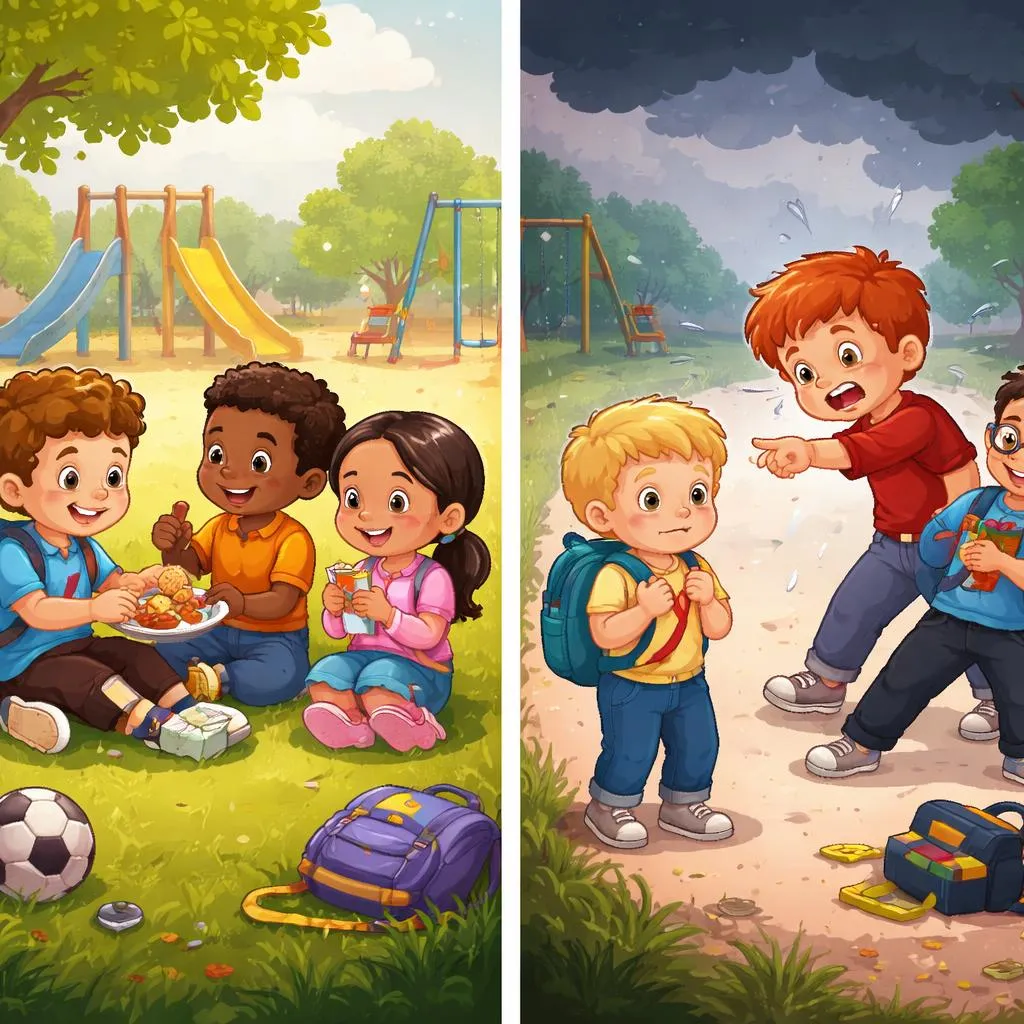

Welcome to our behavior club. Today we meet Mia and Leo. They learn about actions. Last Friday, Mia saw a new girl. The girl dropped her books. Mia picked them up. She smiled and said, "Here you go." She was being good to the new girl. Leo saw a boy with a cool toy. Leo grabbed it. He said, "Mine now!" He laughed meanly. He was being bad to the boy. Mia made a friend. Leo played alone. Both chose their actions. See the difference? One helped kindly. The other acted selfishly. Let us explore why.
Understanding Being Good To And Being Bad To
Being Good To Means Acting In Helpful Ways
Imagine being good to when you share your crayons. You give some to a friend. This is being good to show kindness. Motion feels warm.
Think of being good to when you say "please" and "thank you". You use polite words. This is being good to show respect. Action is thoughtful.
Picture yourself being good to when you clean your room. You put toys away. This is being good to help at home. Effort feels positive.
Being Bad To Means Acting In Hurtful Ways
Now imagine being bad to when you call someone a mean name. You shout it loudly. This is being bad to hurt feelings. Motion feels sharp.
Think of being bad to when you take a toy without asking. You snatch it quickly. This is being bad to show selfishness. Action is greedy.
Consider being bad to when you refuse to share. You hide your snacks. This is being bad to keep things only for yourself. Heart feels cold.
How To Tell Them Apart Fast
Being good to builds bridges. Being bad to builds walls. Ask yourself: Does it make someone smile? If yes, being good to. Does it make someone frown? If yes, being bad to.
Being good to is like sunshine. Being bad to is like a storm. One warms. The other chills.
Remember the outcome. Being good to brings friends. Being bad to pushes them away. Look at the result.
Three Real Life Scenarios
Scene one happens at the playground. Mia sees a kid sitting alone. She walks over. She says, "Want to play tag?" She is being good to include him. Leo sees a group playing soccer. He kicks the ball away. He yells, "You can't play!" He is being bad to exclude them. Mia laughs with the new friend. Leo stands alone. Both chose their path.
Scene two happens in the classroom. Mia finishes her work early. She helps her neighbor with a tricky math problem. She is being good to assist. Leo sees a classmate struggling. He whispers, "You are so dumb." He laughs. He is being bad to mock. Mia feels proud. Leo feels ashamed later. Both acted differently.
Scene three happens at home. Mia's mom is tired. Mia sets the table for dinner. She says, "I will help." She is being good to support mom. Leo's sister wants to watch his show. Leo changes the channel. He says, "No, mine!" He is being bad to be selfish. Mia gets a hug. Leo gets a timeout. Both learned lessons.
Notice the shift. Helpful actions first. Hurtful actions second. Choose your phrase based on the effect.
Common Mistakes And How To Fix Them
Mistake one: Saying "I was bad to when I forgot my homework." Why it is wrong: Forgetting is an accident, not bad behavior. Correct alternative: "I was being good to by telling the truth." Memory trick: Bad to means intentional harm.
Mistake two: Saying "I was good to when I took my brother's toy." Why it is wrong: Taking without asking is bad. Correct alternative: "I was being bad to take his toy." Memory trick: Good to means positive actions.
Mistake three: Saying "She was bad to to say thank you." Why it is wrong: Saying thank you is good. Correct alternative: "She was being good to say thank you." Memory trick: Good to includes manners.
Mistake four: Saying "He was good to to break the rule." Why it is wrong: Breaking rules is bad. Correct alternative: "He was being bad to break the rule." Memory trick: Bad to involves wrong choices.
Memory trick: Think of a scale. Being good to tips the scale to happy. Being bad to tips it to sad. Your brain knows the difference.
Fun Activities To Master These Words
Activity one is a word swap. I say a sentence. You pick the right word. Ready?
Sentence one: "I was ______ to share my cookies." (good/bad) Answer: good.
Sentence two: "I was ______ to call him a name." (good/bad) Answer: bad.
Sentence three: "I was ______ to help with chores." (good/bad) Answer: good.
Sentence four: "I was ______ to hide the toy." (good/bad) Answer: bad.
Activity two is a mini theater. Two scenes. Scene A: Good to. A says, "I am good to help you up." Scene B: Bad to. A says, "I am bad to laugh at you." Act with feeling.
Activity three is spot the odd one. Which sentence sounds funny? "I was good to to steal the candy." Why? Stealing is bad. Should be bad to.
Activity four is make a sentence. Use good to for a kind act. Example: "I am good to hold the door." Use bad to for a mean act. Example: "I am bad to tease my sister."
Bonus challenge: If you see someone fall, say "I am being good to help them." If you see someone fall and you laugh, say "I am being bad to laugh." Practice with a buddy.
These games train your brain. You will pick the right word naturally. Play them with friends today.
Easy Rhyme To Remember Forever
Sunshine warm, that is being good. Stormy cold, that is being bad. Bridge built strong, good to see. Wall built high, bad to be. Friend made fast, good the way. Friend pushed far, bad to stay. Heart feels light, good with care. Heart feels dark, bad to share.
Clap and chant this rhyme. Soon it lives in your memory. No more mix-ups.
Your Homework Assignment This Week
Choose one task below. Write or draw your answer. Share it tomorrow.
Task one: Behavior journal. Prepare a small notebook. Draw three pictures. First: Being good to help someone. Second: Being bad to hurt someone. Third: Both learning from mistakes. Write a sentence under each. Example: "I was good to help Mia. I was bad to take her pencil. Both learned."
Task two: Role-play version. With parents, play "Behavior Talk." You say, "I was good to set the table." Parents say, "I was bad to yell at you." Switch roles. Practice using phrases correctly.
Task three: Sharing version. Tomorrow in class, tell your deskmate: "I was good to yesterday. I was bad to today. What about you?" Listen to their examples.
Bring your work to class. We will hang the best drawings. Everyone shares their sentences.
Life Practice Weekly Challenge
Complete one challenge. Show proof to your teacher or parent.
Challenge A: Morning routine. Be good to when you make your bed. Be bad to when you refuse to brush teeth. Say, "I was good to make my bed. I was bad to refuse brushing." Feel the difference. Take a photo of you being good.
Challenge B: Playtime hero. Be good to when you share a toy. Be bad to when you grab a toy. Place them side by side. Label them correctly. Show your friend.
Challenge C: Reading nook. Be good to in a story about helping. Be bad to in a story about bullying. Use them during story time. Tell your version to a sibling.
Challenge D: Art fun. Be good to draw a child helping. Be bad to draw a child hitting. Create a picture. Hang it on the fridge.
Do at least one challenge. Smile when you use the right phrase. You are growing smarter every day. Keep exploring words. Great job today.