
What is the rhyme?
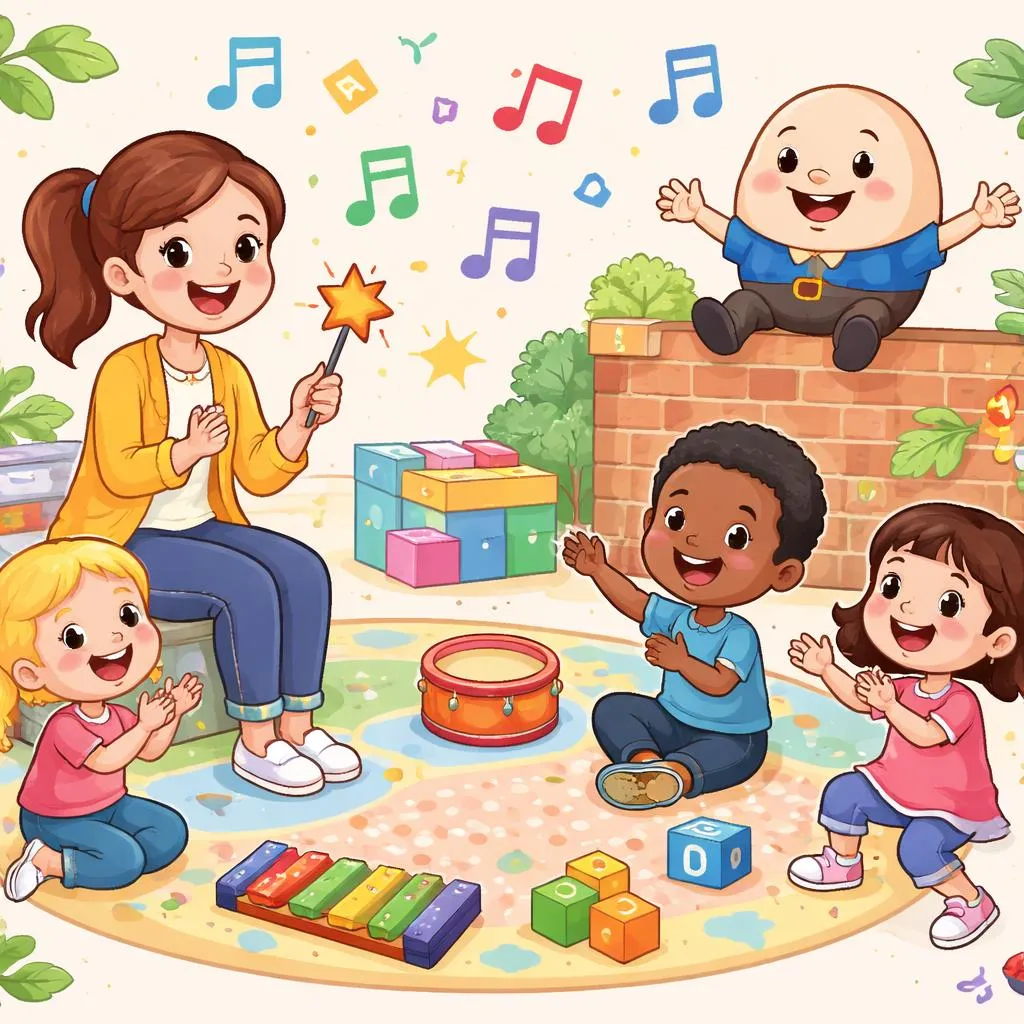
The songs for children humpty dumpty lyrics come from a classic English nursery rhyme. It tells a short story about Humpty Dumpty, an egg-shaped character who sits on a wall and falls.
This rhyme has been shared for centuries. Teachers use it to introduce storytelling, rhythm, and simple sentence patterns.
The story is short and memorable. The repeated structure helps learners follow the narrative easily.
The lyrics of nursery rhymes
The songs for children humpty dumpty lyrics include a simple four-line poem.
“Humpty Dumpty sat on a wall, Humpty Dumpty had a great fall.”
“All the king’s horses and all the king’s men Couldn’t put Humpty together again.”
Teachers can read or sing the rhyme slowly. Pause after each line to explain meaning and rhythm.
This structure supports listening comprehension and memory.
Vocabulary learning
This rhyme introduces basic story vocabulary. “Wall” refers to a tall structure. “Fall” describes moving down suddenly.
“King,” “horses,” and “men” introduce people and animals. “Together” and “again” express repetition and unity.
Teachers can use pictures to support meaning. Show a wall, a horse, and a king.
Simple example sentences help. “Humpty sits on the wall.” “He falls down.” “The king helps him.”
Context-based teaching improves understanding and recall.
Phonics points
The songs for children humpty dumpty lyrics provide clear phonics practice. “Humpty” highlights the short vowel sound in “u.” “Wall” reinforces the /ɔː/ sound.
“Fall” and “all” show the same vowel pattern. “Men” and “again” introduce short and long vowel contrasts.
Teachers can clap syllables in “Hum-pty Dump-ty.” Segment sounds in “fall” and “wall.”
Choral reading strengthens pronunciation and fluency.
Grammar patterns
The rhyme includes simple past tense verbs. “Sat” and “had” describe completed actions.
Teachers can model basic past tense patterns. “He sat on a wall.” “He had a fall.”
The negative sentence “couldn’t put” introduces contraction forms. Explain that “couldn’t” means “could not.”
Model simple sentences. “They couldn’t fix it.” “He couldn’t run.”
Story grammar supports early narrative skills.
Learning activities
The songs for children humpty dumpty lyrics support many guided activities. Act out the story with gestures. One learner sits like Humpty. Another pretends to be a horse or king.
Drawing tasks deepen comprehension. Draw Humpty, the wall, and the king’s men. Label pictures with simple words.
Sequencing activities support story order. Ask learners to place pictures in the correct order.
Listening tasks improve attention. Pause the rhyme and ask, “What happened?”
Printable materials
Printable worksheets help structured practice. Create lyric fill-in-the-blank pages. Remove words like “wall,” “fall,” and “king.”
Flashcards support vocabulary recall. Use cards for “wall,” “fall,” “horse,” and “king.”
Mini-story books encourage retelling. Each page shows one line of the rhyme with an illustration.
Sentence strips support grammar practice. “He sat on a wall.” “He had a fall.”
Educational games
Games make the songs for children humpty dumpty lyrics interactive and memorable. A “Humpty Story Match” game pairs pictures with lyric lines. Learners match text and images.
A rhyme rhythm game builds phonological awareness. Clap the rhythm of each line. Repeat with increasing speed.
A vocabulary hop game uses floor cards. Say “wall” and ask learners to jump to the correct card.
A story retell dice game prompts oral language. Roll a dice and describe the next part of the story.
Digital sing-along tools improve pronunciation and fluency. Interactive quizzes reinforce vocabulary and grammar.
The songs for children humpty dumpty lyrics offer a compact and powerful teaching tool. They connect story structure, phonics, vocabulary, and grammar in a playful context. With guided explanation, visual aids, and structured activities, early English learners build confidence while engaging with a classic rhyme that supports language development and imagination.