
What is the rhyme
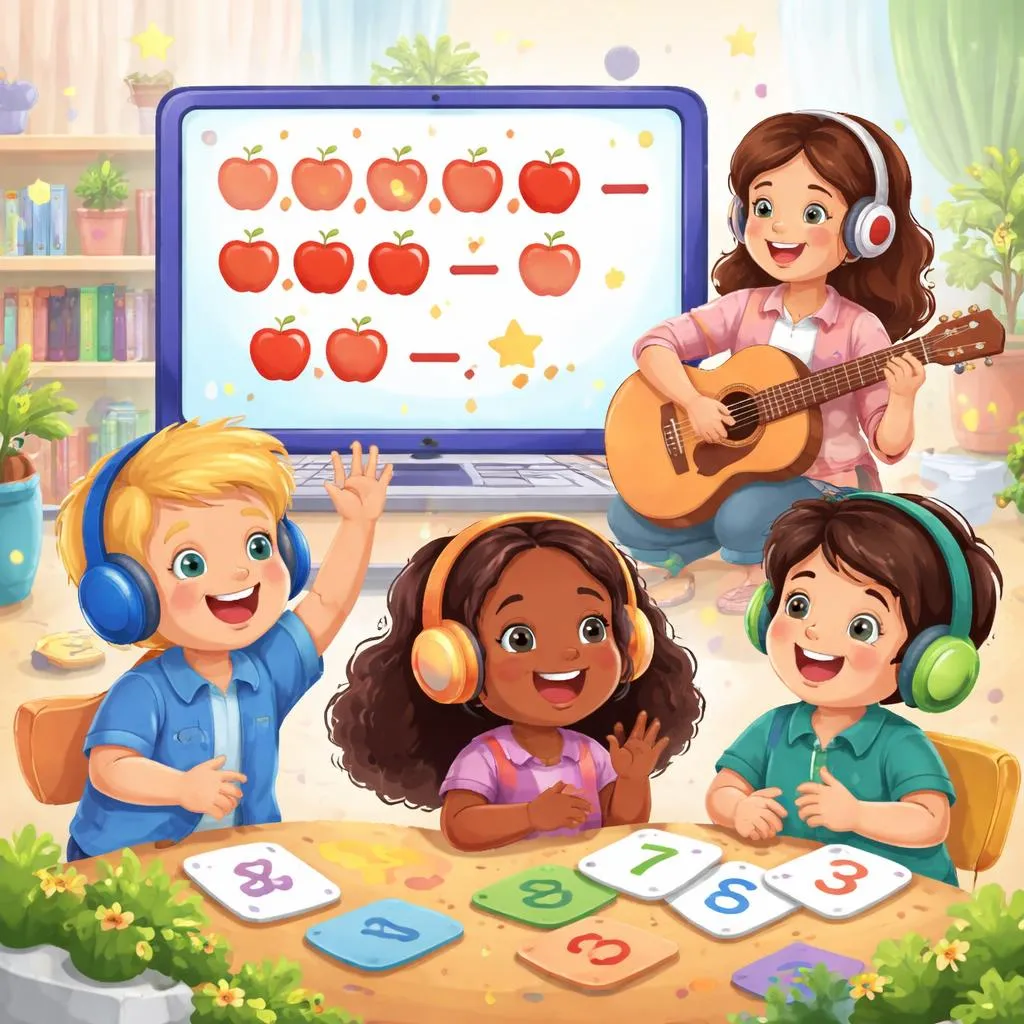
“subtracting with 10 song” is an educational math chant and song. It teaches subtraction facts starting from the number ten.
The song uses rhythm, repetition, and simple counting patterns. This format supports memory, attention, and conceptual understanding.
In teaching practice, the song integrates math and English. It builds number sense while strengthening listening and speaking skills.
A teacher can use the song during math warm-up sessions. It creates a playful and structured learning environment.
The lyrics of nursery rhymes
The lyrics usually follow a countdown pattern. For example, “Ten minus one is nine, nine minus one is eight.”
Each line reduces the number by one. This repeated pattern reinforces subtraction structure.
Teachers can sing one line and invite echo repetition. Echo reading strengthens pronunciation and rhythm awareness.
Choral singing builds confidence and automatic recall. It also helps internalize the subtraction sequence.
Lyrics can be displayed on charts or digital slides. Highlighting numbers connects spoken and written forms.
Vocabulary learning
The song introduces core math vocabulary. Key words include subtract, minus, take away, and equals.
Numbers from ten to zero appear in sequence. Number words support early numeracy and language integration.
Teachers can connect vocabulary with manipulatives. For example, ten blocks and one block removed.
Simple sentence models can reinforce meaning. For example, “Ten minus one is nine.”
Teachers can introduce question forms. For example, “What is ten minus two?”
This integrates math language with conversational English.
Phonics points
The song offers clear pronunciation practice for number words. Words like ten, nine, eight, and seven show varied vowel sounds.
Teachers can highlight initial sounds in six, seven, and nine. This supports phonemic awareness and articulation.
Rhythm supports syllable segmentation. For example, se-ven and ze-ro have two syllables.
Repetition supports stress pattern recognition. Stress awareness improves natural English speech.
Teachers can slow down tricky words. This helps learners segment sounds and blend phonemes.
Grammar patterns
The song models simple present tense. For example, “Ten minus one is nine.”
The verb “is” shows equality in math sentences. This links math statements with English grammar.
Sentence patterns repeat in predictable structures. Predictability supports syntactic awareness and fluency.
Teachers can extend patterns with new numbers. For example, “Ten minus three is seven.”
Teachers can introduce imperative forms. For example, “Take away one.”
This connects classroom instructions with grammar learning.
Learning activities
A counting with objects activity can start the lesson. Teachers show ten counters and remove one each verse.
Movement activities can reinforce subtraction. Learners step backward while singing the countdown.
A listening gap-fill activity can follow. Teachers remove numbers from printed lyrics.
Learners fill in missing numbers while listening. This trains auditory discrimination and number recognition.
A speaking activity can encourage mental math. Teachers ask simple subtraction questions orally.
A drawing activity can integrate math and art. Learners draw ten objects and cross out some.
Printable materials
Printable number cards can support subtraction practice. Each card shows a number and a word form.
A subtraction chart can show the countdown from ten. Learners trace and read the number sentences.
Flashcards with “minus” and “equals” can support drills. Large fonts help early readers decode math language.
A worksheet can include subtraction sentence frames. For example, “10 – ___ = ___.”
A mini-book can present one subtraction line per page. Repeated reading builds fluency and number sense.
A phonics worksheet can highlight vowel sounds in number words. Learners circle target sounds in ten, nine, and eight.
Educational games
A subtraction song relay game can build teamwork. Each learner sings the next subtraction line.
A number card game can reinforce subtraction facts. Learners pick cards and say the subtraction sentence aloud.
A movement game can integrate counting backward. Teachers say “Ten minus one,” and learners step back.
A bingo game can use subtraction answers. Teachers call out equations and learners mark answers.
A matching memory game can pair equations with answers. This strengthens recall and conceptual understanding.
A classroom board game can include subtraction prompts. Landing on a square requires solving and saying a subtraction fact.
“subtracting with 10 song” integrates math, language, and music in one lesson. It supports numeracy, vocabulary, phonics, and grammar in a unified framework.
Songs reduce cognitive load and increase motivation. They connect abstract math concepts with concrete auditory patterns.
Through repeated singing, manipulatives, and playful games, subtraction facts become familiar language tools. Learners develop confidence in math thinking and English expression through rhythmic and meaningful learning experiences.