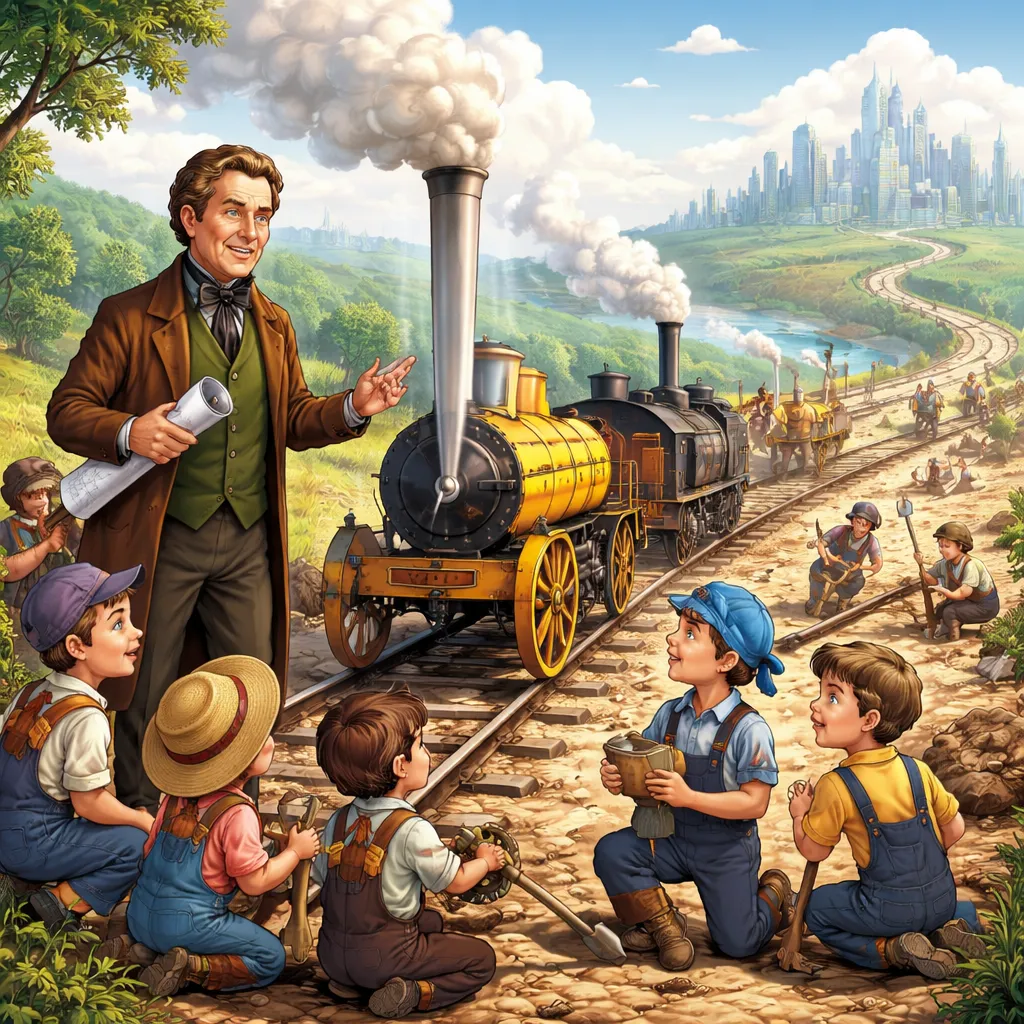

Introduction to George Stephenson
George Stephenson was an English engineer and the father of railways. He built the first public railway line using steam locomotives. This celebrity story: George Stephenson shows how a poor, uneducated boy grew into a great inventor. He started work at age eight. He could not read or write until he was eighteen. Yet he built machines that changed the world. Children can learn that a late start does not mean a bad finish. Parents can use his story to teach determination and self-belief. Stephenson did not have rich parents or fancy schools. He had strong hands and a curious mind. His life proves that where you start does not decide where you end.
Early Life and Background
George Stephenson was born on June 9, 1781, in Wylam, England. His father, Robert Stephenson, worked as a fireman for a coal mine. The family was very poor. They lived in a single room cottage. George had six siblings. At age eight, George worked as a cow herder for two pennies a day. He could not attend school. He later worked at the coal mine leading horses. At seventeen, he operated a steam engine at the mine. He realized he needed to learn more. At eighteen, he paid for night school. He learned to read, write, and do arithmetic. He studied in the evenings after working twelve hours. His teachers were amazed at his quick mind. He also taught himself to fix clocks and shoes. He became known as a clever mechanic. In 1802, he married Frances Henderson. They had a son, Robert, in 1803. His wife died in 1806. George was heartbroken. He worked even harder. He sent his son to school while teaching himself advanced mathematics. He studied every steam engine he could find.
Career Highlights and Achievements
Stephenson became the chief engineer of the Killingworth Colliery in 1812. He improved the mine's steam engine. In 1814, he built his first locomotive called Blücher. It pulled eight wagons of coal at four miles per hour. That does not sound fast today. But in 1814, it was a wonder. He kept improving his designs. In 1821, a man named Edward Pease hired Stephenson to build a railway line. The line would run from Darlington to Stockton, 25 miles long. Stephenson convinced Pease to use steam locomotives instead of horses. In 1825, the Stockton and Darlington Railway opened. Stephenson's locomotive, Locomotion No. 1, pulled 80 tons of coal and flour at 15 miles per hour. Thousands of people came to watch. The railway was a huge success. In 1829, a competition called the Rainhill Trials chose a locomotive for a new railway. Stephenson's Rocket won easily. Rocket could reach 30 miles per hour. It had a multi-tube boiler and a blast pipe. Both designs are still used today. Stephenson became the most famous engineer in Britain.
Famous Works or Performances
George Stephenson's most famous work is the Rocket locomotive. Rocket had several new features. A multi-tube boiler passed hot gases through many small tubes. This heated water much faster. A blast pipe sent exhaust steam up the chimney. This pulled more air through the fire. The fire burned hotter. Rocket also had direct drive from pistons to wheels. Earlier locomotives used gears or chains. Rocket set the standard for all future steam engines. Another famous work is the Stockton and Darlington Railway. This was the first public railway to use steam locomotives. It carried both goods and passengers. Another great work is the Liverpool and Manchester Railway. Stephenson built this line through bogs, cliffs, and swamps. Engineers said it was impossible. Stephenson built it anyway. He also invented a safety lamp for coal mines. A man named Humphry Davy invented a similar lamp at the same time. Stephenson proved he created his lamp independently. Parliament gave him money as a reward. His son Robert Stephenson became a famous engineer too. They worked together on many projects.
Personal Life and Fun Facts
George Stephenson had many interesting personal stories. He loved birds and animals. He kept pet chickens, dogs, and even a pet goose. A fun fact is that he could not read until age eighteen. He learned by paying a teacher with part of his small wages. Another fun fact is that he loved to grow vegetables. His garden was famous for large cabbages and onions. He also enjoyed fishing. He would sit by a river for hours thinking about engineering problems. Stephenson was very kind to poor children. He started a school for miners' children near his home. He paid the teacher himself. He also gave money to young engineers who could not afford training. Stephenson never forgot his own hard childhood. He once said, "I had to learn my letters like a little child." He was famous for his strong, rough hands. People called him "Old George." He spoke with a thick northern English accent. Rich people sometimes laughed at his manners. He did not care. He just kept building railways. Stephenson died on August 12, 1848, in Chesterfield, England. He was 67 years old.
Legacy and Influence
George Stephenson changed how people and goods move. Before him, travel was slow. Horses pulled wagons on bumpy roads. After him, trains carried everything faster, cheaper, and safer. Stephenson's standard railway gauge of 4 feet 8.5 inches became the world standard. More than 60 percent of the world's railways use this gauge. That includes the United States, Canada, China, and most of Europe. His locomotive designs influenced every steam engine built after 1830. The Rocket's multi-tube boiler and blast pipe remained standard for 100 years. Stephenson's son Robert carried on the work. Robert built the famous Rocket and many other locomotives. Together they built railways in England, Belgium, Spain, and Norway. The Stephenson Railway Museum in North Shields, England, displays their work. Statues of George Stephenson stand in Liverpool, London, and Newcastle. His name appears on schools, streets, and railway stations. Every time a child rides a train, they follow tracks that Stephenson helped lay. Every time a train whistle blows, it echoes his stubborn, brilliant spirit.
Quotes or Famous Sayings
George Stephenson left behind several memorable words. One famous quote is, "I am not afraid of anything. I have seen too much of the world to be afraid." Another wise saying is, "My hard work has been my best friend." He also said, "Nothing teaches a man more than experience." Children might like this one: "I had to learn my letters like a little child, but I learned them well." Families can read these quotes together. Ask children, "What does it mean that hard work is a best friend?" Stephenson also said, "Do not be afraid of what people say. Let your work speak for you." Parents can help children see that Stephenson did not let rich or educated people stop him. He kept building. He kept learning. His work spoke louder than any insult. That lesson applies to school projects, sports, and friendships. Do your best. Ignore the doubters. Let your results do the talking.
How to Learn from George Stephenson
Children can learn many lessons from George Stephenson. First, start where you are. He could not read at eighteen. He learned anyway. Second, use your hands. Stephenson fixed clocks and shoes before he built locomotives. Practical skills build strong minds. Third, never stop studying. He went to night school as an adult. He read mathematics books while working in a coal mine. Parents can encourage young children to learn one new skill each month. Fix a broken toy. Build a model bridge. Learn to tie a new knot. Older children can research how steam engines work. Build a simple model engine from a kit. Families can also visit a railway museum or take a ride on a heritage steam train. Listen to the whistle. Feel the wheels turn. Think about Stephenson standing beside his Rocket in 1829. Another activity is to measure distances. How long is 25 miles? That is how far the Stockton and Darlington Railway ran. Could you walk that far in one day? A train did it in two hours. George Stephenson showed that hard work builds tracks to the future. He started with nothing. He ended with the world at his wheels. Every child has that same chance. Pick a goal. Work at it every day. Let no one tell you it is impossible. The railway is waiting. You just have to lay the first track.