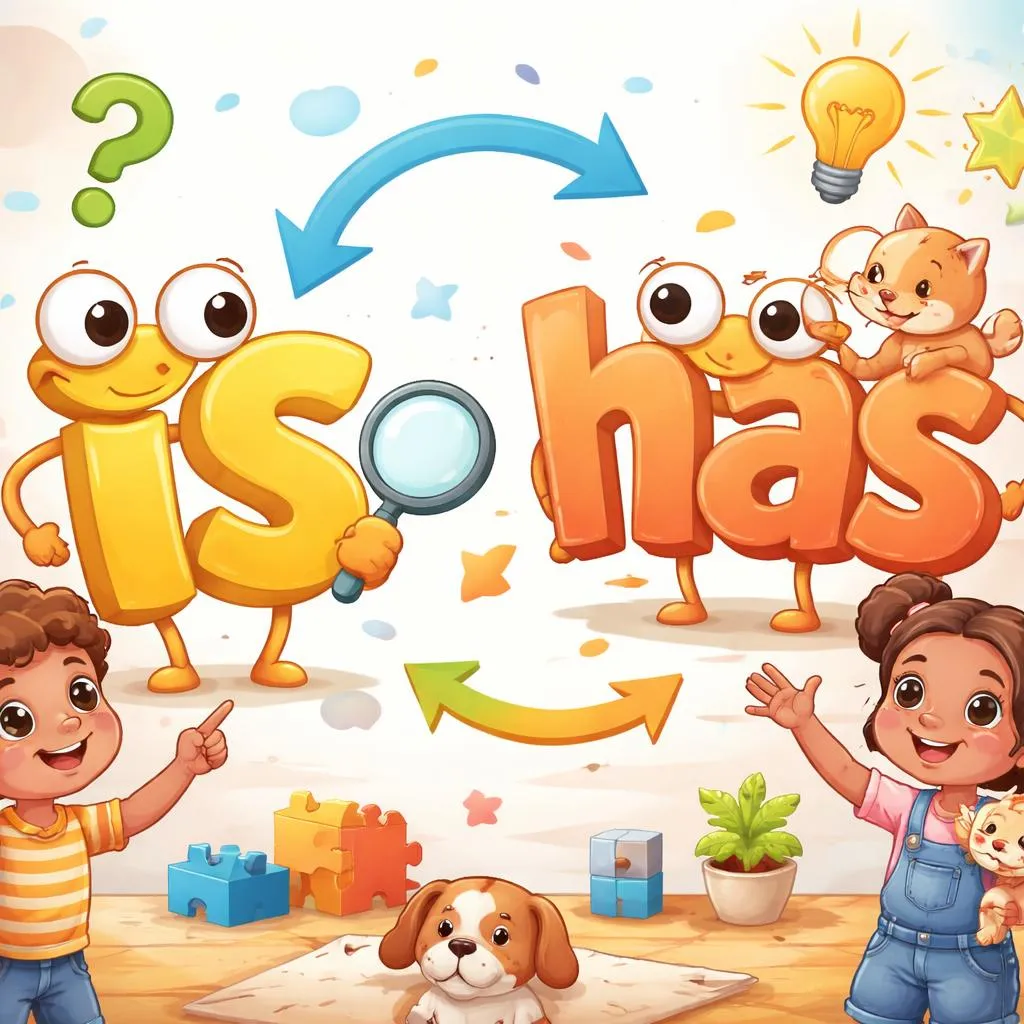

Meaning Today, we are exploring two very important words: "is" and "has." The phrase "is has a to be verb" helps us ask a smart question. The word "is" is indeed a to be verb. It shows a state of being or identity. However, the word "has" is not a to be verb. "Has" is a form of the verb "to have." It shows possession or ownership. They are different verbs with different jobs. "Is" tells us what something is. "Has" tells us what something holds. This is a key difference in English grammar.
Conjugation Let's look at how these verbs change, or conjugate. The to be verb has three present forms: am, is, and are. We use "is" for he, she, and it. The verb "to have" has two present forms: have and has. We use "has" for he, she, and it. We use "have" for I, you, we, they. Both "is" and "has" share a rule. They are the special forms used for the same subjects: he, she, and it. But they come from different verb families. I am happy. She is happy. I have a ball. She has a ball.
Present Tense We use "is" in the present tense to describe states. He is tall. The cat is sleepy. It is sunny. We use "has" in the present tense to show possession. She has a brother. The book has a blue cover. My dad has a car. They are both used for current, general truths. Remember, "is" connects to descriptions. "Has" connects to things people own or hold. The dog is furry. The dog has a tail.
Past Tense The past tense shows the difference clearly. The past tense of "is" is "was." Yesterday, she was at school. It was cold. The past tense of "has" is "had." Yesterday, she had a cookie. He had a red shirt. They do not use the same word in the past. "Was" describes a past state. "Had" describes past possession. Last week, the tree was small. Last week, the tree had few leaves.
Future Tense For the future, both verbs use "will." For the to be verb, we say "will be." She will be a scientist. For the verb "to have," we say "will have." She will have a new book. They both use the helper "will." But the main verb is different: "be" vs. "have." He will be happy. He will have a gift. This pattern is consistent for all subjects.
Questions To make questions with "is," we invert the order. Statement: "She is here." Question: "Is she here?" To make questions with "has," we usually add the helper "does." Statement: "She has a bike." Question: "Does she have a bike?" Notice that "has" becomes "have" in the question. This is a major difference. "Is" can stand alone in a question. "Has" usually needs "does" to form a question in the present tense.
Other Uses "Is" is also used as a helper verb. It helps make the present continuous tense. "He is eating." "Has" is used as a helper verb too. It helps make the present perfect tense. "He has eaten." Both are essential for more advanced grammar. But their core meanings remain. "Is" links to being and action. "Has" links to possessing and completion.
Learning Tips A great tip is to use a simple chart. Make two columns. Label one "He/She/It IS" and the other "He/She/It HAS." Practice by describing a picture. "The girl IS happy. She HAS a balloon." This separates the two concepts. A rhyme can help: "For what something IS, use IS. For what something HAS, use HAS." Test yourself. Can you replace the verb with "equals"? If yes (The sky = blue), use "is." If no, use "has."
Educational Games Play "Is or Has?" Show a picture. Make two statements, one correct, one wrong. "The bear is brown. The bear has a hat." Children shout "Yes!" for the correct one. Another game is "Sentence Sort." Have cards with subjects (The sun, My sister) and predicates (is hot, has a dog). Children match them to make logical sentences. For a active game, play "Simon Says" with both verbs. "Simon says, point to something that is green. Simon says, touch someone who has glasses."
Understanding why "is" has a to be verb identity and "has" does not is a crucial step. It clarifies two of the most common verbs in English. Mastering this prevents sentences like "She has happy" (wrong) instead of "She is happy." This knowledge builds a solid grammatical foundation. It allows children to accurately describe both the world around them (using "is") and what exists within it (using "has"). With practice, choosing the right verb becomes automatic, leading to clearer and more confident English communication.