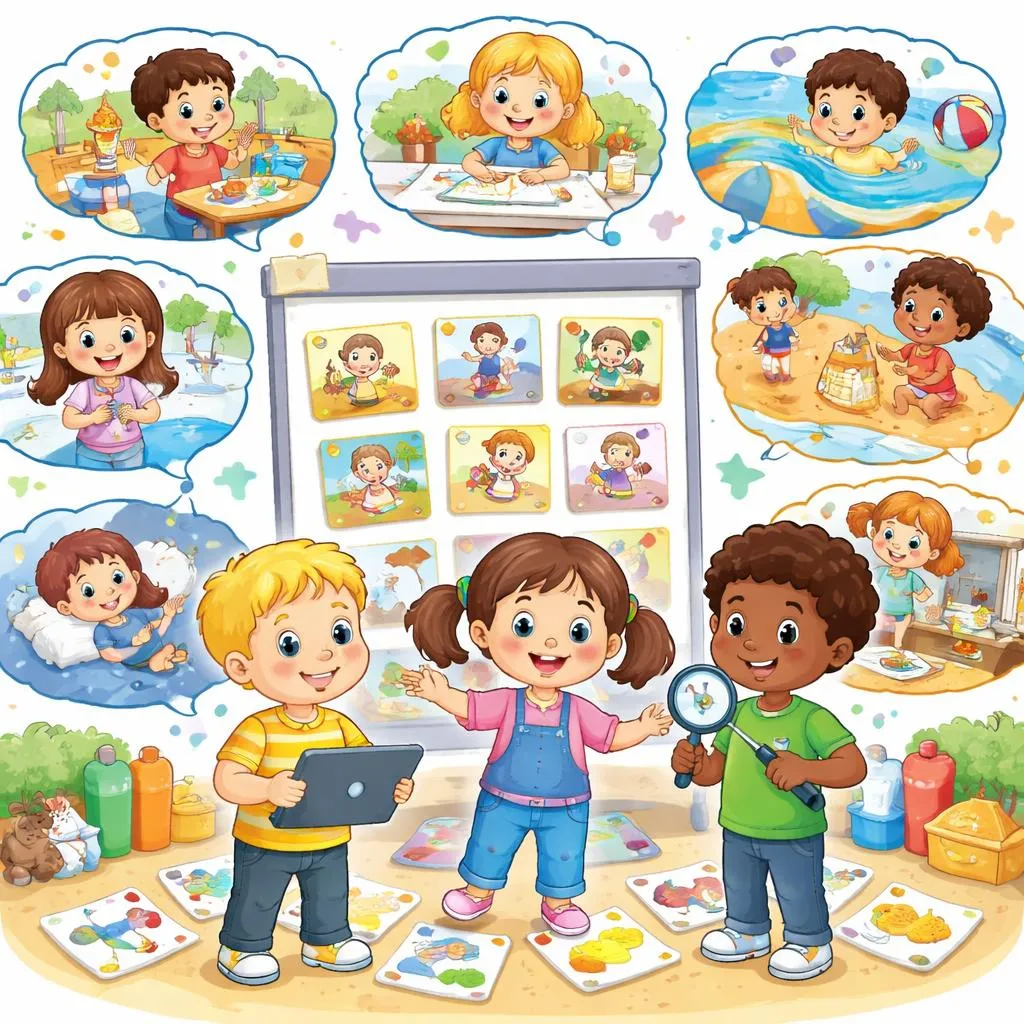

Learning a new language is like opening a treasure chest filled with wonderful ways to express ourselves. For a six-year-old, every new word and sentence structure is a shiny new coin to add to their collection. One of the most beautiful and useful treasures in English is the past continuous tense. It helps us paint pictures with our words, describing exactly what was happening at a special moment in the past. This guide will walk you and your child through the 70 most common past continuous examples, making grammar a friendly and exciting adventure.
What Is the Past Continuous and Why Do We Use It?
Think of the past continuous as a camera that takes a video of the past. When we use it, we are not just saying something happened; we are showing what was in progress at a certain time. We use it to talk about actions that continued for a bit of time in the past. For a six-year-old, it is the perfect tense to describe scenes from their day. Instead of saying "I played," which sounds like a completed action, they can say "I was playing," which makes the listener feel like they are right there in the middle of the fun.
Meaning and Simple Explanation for Young Learners
To help a child understand this tense, we connect it to their imagination. Ask them to close their eyes and imagine a little movie in their head. The past continuous is the main part of that movie. It tells us what the characters were doing. The magic formula is simple: we take the word "was" or "were" and add "ing" to the action word. For example, "The sun was shining" or "The birds were singing." It gives a feeling of a long action, like a slow, beautiful song.
Conjugation Made Easy: I Was, You Were
Conjugation can sound like a big word, but it just means matching the right helper word with the right person. We use "was" for one person or thing, like "I," "he," "she," and "it." We use "were" for more than one, like "you," "we," and "they." Practicing this with your child can be a fun chant. "I was walking, you were walking, we were all walking together." Repetition in a playful voice helps these patterns stick in a young mind without any pressure.
Present Tense Connection: What Is Happening Now?
Before we jump into the past, it helps to look at the present. Right now, in this moment, we use the present continuous. If a child is building with blocks, they are building. This is happening now. The past continuous simply takes that action and moves it to yesterday or any time before now. "Yesterday, at this time, I was building a castle." This comparison makes the time shift clear and logical for a child. It is the same action, just in a different time frame.
Past Tense Adventures: Telling Stories About Yesterday
The past continuous is a storyteller's best friend. When we tell stories about what happened yesterday, we can use this tense to set the scene. "We were walking to the park when we saw a big, fluffy dog." The action of walking was happening, and then another action happened. These 70 most common past continuous for 6-year-old learners include many such daily scenes. They help children describe their world, from what they were eating for breakfast to what they were playing with their best friend.
Future Tense Fun: Planning Our Stories
Even though we are talking about the past, we can look forward to telling stories about it. Before a fun event, like a trip to the zoo, you can say to your child, "Tomorrow, we will be able to say, 'We were looking at the elephants!'" This builds anticipation and gives them the exact words they will use later. It turns language learning into a game of prediction and reflection, making the grammar a natural part of their experience.
Asking Questions: What Were You Doing?
Questions are the key to conversation. To form a question in the past continuous, we simply move the "was" or "were" to the front of the sentence. "You were singing" becomes "Were you singing?" Practicing this with your child creates a lovely back-and-forth dialogue. You can ask them, "What was I doing when you came into the kitchen?" and they can guess, "You were making dinner." This turn-taking builds both grammar and connection.
Other Uses: Interrupted Actions and Parallel Play
There are two main ways we use this tense that are perfect for a six-year-old's life. The first is for interrupted actions. "I was drawing a picture when the phone rang." The drawing was happening, and then it stopped. The second is for two things happening at the same time, or parallel actions. "While Dad was reading, I was playing with my cars." These patterns help children understand the sequence of events and how moments in time can overlap.
Learning Tips for Parents: Weaving Grammar into Daily Life
The best way for a six-year-old to learn is through natural conversation, not drills. You can model the past continuous throughout the day. At dinner, you might say, "I was thinking about you today while I was working." When you pick them up from school, ask, "What were you doing when the bell rang?" This shows them that this grammar is not just for a lesson; it is for life. Be patient and use the structures yourself, and your child will absorb them like a sponge.
Educational Games: Playful Practice with 70 Common Examples
Games make learning stick. One fun game is "The Freeze Game." Play some music and have your child dance. When you stop the music, ask, "What were you doing?" and they can answer, "I was dancing." Another game is "The Detective." You can leave a few items slightly out of place and have your child guess, "Were you reading this book?" and you can answer, "Yes, I was reading it earlier." Using the 70 most common past continuous for 6-year-old scenarios, you can create simple cards with pictures showing actions like sleeping, eating, or running. Pick a card and ask your child, "Who was running?" This visual and active approach ensures that learning feels like play, which is exactly how young minds grow best. By integrating these phrases into your daily conversations and games, you are giving your child the gift of expressive language, allowing them to share their inner world and daily adventures with clarity and joy.