
Start! Find a Pair of 'Magic Twin' Words
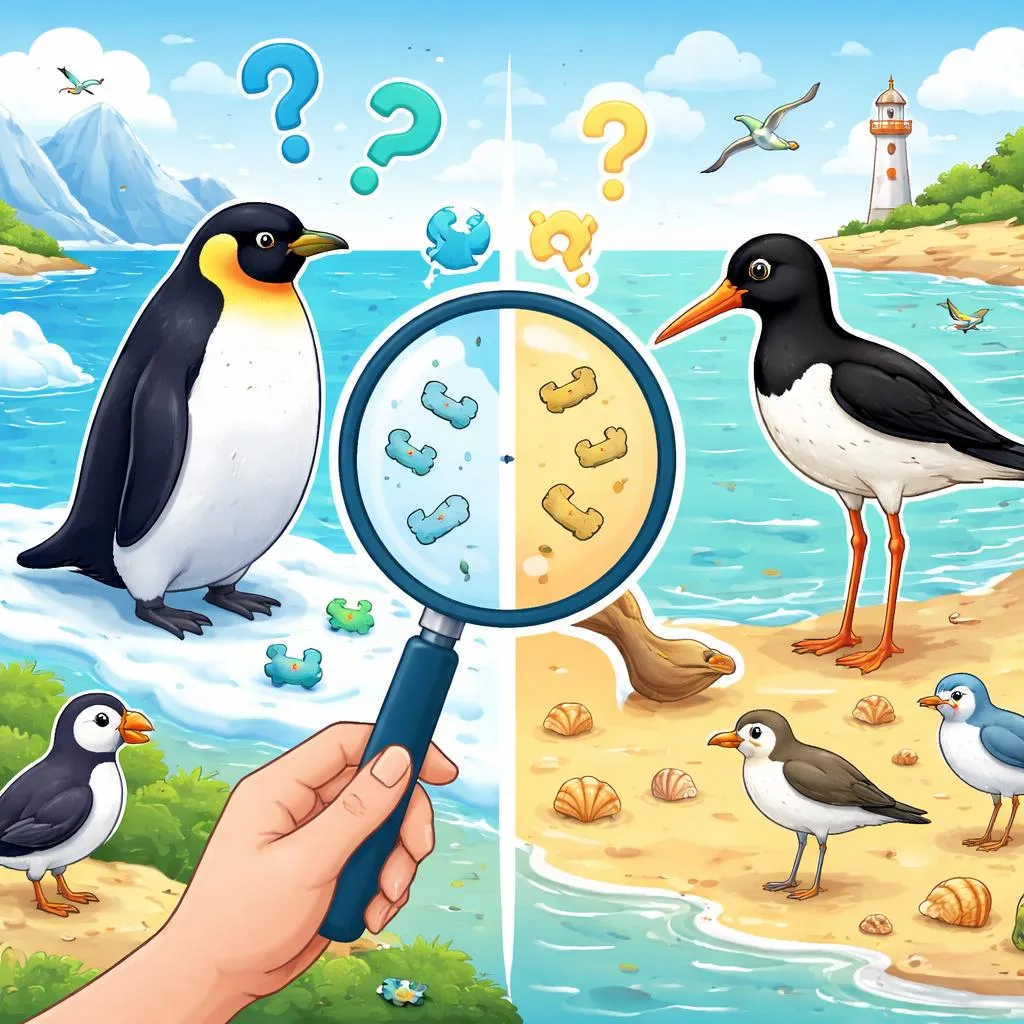
Hello, word explorer! Have you ever seen a funny bird in a movie? It wears a black and white suit. It cannot fly but it swims fast. What do you call it? You say "penguin"! Now, imagine a tall, graceful bird. It stands in a shallow lake on long, thin legs. What do you call that? You might say "bird." But there is a special word: "wader." They are both birds that like water. Are they the same? This is a cool word puzzle. Today we explore a word pair. We explore penguin and wader. They are like two different water sports. One is swimming. One is walking in water. Knowing the difference is a superpower. Your nature knowledge will be deep and clear. Let us start our word expedition!
Be a Language Watcher now. Our first clue is at home. You watch a cartoon about the South Pole. It shows a group of penguins sliding on ice. Then, you look at a nature calendar. It has a picture of a pink bird in a lake. The caption says "Flamingo, a type of wader." They are both birds near water. But are they the same word? Let us test with two sentences.
"The penguin dove into the icy ocean to catch fish." This is about a specific bird from cold places. "The wader stood perfectly still in the marsh, waiting for a frog." This is about a bird that walks in shallow water.
They seem to talk about birds and water. But one is a specific animal. One is a type of behavior. Your watching mission starts. Let us waddle into their word world.
Adventure! Wade Into the Word World
Feel the Word's Climate!
Feel the word penguin. It is a cool, playful word. It feels like ice, snow, and funny waddling. It makes us think of Antarctica and swimming. The word wader is a calm, patient word. It feels like a warm, shallow lake at sunset. It makes us think of long legs and quiet waiting. Penguin is for the cold, dramatic ocean. Wader is for the peaceful, muddy shore. One is a comedian in a tuxedo. The other is a ballet dancer in water. Let us see this at school.
In a geography class, you learn: "The emperor penguin lives in Antarctica." This is a fact about a cold place. In a biology class, you might learn: "A wader has long legs for walking in water." This is a fact about a bird's adaptation. Saying "A penguin has long legs" is not true. The climate of the words is different.
Compare Their Family and Behavior!
Think about a specific sports player and a whole team sport. The word penguin is the specific player. It is one kind of bird. There are many species of penguins, but they are all flightless, swimming birds. The word wader is the name of the sport. It is a category of birds that share a behavior: wading. Herons, storks, flamingos, and sandpipers are all waders. A penguin is not a wader. A penguin swims, not wades. Their worlds are different. Let us test this on the playground.
You play a game. You waddle with your arms at your side. You shout, "I am a penguin!" Your friend stands on one leg in a pretend puddle. She says, "I am a wader!" The actions are different. The word penguin means a specific way of moving. The word wader describes a way of standing and feeding. The playground shows the difference.
Meet Their Best Word Friends!
Words have favorite buddies. The word penguin likes cold and swimming words. It teams up with 'emperor', 'king', 'colony', 'slide', 'ice', and 'flipper'. You see a penguin colony. A penguin has flippers. The word wader likes water and leg words. It teams up with 'shorebird', 'long-legged', 'marsh', 'shallow', and 'stilt'. A wader bird lives in a marsh. The wader has stilt-like legs. Their buddies are from different environments. Let us go back to school.
In a science report, you write about penguin conservation. This is about protecting a specific group. In an art project, you draw a wetland scene with various waders. This is about a habitat and a group of birds. You would not draw a penguin in a wetland scene. The word friends help set the scene correctly.
Our Little Discovery!
We explored the word wetland and ice shelf. We made a clear discovery. The words penguin and wader are not in the same team. The word penguin is a specific type of bird. It cannot fly. It swims in cold oceans. The word wader is a category for many kinds of birds. They have long legs and wade in shallow water to eat. Penguin is the swimmer. Wader is the walker. One is a particular bird. The other is a group defined by how they feed.
Challenge! Become a Wetland Word Expert
"Best Choice" Challenge!
Let us look at two scenes. Read each one. Pick the champion word. Scene one: You are at the zoo. You see a bird exhibit. The birds are black and white. They are swimming fast underwater. The sign says, "These are ______ from the Southern Hemisphere." Is it Penguins or Waders? The champion is Penguins! They are the specific birds that swim. Scene two: You are by a river. You see a tall, blue-grey bird on stick-like legs. It is motionless in the water. Your dad says, "That's a heron, a type of ______." Is it penguin or wader? The champion is wader! The heron fits the category of long-legged birds that wade. Great job!
"My Sentence Show"!
Now, create your own sentences. Here is a scene: Imagine a cold, rocky coastline. Use the word penguin in one sentence. Now imagine a warm, grassy marsh. Use the word wader in another. Try it! Here is an example. Sentence one: "A group of penguins huddled together against the wind." Sentence two: "Several waders searched for food in the tidal flat." See the difference? The first sentence is set in a cold, harsh place. The second is set in a calm, watery area.
"Eagle Eyes" Search!
Can you find the word that needs help? Read this sentence: "On our field trip, we saw a penguin standing in the pond; it had very long, thin legs." Hmm. This is likely wrong. A penguin has short legs and would not stand in a pond like that. The bird described is probably a wader. A better sentence is: "On our field trip, we saw a wader standing in the pond; it had very long, thin legs." You spotted the mix-up!
What a fantastic expedition! You started as a curious learner. Now you are a word biologist. You know the secret of penguin and wader. You can feel their different climates. You see their family and behavior. You know their best word friends. This is a real language superpower.
You can learn amazing things from this article. You now know that a 'penguin' is a specific, flightless bird that swims and lives in cold places. You understand that a 'wader' is a category for birds with long legs that walk in shallow water to find food. You can explain that a flamingo is a wader, but a penguin is not. You learned that the words describe completely different bird lifestyles and habitats.
How can you use this today? It is easy and fun. Next time you visit a zoo or see a nature documentary, be a detective. If you see a bird swimming in cold water, it might be a penguin. If you see a bird standing in a lake or marsh, it might be a wader. Look at your bird books. Can you find examples of waders? Draw two pictures: one of a penguin colony on ice and one of waders in a marsh. You are using your new skill every day.
Keep your scientist eyes open. The natural world is full of amazing groups and species. You are learning the words to describe them correctly. Great work, word expert. Your English journey is getting more precise and exciting with every new word pair you master!