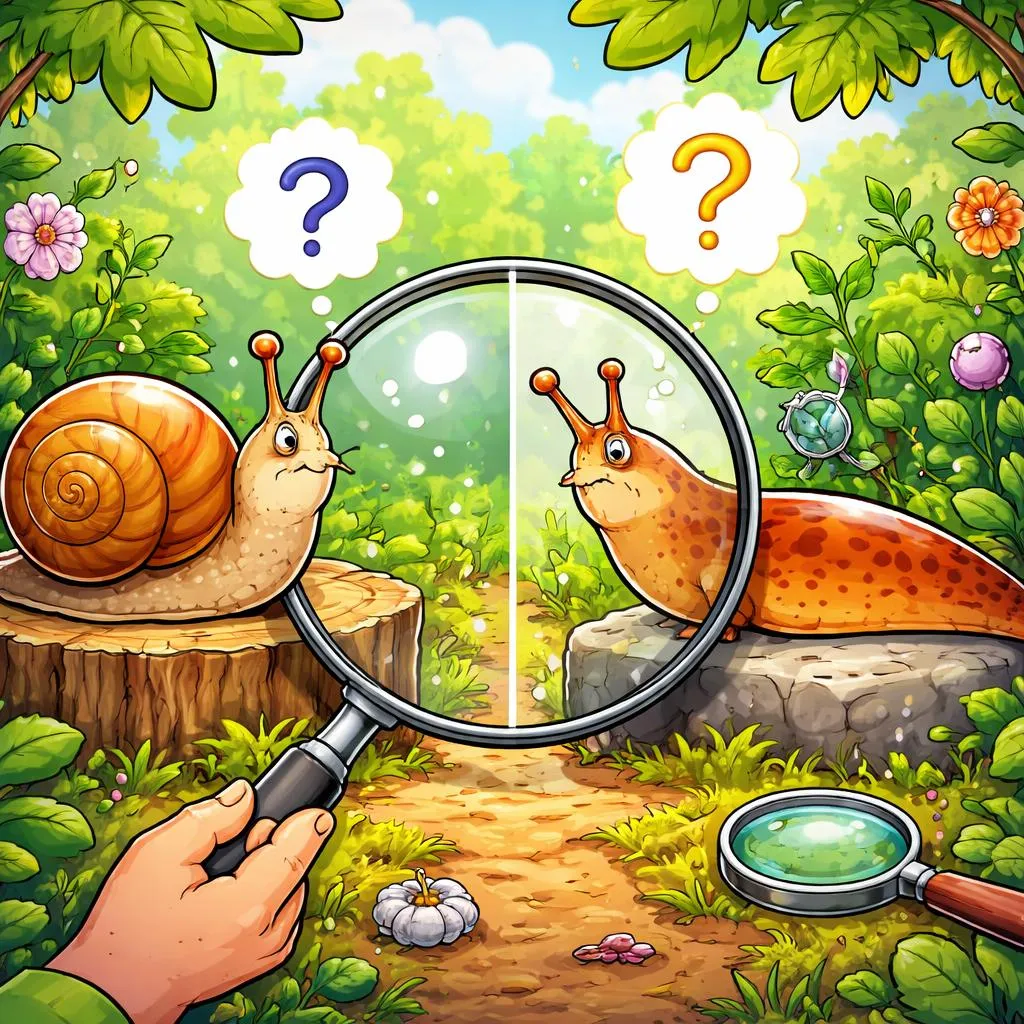

Start! Find a Pair of 'Garden Twin' Words
Hello, word explorer! Have you ever been in a garden after the rain? You see a slow creature with a spiral shell on its back. What do you call it? A snail! Then, you see another slow, slimy creature without a shell. What is that? A slug! They look so similar. Are they the same? This is a fun garden puzzle. Today we explore a word pair. We explore snail and slug. They are like two cousins in the garden. They are both mollusks. But one has a house. One does not! Knowing the difference is a superpower. Your garden stories will be precise and clear. Let us start our slow and steady word adventure!
Be a Language Watcher now. Our first clue is at home. You help in the garden. You see a small creature with a brown shell. Your mom says, "Look, a snail on the lettuce." Then, you see a slimy trail on the ground. Your dad says, "A slug has been here." They are both garden visitors. But are they the same? Let us test with two sentences.
"The snail retreated into its shell for safety." This shows a creature with a home. "The slug left a shiny trail on the pavement." This shows a creature without a shell.
They both describe slow, slimy garden animals. But one has a portable house. One does not. Your watching mission starts. Let us crawl into their word garden.
Adventure! Crawl Into the Word Garden
Feel the Word's Protection!
Feel the word snail. It is a safe, contained word. It feels like having a cozy home you carry. It is slow but protected. The word slug is a soft, vulnerable word. It feels exposed and flexible. It must hide under leaves. Snail is the prepared traveler with a backpack. Slug is the brave explorer without one. One is a mobile home. The other is a camping trip. Let us see this at school.
In a general science class, you learn: "The snail's shell protects it from drying out." This is about a key feature. In a lesson about habitats, you might learn: "The slug must stay in damp places to survive." This is about a challenge. Saying a "snail must stay damp" is also true. But the shell makes a big difference. The feeling of safety is different.
Compare Their Bodies and Defense!
Think about a knight in armor and a ninja in stealth gear. The word snail is the knight. It has a hard, spiral shell for defense. It can hide inside. The word slug is the ninja. It has no shell. It uses slime and darkness to protect itself. Their bodies are their main difference. A snail has a shell. A slug does not. This one fact changes everything. Let us test this on the playground.
You play a game. You curl into a ball and say, "I am a snail in its shell!" You are hiding. Your friend slinks along the ground, leaving an imaginary trail. She says, "I am a slug, hiding under a rock." The word snail means having a hiding place you carry. The word slug means being sneaky and soft. The playground shows the difference in defense.
Meet Their Best Word Friends!
Words have favorite garden partners. The word snail likes shell and slow words. It teams up with 'shell', 'pace', 'mail', 'garden', and 'escargot'. You hear about snail mail. The snail has a spiral shell. The word slug likes slimy and pest words. It teams up with 'slimy', 'trail', 'pest', 'banana', and 'speed'. You see a slug trail. A slug is a garden pest. Their partners are different. Let us go back to school.
In a art class, you might draw a beautiful snail shell pattern. This is about its design. In a gardening club, you learn how to keep slugs away from plants. This is about garden care. You would not usually draw a slug for its beautiful shell. The word friends set the right topic.
Our Little Discovery!
We explored the word garden path. We made a clear, slimy discovery. The words snail and slug are close relatives. But they are not the same. The word snail describes a mollusk with a hard, spiral shell on its back. The word slug describes a mollusk without that shell. Snail carries its house. Slug carries only its slime. One is armored. The other is agile. This is the biggest difference.
Challenge! Become a Garden Word Expert
"Best Choice" Challenge!
Let us look at the garden. Read each scene. Pick the champion word. Scene one: You find a beautiful, brown spiral shell on the ground. You pick it up. A creature is inside! You say, "I found a ______!" Is it Snail or Slug? The champion is Snail! Only snails have such shells. Scene two: You see a long, sticky line on a leaf in the morning. You know an animal passed by at night. You say, "A ______ made this trail." Is it snail or slug? Both can! But the word slug is more commonly associated with slimy trails. However, snails also leave trails. For this clue, both are possible, but the trail is a key clue for slugs. Let us say the champion is slug for this common association. Great!
"My Sentence Show"!
Now, create your own sentences. Here is a scene: Imagine a wet, rainy morning in a vegetable patch. Use the word snail in one sentence. Use the word slug in another. Try it! Here is an example. Sentence one: "The snail slowly climbed the stalk, its shell wobbling." Sentence two: "The slug munched a hole in the middle of a leaf." See the difference? The first focuses on the snail and its shell moving. The second focuses on the slug eating, with no shell to describe.
"Eagle Eyes" Search!
Can you find the word that needs help? Read this sentence: "I wanted to pick up the garden snail, but I didn't want to touch its slimy, shell-less body." Hmm. This is a contradiction. A snail is not shell-less. The creature described is more like a slug. A better sentence is: "I wanted to pick up the garden slug, but I didn't want to touch its slimy, shell-less body." You spotted the mix-up!
What a wonderful garden exploration! You started as a curious observer. Now you are a word gardener. You know the secret of snail and slug. You can feel their different protections. You see their bodies and defenses. You know their best word friends. This is a real language superpower.
You can learn amazing things from this article. You now know that a 'snail' has a hard, spiral shell on its back for protection. You understand that a 'slug' does not have a shell and is more soft and slimy. You can explain that both leave slimy trails, but only the snail can hide in its shell. You learned that 'snail' is used in phrases like 'snail mail' for slow post, and 'slug' can mean a garden pest.
How can you use this today? It is easy and fun. Next time you are in a garden or park after rain, be a detective. Look for the shelled snail and the shell-less slug. Look for their shiny trails. Draw two pictures. Draw a snail with its beautiful shell. Draw a slug without one. You are using your new skill every day.
Keep your explorer eyes open. The world is full of amazing word pairs. You are learning to see the small details. Great work, word expert. Your English journey is getting more detailed and fun with every new word pair you master!