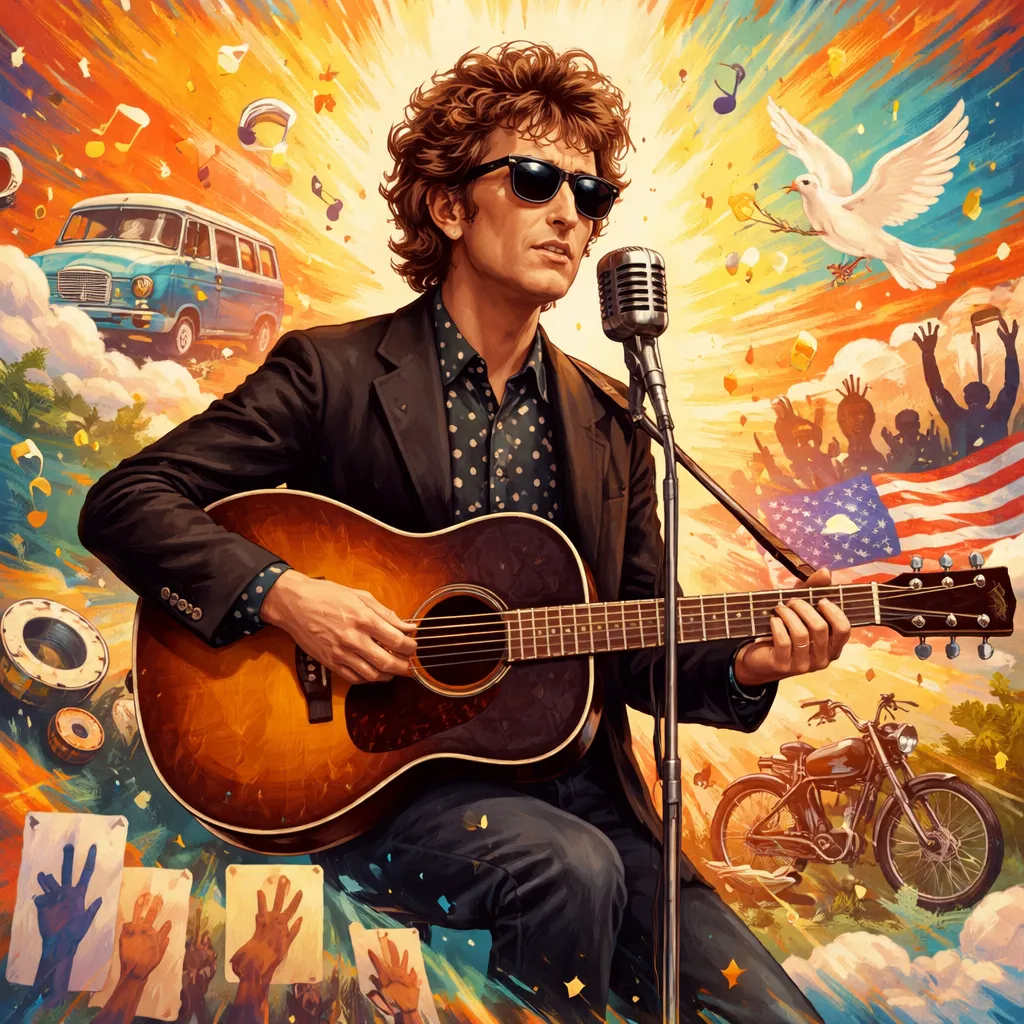

Introduction to Bob Dylan
Bob Dylan, born Robert Zimmerman, is an American singer-songwriter and one of the most influential musicians of the 20th century. His work has touched every corner of the music industry and continues to inspire new generations of artists and listeners. Dylan's ability to blend poetic lyrics with powerful social commentary transformed the landscape of folk and rock music.
Why is Bob Dylan worth knowing about? His music not only reshaped the world of music but also gave voice to social movements. Dylan became an iconic figure in the 1960s, a time of major social and political changes. His songs, filled with rich meanings, spoke to the struggles of ordinary people and tackled big issues like civil rights, war, and peace. Learning about Bob Dylan helps children and families understand the power of music to influence society and provoke change.
Early Life and Background
Bob Dylan was born on May 24, 1941, in Duluth, Minnesota, into a Jewish family. His childhood was spent in a small town called Hibbing, where he developed an early love for music. Dylan was heavily influenced by the sounds of radio shows, especially the folk music and blues that played in the 1950s.
Growing up, Bob Dylan's family experienced some financial difficulties, which shaped his outlook on life. His parents, Abraham and Beatty Zimmerman, encouraged his interest in music. Bob learned to play the piano and guitar, experimenting with different musical styles as a teenager. He was also drawn to poetry and literature, often quoting writers like Arthur Rimbaud and Walt Whitman, whose works later inspired his lyrics.
In high school, Bob formed his first band, the Golden Chords, and performed at school dances. However, his real turning point came when he discovered the music of folk artists like Woody Guthrie and Hank Williams. Dylan’s fascination with these artists set him on a path toward becoming a professional musician.
After finishing high school, Dylan moved to New York City in 1961 to pursue his dreams. There, he immersed himself in the vibrant folk music scene and began playing in small clubs. He adopted the stage name "Bob Dylan," inspired by the poet Dylan Thomas, and started making a name for himself as a gifted singer-songwriter.
Career Highlights and Achievements
Bob Dylan's career truly took off in the early 1960s. His breakthrough moment came with the release of his self-titled debut album in 1962, which showcased his raw talent as a folk musician. However, it was his second album, The Freewheelin' Bob Dylan (1963), that turned him into a household name. The album featured some of his most iconic songs, including "Blowin' in the Wind," a protest song that became an anthem for the civil rights movement.
In the mid-1960s, Dylan's music underwent a major transformation. He shifted from acoustic folk music to electric rock music, a change that caused controversy among his fans. However, this move proved to be a groundbreaking step in his career. Albums like Highway 61 Revisited (1965) and Blonde on Blonde (1966) were hailed as masterpieces, with songs like "Like a Rolling Stone" becoming iconic in the history of rock music.
Dylan continued to push boundaries in his music, experimenting with various genres and styles, from country to gospel. He was always evolving and never afraid to take risks. His ability to stay relevant over decades is a testament to his genius.
Over his long career, Dylan has received numerous accolades. He won the Nobel Prize in Literature in 2016, a rare honor for a musician. This recognition highlighted the literary quality of his songwriting, cementing his place in history as not only a great musician but also a poet. Dylan has also received numerous Grammy Awards and an Academy Award for his song "Things Have Changed" from the 2000 film Wonder Boys.
Famous Works or Performances
Bob Dylan's discography is filled with songs and albums that changed the course of music history. His influence can be seen in countless musicians who followed in his footsteps. Here are some of his most famous works:
"Blowin' in the Wind" (1962): A simple yet powerful song, "Blowin' in the Wind" became an anthem for peace and civil rights. Its lyrics ask profound questions about freedom and justice, and the song’s gentle melody helped it resonate with millions of people around the world.
"Like a Rolling Stone" (1965): This song marked a dramatic shift in Dylan’s sound, moving from folk to rock. The song is considered one of the greatest in rock history, with its catchy tune and poignant lyrics about a woman’s fall from grace.
"The Times They Are a-Changin’" (1964): A call for social and political change, this song became a rallying cry for the youth movement of the 1960s. Its message is timeless, encouraging people to embrace change and fight for justice.
"Mr. Tambourine Man" (1965): This dreamy, surreal song is one of Dylan's most beloved. Its lyrics are full of vivid imagery, and it became a hit for both Dylan and the Byrds, whose version of the song helped introduce Dylan’s electric sound to a broader audience.
"Tangled Up in Blue" (1975): Featured on the album Blood on the Tracks, this song is a perfect example of Dylan’s storytelling ability. The song’s lyrics, which tell a complex tale of love and loss, are deeply personal yet universally relatable.
Personal Life and Fun Facts
Bob Dylan’s personal life has been just as fascinating as his music career. Over the years, Dylan has been a bit of a mystery, choosing to keep many aspects of his life private. However, some fun facts about Dylan reveal his quirky personality and the experiences that have influenced his art:
Dylan’s love for art: In addition to music, Dylan has always had a passion for visual arts. He is an accomplished painter and has even held art exhibitions. His artwork often explores similar themes to his music, such as identity, change, and self-reflection.
The motorcycle accident: In 1966, Dylan was involved in a mysterious motorcycle accident that caused him to retreat from public life for a period. During this time, he focused on his family and his music, creating some of his most introspective albums.
Dylan’s influences: Dylan has always cited literary figures such as Rimbaud, Whitman, and Homer as major influences on his writing. His lyrics often reflect these influences, blending poetry with music to tell stories that are both personal and political.
Legacy and Influence
Bob Dylan’s influence on music and culture is immeasurable. His lyrics, filled with social commentary, inspired generations of musicians to use their art to speak out against injustice. Dylan’s ability to blend various musical styles—folk, rock, blues, and country—helped shape the sound of modern music.
Dylan's style of songwriting has been studied and admired by writers, poets, and musicians alike. His work has inspired artists ranging from Bruce Springsteen to Patti Smith, and his music continues to be covered by countless artists around the world.
Beyond music, Dylan’s influence extends to social and political movements. His songs were integral to the civil rights movement and anti-war protests of the 1960s. His work continues to be a source of inspiration for those who use art to challenge the status quo.
Quotes or Famous Sayings
Bob Dylan’s words have inspired countless people, not just through his songs but also in his interviews and public appearances. Here are a few of his most memorable quotes:
"The times they are a-changin’."
"A poem is a naked person... Some people say that I am a poet."
"You don't need a weatherman to know which way the wind blows."
These quotes reflect Dylan’s deep understanding of the world around him and his belief in change, individuality, and the power of art.
How to Learn from Bob Dylan
Bob Dylan's life and career offer valuable lessons for young readers and aspiring musicians. His ability to evolve with the times, push boundaries, and remain true to his artistic vision is a testament to the importance of self-expression and authenticity. Dylan's message encourages young people to think critically about the world, embrace creativity, and use their talents to make a difference.
In addition, Dylan's perseverance through hardships—whether personal or professional—shows that success is often the result of hard work and resilience. His willingness to take risks and experiment with new ideas serves as an inspiring example of what can be achieved when we dare to break from tradition and follow our own paths.
Bob Dylan’s story is one of creativity, innovation, and perseverance. His legacy continues to influence the world of music and beyond, proving that one person’s voice—when used for change—can resonate through the generations.