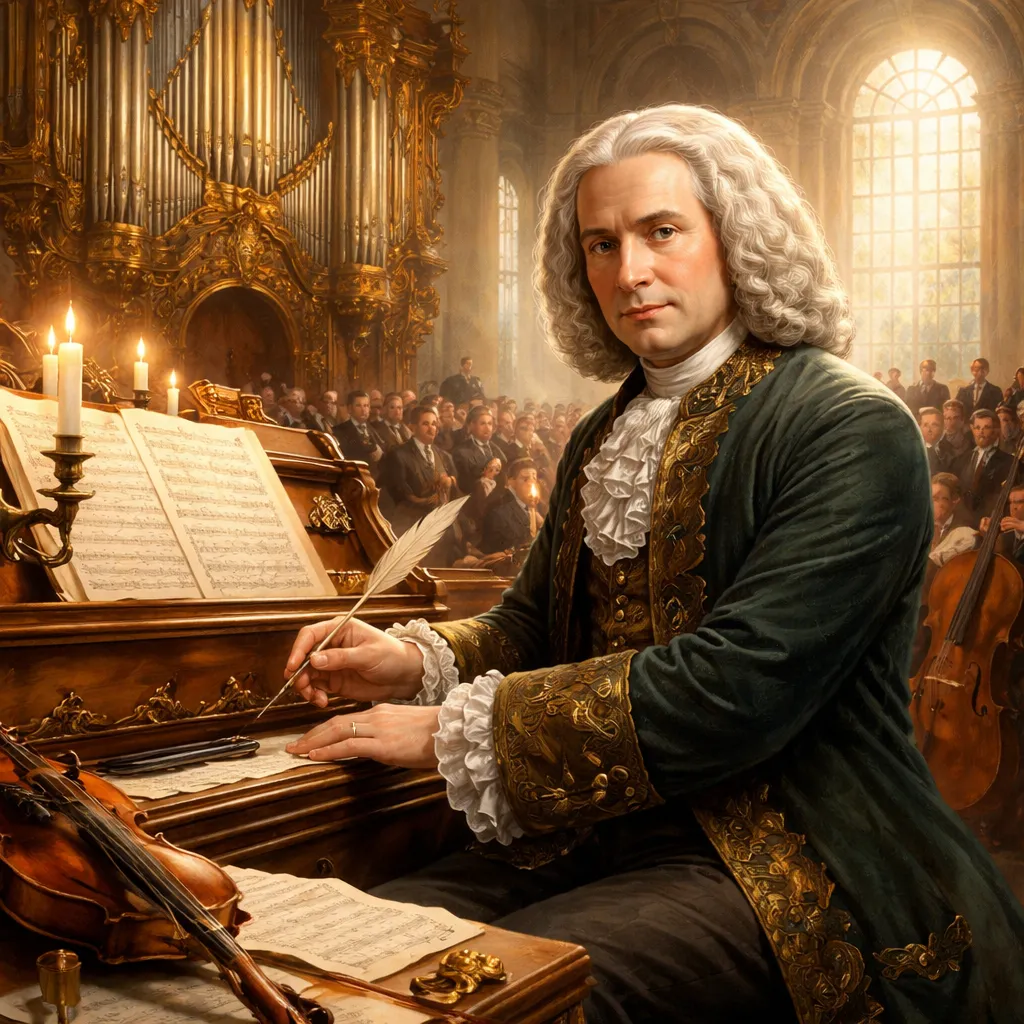

Introduction to Johann Sebastian Bach
Johann Sebastian Bach, born on March 31, 1685, in the small town of Eisenach, Germany, is considered one of the greatest composers in history. His extraordinary contributions to music during the Baroque period have shaped the course of Western classical music. Bach’s compositions, ranging from intricate fugues to emotional cantatas, display his genius in blending complex structures with deep emotional resonance.
Bach’s work is worth exploring not only for its technical brilliance but also for its emotional depth and innovation. While Bach was not widely recognized during his lifetime, his music has become iconic, influencing countless composers, musicians, and listeners worldwide. His ability to transform the musical landscape makes his story one of incredible importance in music history.
Early Life and Background
Johann Sebastian Bach was born into a highly musical family. His father, Johann Ambrosius Bach, was a musician and worked as a court musician and city trumpeter. Bach’s mother, Maria Elisabeth, came from a family of musicians as well. From a young age, Johann was immersed in music. His father taught him to play violin and keyboard, and by the age of seven, he was sent to live with his elder brother, Johann Christoph Bach, who was also a musician and organist.
Bach’s early education was heavily influenced by his family’s musical traditions, and he showed remarkable talent from the start. He was taught to play the violin, organ, and harpsichord. As a young boy, Bach entered the St. Thomas School in Leipzig, where he studied music, Latin, and other subjects. It was here that he began to seriously explore music composition and develop his unique style.
Bach’s early exposure to a wide range of musical genres, combined with the intense education he received at school and from his family, laid the groundwork for his future career as a composer. His early years were filled with opportunities to perform and study music, and by the time he was a teenager, he had already begun composing his own works.
Career Highlights and Achievements
Bach’s career is marked by his exceptional productivity and influence. Throughout his life, he held various musical positions, from organist to concertmaster, and wrote hundreds of pieces of music, many of which are still performed today.
One of the most significant milestones in Bach’s career was his position as the cantor at St. Thomas Church in Leipzig, a role he held for over 27 years. This position allowed him to compose and perform regularly, and it was during this time that he produced many of his most important works. His compositions during this period include the Mass in B Minor, the St. Matthew Passion, and the Brandenburg Concertos. These works are considered masterpieces of the Baroque period and are still celebrated for their complexity, beauty, and emotional depth.
In addition to his work as a composer, Bach was a renowned performer, particularly as an organist and harpsichordist. His skills on the organ were legendary, and he was frequently called upon to perform at various churches and festivals. His Toccata and Fugue in D Minor is one of his most famous organ works, known for its dramatic opening and intricate counterpoint.
Bach’s influence was not fully appreciated during his lifetime, and he struggled financially. However, in the years following his death, his music was rediscovered and became highly regarded. Today, Bach is widely considered one of the greatest composers in history, and his works are a cornerstone of classical music.
Famous Works or Performances
Bach composed over 1,000 works during his lifetime, many of which are still performed around the world. His works span a variety of genres, including choral, orchestral, and keyboard music. Some of his most famous works include:
The Brandenburg Concertos (1721): These six concertos are perhaps Bach’s most famous orchestral works. Each concerto features a unique combination of instruments, showcasing Bach’s mastery of orchestration and his ability to blend different sounds into cohesive compositions.
Mass in B Minor (1749): This monumental work is one of Bach’s most profound religious compositions. The Mass in B Minor is a grand choral work that combines intricate vocal harmonies with rich orchestration, displaying Bach’s skill in both sacred and secular music.
St. Matthew Passion (1727): One of Bach’s most emotional and powerful works, the St. Matthew Passion is a sacred oratorio that tells the story of Christ’s crucifixion. Its intense emotional depth, combined with Bach’s sophisticated musical techniques, makes it one of the most revered works in the classical repertoire.
The Well-Tempered Clavier (1722, 1742): A collection of two volumes, this set of preludes and fugues demonstrates Bach’s mastery of counterpoint and his exploration of all 24 major and minor keys. It remains a fundamental work for aspiring pianists.
Toccata and Fugue in D Minor (1704): One of Bach’s most famous organ works, it is known for its dramatic, haunting opening and intricate fugue. This piece has been widely popularized in modern culture, often associated with horror and mystery.
Cello Suites (1720): These six suites for unaccompanied cello are some of the most famous and beloved works in the cello repertoire. The suites are a perfect example of Bach’s ability to write music that is both technically challenging and emotionally expressive.
Personal Life and Fun Facts
Bach’s personal life was marked by both success and hardship. He married twice, first to Maria Barbara Bach, his cousin, and later to Anna Magdalena Wilcke, a singer who shared his passion for music. Together, Bach and Anna Magdalena had 13 children, many of whom became musicians in their own right.
Despite his musical success, Bach faced financial difficulties throughout his life. He often had to rely on his positions at various churches and his compositions to make ends meet. His final years were particularly challenging, as he suffered from failing eyesight, which eventually led to his death on July 28, 1750.
Bach was known for his dedication to his work and his meticulous attention to detail. He often spent long hours composing and revising his music. He was also known to be deeply religious, and many of his works were composed for church services or special religious occasions.
A fun fact about Bach is his famous musical family. Many of his children and relatives were also musicians, and Bach’s legacy lived on through them. His sons, including Carl Philipp Emanuel Bach and Johann Christian Bach, became successful composers in their own right, further spreading the Bach family’s influence on music.
Legacy and Influence
Johann Sebastian Bach’s impact on music is immeasurable. His innovative use of harmony, counterpoint, and orchestration revolutionized the Baroque period and influenced composers across generations. Bach’s music laid the foundation for many of the great composers who followed, including Ludwig van Beethoven, Johannes Brahms, and Franz Schubert.
Bach’s work remains central to the study of classical music. His compositions are a cornerstone of music education, and his works are frequently performed and recorded by orchestras and ensembles worldwide. His mastery of counterpoint, structure, and emotional depth continues to inspire musicians today.
The legacy of Bach is also evident in modern music. His techniques, such as the use of counterpoint and fugue, have been adopted by composers in many genres, including jazz and popular music. Even today, Bach’s influence can be heard in the works of contemporary musicians who continue to draw inspiration from his compositions.
How to Learn from Johann Sebastian Bach
Johann Sebastian Bach’s life and work offer valuable lessons for young musicians and artists. His dedication to his craft and his ability to compose complex, yet emotionally resonant music serve as an inspiration to anyone pursuing artistic excellence.
One of the key lessons from Bach’s life is the importance of hard work and perseverance. Bach faced many challenges throughout his life, yet he never stopped composing. His commitment to creating music, even in the face of adversity, is a powerful reminder of the value of persistence.
Additionally, Bach’s ability to combine technical mastery with deep emotional expression teaches us the importance of balancing skill with passion. Whether in music, art, or any other field, Bach’s work shows us that true mastery requires both dedication and emotional engagement.
Johann Sebastian Bach’s story encourages us to strive for excellence in everything we do, to embrace challenges, and to remain passionate about our pursuits. His legacy reminds us that the pursuit of art and creativity can lead to enduring success and influence.
Johann Sebastian Bach’s contributions to music continue to resonate with people around the world. His works stand as some of the greatest achievements in the history of Western music, and his influence has shaped the future of classical and modern music alike.