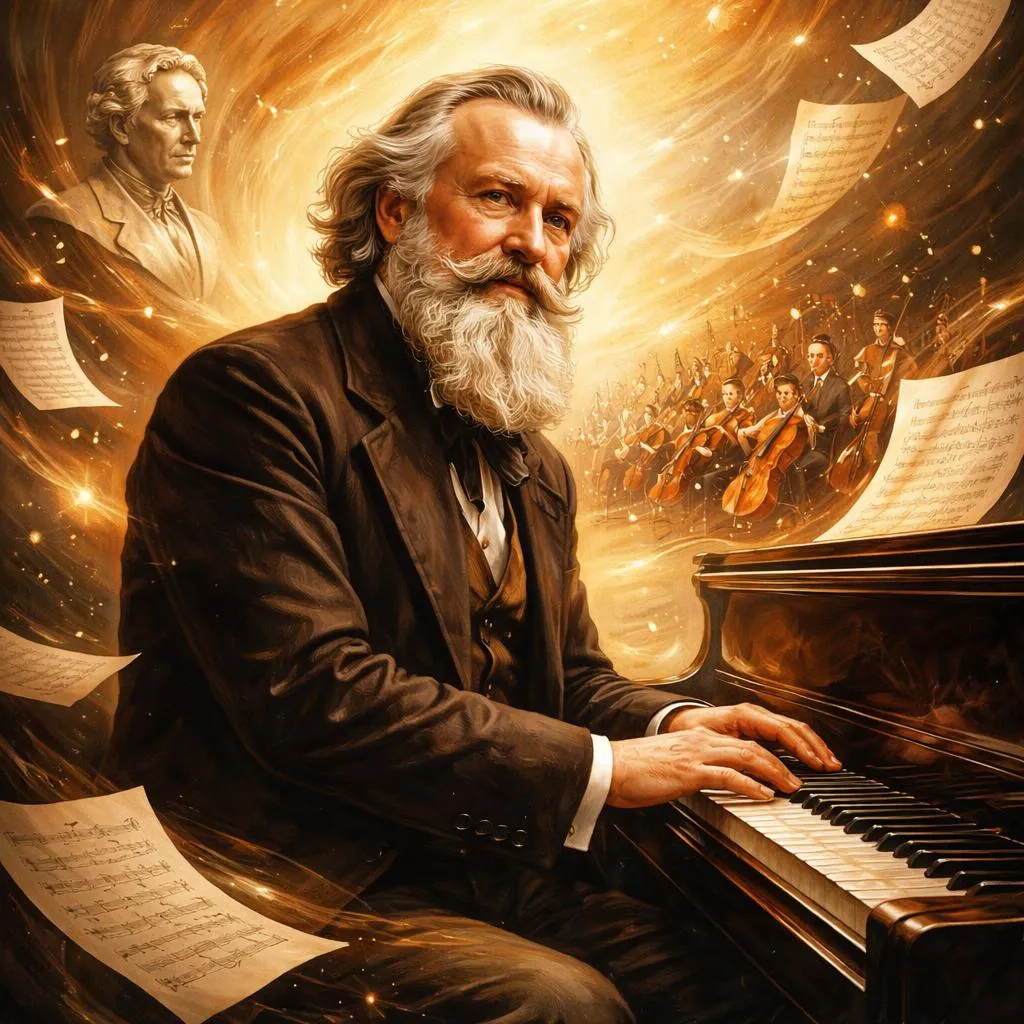

Introduction to Johannes Brahms
Johannes Brahms, born on May 7, 1833, in Hamburg, Germany, is one of the most celebrated composers of the Romantic era. Known for his symphonies, concertos, chamber music, and Lieder, Brahms’s music has remained a vital part of the classical music repertoire. His compositions are renowned for their deep emotional content, intricate structures, and rich harmonies. Brahms’s work bridges the Classical and Romantic traditions, making him a key figure in music history.
Brahms’s dedication to his craft, along with his ability to blend innovation with tradition, ensures that his music continues to inspire musicians and music lovers alike. His legacy as a composer whose works encompass both complexity and beauty is one of the reasons why he is worth learning about.
Early Life and Background
Johannes Brahms was born into a humble family. His father, Johann Jakob Brahms, was a musician who played the double bass, and his mother, Johanna, was a singer. Growing up in a working-class neighborhood, Brahms was surrounded by music from an early age. His father, aware of his son’s musical talent, provided early musical training. Brahms learned to play the piano, and by the age of seven, he was already performing in public.
Brahms’s early education in music was largely informal, but his talent was undeniable. He studied music theory and composition, and by his teenage years, Brahms had already begun composing his own works. At the age of 13, Brahms began playing piano at local taverns to help support his family. Despite the challenges, he was determined to become a professional musician.
Brahms's love for music was matched only by his dedication. His early experiences shaped his later works, with many of his compositions reflecting the struggles and emotions he faced in his youth. He also found inspiration in the works of older composers, particularly Ludwig van Beethoven, whose influence would play a significant role in Brahms's development as a composer.
Career Highlights and Achievements
Brahms’s career took off in the 1850s when he gained recognition as a composer and performer. In 1853, he met Robert Schumann, another great composer, who praised Brahms’s work and helped him secure a place in the musical community. This meeting was a turning point in Brahms’s career, and soon his compositions began to be performed in concert halls across Europe.
One of Brahms’s early major achievements was his first symphony, completed in 1876 after years of meticulous work. Known as "Beethoven’s Tenth" by some, Brahms’s Symphony No. 1 is often viewed as a tribute to Beethoven while also showcasing Brahms’s unique style. The symphony’s emotional depth and dramatic contrasts made it an instant success and solidified Brahms’s place in the world of classical music.
Another key milestone in Brahms’s career was his series of concertos, including his Piano Concerto No. 1 and Violin Concerto. These works demonstrated his ability to combine virtuosity with lyrical beauty, making them staples of the concerto repertoire.
Brahms was also known for his chamber music, particularly his string quartets and piano quintets. These works, while deeply rooted in classical forms, pushed the boundaries of the traditional structure and expanded the possibilities of musical expression.
Throughout his life, Brahms received many honors and accolades for his work. He was invited to conduct and perform across Europe, and his music was celebrated in concert halls from Vienna to London. Despite his success, Brahms was known for his humility and shyness, often avoiding the limelight in favor of a quieter, more contemplative life.
Famous Works or Performances
Brahms’s output includes a wide range of compositions, but some works stand out as particularly influential. Below are some of his most famous pieces:
Symphony No. 1 in C minor, Op. 68: Completed after a long period of intense work, this symphony is often called “Beethoven’s Tenth” because of its dramatic intensity and ambitious scope. The symphony is full of contrasting moods, from the triumphant opening to the serene final movement, showcasing Brahms’s mastery of orchestral color and structure. Piano Concerto No. 1 in D minor, Op. 15: This concerto, with its sweeping themes and dramatic intensity, is one of Brahms’s most admired works. The concerto features a powerful dialogue between the soloist and the orchestra, demonstrating Brahms’s ability to blend virtuosity with emotional depth. Violin Concerto in D major, Op. 77: Brahms’s Violin Concerto is known for its beauty and complexity. The piece is filled with lyrical passages and virtuosic moments, making it one of the most beloved violin concertos in the classical canon. A German Requiem, Op. 45: Unlike traditional requiems, Brahms’s German Requiem is not a liturgical work but a deeply personal meditation on death, comfort, and solace. The piece is renowned for its profound emotional impact and its exploration of human grief and hope. Hungarian Dances, WoO 1: A set of 21 lively, folk-inspired piano pieces, the Hungarian Dances became incredibly popular during Brahms’s lifetime. These pieces showcase his ability to evoke different musical styles while maintaining his distinct compositional voice. String Quintet in F major, Op. 88: Brahms’s string quintet is considered one of his masterpieces in chamber music. The piece combines sweeping melodies with intricate counterpoint, showcasing Brahms’s ability to write deeply expressive and complex music.
Each of these works is a testament to Brahms’s ability to blend rich melodies with complex harmonies, creating music that is both beautiful and emotionally resonant.
Personal Life and Fun Facts
Brahms’s personal life was marked by a deep connection to music and a certain amount of solitude. Unlike some of his contemporaries, Brahms never married, and his love life was often the subject of speculation. One of the most notable relationships in Brahms’s life was with Clara Schumann, the wife of Robert Schumann. Brahms and Clara shared a close friendship, and it’s widely believed that Brahms had unspoken feelings for her, although their relationship remained platonic.
Brahms was known for his love of nature and his fondness for walking in the countryside. Many of his compositions reflect his introspective nature, and his music often conveys a sense of melancholy and longing. Despite his somewhat reclusive nature, Brahms was well-liked by his colleagues and friends, known for his warm personality and generosity.
Fun fact: Brahms’s famous “Hungarian Dances” were originally written for piano four hands before being arranged for orchestra. These lively and rhythmic pieces reflect Brahms’s ability to draw inspiration from folk music and turn it into sophisticated classical compositions.
Legacy and Influence
Johannes Brahms’s influence on classical music is immeasurable. He is regarded as one of the central figures of the Romantic era, and his music helped shape the course of Western classical music. Brahms's works influenced composers such as Gustav Mahler, Antonín Dvo?ák, and even Claude Debussy, who admired Brahms’s mastery of orchestral textures and emotional depth.
Brahms’s music is still widely performed in concert halls and is a central part of the classical repertoire. His symphonies, concertos, and chamber works continue to be celebrated for their structural complexity, emotional power, and timeless beauty. His works serve as models for composers who seek to balance technical rigor with emotional expression.
Today, Brahms’s music is often taught to music students, as his works offer valuable insights into harmony, form, and orchestration. His ability to blend classical traditions with the emotional intensity of the Romantic period makes him a key figure for anyone studying music history.
How to Learn from Johannes Brahms
Johannes Brahms's life offers many lessons in perseverance, passion, and artistry. Despite facing many challenges, including personal struggles and criticism, Brahms remained committed to his music. His dedication to his craft teaches us the importance of persistence in the face of adversity. Brahms’s work ethic, combined with his ability to create music that was both complex and accessible, serves as an inspiration for aspiring musicians.
Brahms’s music also emphasizes the power of emotion in art. His works show that music is not just about technical skill, but also about conveying deep feelings. This is a lesson for all artists: to create something meaningful, you must connect with your audience on an emotional level.
Johannes Brahms’s legacy continues to inspire musicians and listeners alike, showing us that true artistry is not just about following tradition, but also about infusing it with personal expression and emotion.
Johannes Brahms remains one of the giants of classical music. His compositions, filled with emotional depth and technical brilliance, continue to captivate audiences and musicians alike. Through his life and work, Brahms demonstrated that music can transcend time, conveying feelings and ideas that resonate across generations.