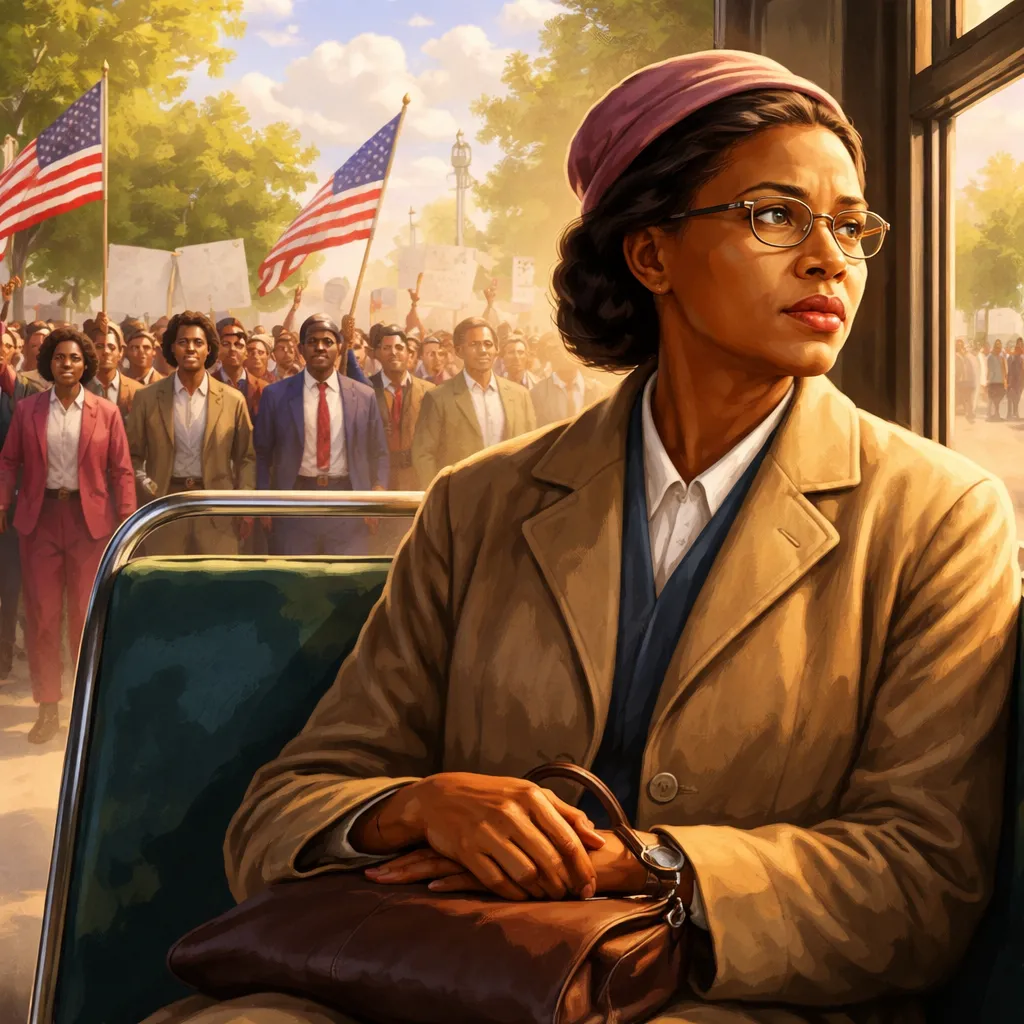

Introduction to Rosa Parks
Rosa Parks was a civil rights activist from the United States, best known for her pivotal role in the Montgomery Bus Boycott. Born on February 4, 1913, in Tuskegee, Alabama, she became a symbol of the struggle against racial segregation. Parks’ decision to refuse to give up her seat to a white man on a segregated bus in Montgomery, Alabama, became one of the defining moments in the Civil Rights Movement.
Her courage and determination sparked a movement that led to major social and legal changes in the United States. Rosa Parks didn’t just take a stand on a bus; she became the face of the fight for racial equality, inspiring millions of people around the world. Her story is not just one of defiance, but also of resilience, justice, and change.
Rosa Parks’ story is important because it shows how one brave person’s actions can change the world. Her commitment to equality and her role in one of the most significant moments of the Civil Rights Movement make her a hero worth knowing.
Early Life and Background
Rosa Louise McCauley was born on February 4, 1913, in Tuskegee, Alabama, to James and Leona McCauley. Rosa's mother was a teacher, and her father was a carpenter. She had a strong family foundation, though her early years were shaped by the racial injustices that were widespread in the South.
Rosa's early life was marked by the hardships of growing up in a segregated society. Segregation, or the legal separation of white and black people, was enforced in schools, restaurants, buses, and even in the streets. From a young age, Rosa experienced the effects of these unjust laws, which would later motivate her to fight for change.
Parks attended the Montgomery Industrial School for Girls, an institution that focused on practical education for African American girls. After her education there, Rosa attended Alabama State College, where she studied to become a teacher. Rosa Parks was deeply influenced by her teachers, who instilled in her a sense of pride and the importance of standing up for oneself.
Growing up in the racially tense environment of the South, Parks developed a strong sense of justice. Her grandmother, who had been involved in early efforts to challenge segregation, was a significant influence on Rosa’s development and encouraged her to fight for her rights.
Career Highlights and Achievements
Rosa Parks’ career in activism began long before her famous moment on the bus. In 1943, she joined the Montgomery chapter of the National Association for the Advancement of Colored People (NAACP). She served as the secretary and worked to improve conditions for African Americans in Montgomery. Parks was involved in several cases where African Americans were mistreated by white people, and she helped organize efforts to fight against these injustices.
Parks’ most famous act of defiance took place on December 1, 1955, when she refused to give up her seat on a segregated bus to a white man. In Montgomery, Alabama, laws required African Americans to sit at the back of the bus, and they were also expected to give up their seats if a white person needed it. Parks’ refusal to move was an act of resistance that sparked the Montgomery Bus Boycott, a 13-month protest that eventually led to the desegregation of Montgomery’s public buses.
Her courage on that day caught the attention of Dr. Martin Luther King Jr. and other civil rights leaders, who led the boycott. The boycott, which involved African Americans refusing to ride the buses, was one of the most successful nonviolent protests in American history. Eventually, the U.S. Supreme Court ruled that bus segregation was unconstitutional, a victory for the Civil Rights Movement.
Rosa Parks’ contributions to the Civil Rights Movement did not stop with the bus boycott. She continued to work for equality and justice throughout her life, supporting movements for voting rights and anti-segregation efforts. Parks became a respected leader in the African American community and a symbol of resistance to oppression.
Famous Works or Performances
Rosa Parks’ most famous "work" was not a book or artwork, but an act of courage that inspired millions. Her refusal to give up her seat on the bus sparked the Montgomery Bus Boycott, a major turning point in the Civil Rights Movement.
While she did not create physical works like painters or musicians, her contributions are still felt in the lasting changes she helped bring about in society. Some of her most significant "performances" include:
Montgomery Bus Boycott: This was Parks’ most iconic moment. It helped to bring attention to the injustice of segregated public transport and was a catalyst for further civil rights actions.
Public Speaking and Advocacy: Following the boycott, Parks traveled the country to speak about the Civil Rights Movement and the need for racial equality. She became an international symbol of resistance to segregation.
Rosa Parks Foundation: After her activism, Parks founded the Rosa and Raymond Parks Institute for Self-Development in honor of her late husband. The foundation works to support young people in their educational and career pursuits.
Though Parks is not known for "performances" in the traditional sense, her life’s work and advocacy for justice had a lasting impact on American society.
Personal Life and Fun Facts
Rosa Parks led a life that was deeply committed to her community and her values. She married Raymond Parks in 1932, and together they became active in the fight for racial justice. Raymond was a barber and a dedicated activist, and the couple shared a passion for equality. Rosa and Raymond had no children of their own, but Parks was deeply involved in mentoring young people throughout her life.
Beyond her activism, Parks had a quieter, more reflective side. She enjoyed reading and was known to be a private person who did not seek the spotlight despite her significant role in history. Parks had a deep faith and attended church regularly, and her spiritual beliefs were an important part of her life.
Parks’ bravery extended beyond the bus boycott. During the 1960s, after moving to Detroit, she continued to advocate for civil rights and was involved in various local and national initiatives. She also supported the Black Power movement, even though she felt that nonviolent resistance was the most effective way to achieve change.
Parks’ life was one of both personal and public struggles. She faced personal hardships, including death threats and financial difficulties, but she remained steadfast in her commitment to justice.
Legacy and Influence
Rosa Parks’ legacy is monumental. She became an enduring symbol of the Civil Rights Movement, and her decision to sit in the front of the bus was a powerful moment in the fight against racial segregation. Her role in the Montgomery Bus Boycott helped to unite African Americans in their struggle for equal rights and served as a blueprint for future protests, including the March on Washington and the Selma to Montgomery marches.
Parks’ influence extended beyond her lifetime. She inspired future generations of activists, including young people who continue to fight for racial equality. Her courage also helped spark the broader Civil Rights Act of 1964, which outlawed segregation in public places, and the Voting Rights Act of 1965, which protected the voting rights of African Americans.
Her work has been honored in countless ways, from schools and streets named after her to statues erected in her honor. Rosa Parks received numerous awards, including the Presidential Medal of Freedom in 1996 and the Congressional Gold Medal in 1999.
Parks’ life reminds us of the power of one individual to create change. Her commitment to equality and her stand against racial injustice continue to inspire movements for social justice around the world.
Quotes or Famous Sayings
Rosa Parks is known for her powerful words and the lasting impact of her actions. Some of her most memorable quotes include:
“The only tired I was, was tired of giving in.”
“I have learned over the years that when one’s mind is made up, this diminishes fear.”
“Each person must live their life as a model for others.”
These quotes reflect Rosa Parks’ belief in standing firm for what is right, regardless of the obstacles that may arise. They continue to inspire those who fight for justice and equality.
How to Learn from Rosa Parks
Rosa Parks teaches us many valuable lessons, including the importance of standing up for what is right, even in the face of fear or adversity. Her example encourages us to be brave in the pursuit of justice, no matter how small or large the actions may seem. Parks also showed the power of nonviolent resistance and the importance of using one’s voice for good.
For young people today, Rosa Parks’ life teaches the importance of resilience and determination. Her story is a reminder that even one small action can lead to significant change. Parks also demonstrated the power of community and how working together can make a difference.
Rosa Parks’ commitment to justice is an enduring lesson. By following her example, we can continue to fight for a world that is fair, just, and equal for all.