
What is the rhyme?
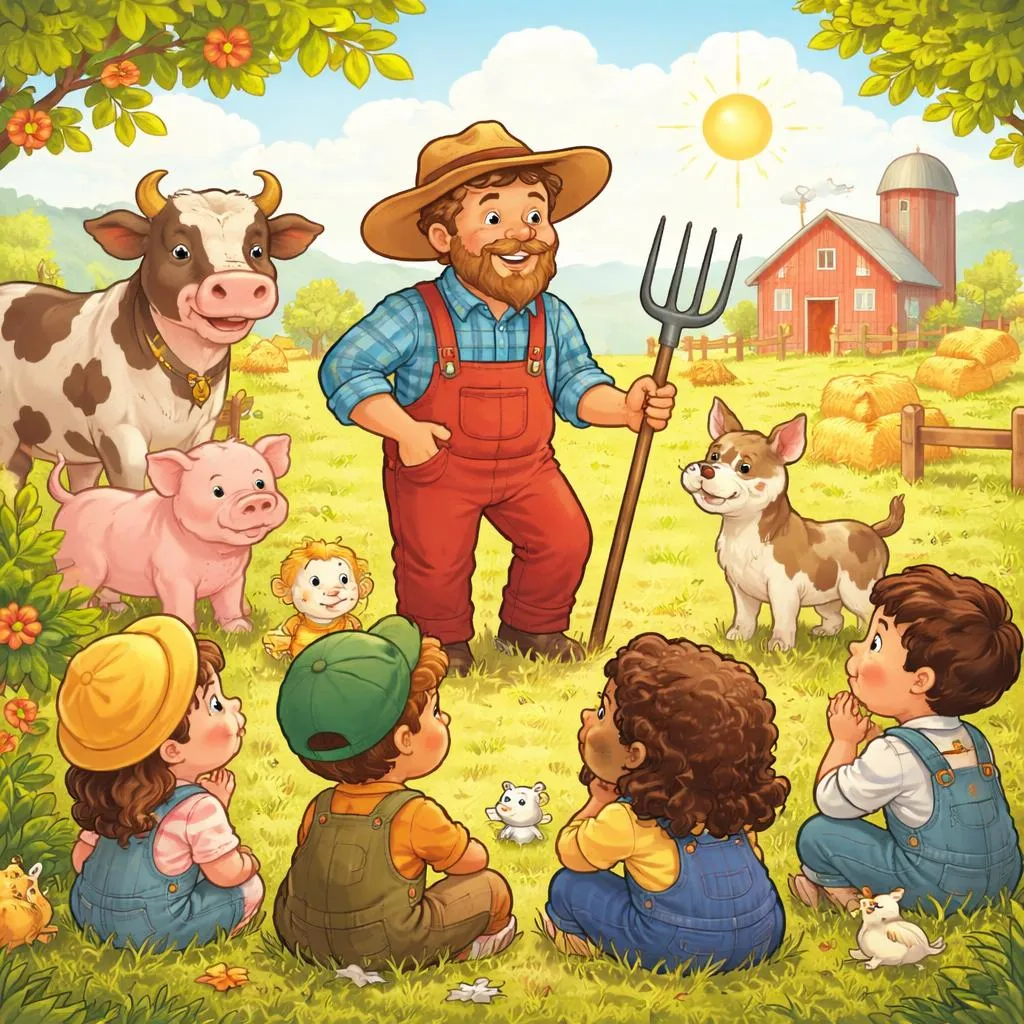
Let’s gather for a classic circle game and song. The Farmer in the Dell is a traditional nursery rhyme and singing game with origins dating back centuries. It is a cumulative song, meaning each verse builds upon the last by adding a new character or element. The song describes a simple, circular narrative about a farmer choosing a partner, and that partner choosing another, forming a chain of characters from a traditional rural community.
The game that accompanies it involves children forming a circle, with one in the center as "the farmer." As the song progresses, the farmer chooses another child to join them in the center, and so on. Exploring The Farmer in the Dell lyrics meaning is about more than just defining words; it’s about understanding a piece of cultural history, sequence, and community roles through music and play.
The lyrics of nursery rhymes
The lyrics follow a very predictable and repetitive pattern, which is key to its appeal for young learners. The song begins with the central premise:
The farmer in the dell, The farmer in the dell, Hi-ho, the derry-o, The farmer in the dell.
The next verse introduces a new character chosen by the farmer: The farmer takes a wife... This pattern continues as the wife takes a child, the child takes a nurse, the nurse takes a dog, the dog takes a cat, the cat takes a rat, and the rat takes the cheese. The final verse concludes with: The cheese stands alone. This structure creates a clear, memorable sequence perfect for teaching order and anticipation.
Vocabulary learning
This song is a wonderful source of specific, thematic vocabulary. It introduces key nouns for people, animals, and things within a historical farm setting: farmer, dell (a small valley), wife, child, nurse, dog, cat, rat, cheese. These words paint a picture of a simple, interdependent community.
The lyrics also feature important action verbs: takes, stands. The repetitive phrase "Hi-ho, the derry-o" is a nonsense refrain, common in folk songs, which adds to the rhythm and fun without specific meaning. Learning these words in context helps children understand roles and relationships in a story, building a foundation for more complex narratives.
Phonics points
The rhythmic and rhyming structure of The Farmer in the Dell offers excellent phonics practice. The most obvious feature is the constant rhyme throughout. Each verse’s first two lines rhyme (dell/dell, wife/wife, child/child), and the last line repeats the subject, creating a strong auditory pattern.
We can focus on initial consonant sounds and alliteration. Listen for the /f/ in farmer, the /w/ in wife, the /ch/ in child, and the /r/ in rat. The nonsense refrain "Hi-ho, the derry-o" allows practice of the /h/, /d/, and long /o/ sounds in a playful, low-pressure way. Clapping to the steady beat helps children feel the syllables and rhythm of the English language.
Grammar patterns
The song clearly models the simple present tense, used for storytelling and stating general truths: "The farmer takes a wife." "The cheese stands alone." This tense is foundational for describing actions in narratives.
The lyrics consistently use the structure [Subject] + takes + [Object]. This pattern reinforces basic subject-verb-object sentence construction in English. Furthermore, the final line, "The cheese stands alone," introduces the concept of a linking verb ("stands") used to describe a state of being. The repetitive nature of the song engrains these grammatical structures through melody.
Learning activities
The most authentic learning activity is to play the traditional circle game. This kinesthetic experience ties the The Farmer in the Dell lyrics meaning directly to social interaction, turn-taking, and sequence. As children are chosen to enter the circle, they physically become part of the growing story, reinforcing the vocabulary and order of events.
A great follow-up cognitive activity is "Sequence the Story." After singing, provide picture cards for each character (farmer, wife, child, nurse, dog, cat, rat, cheese). Learners work to put them in the correct order as they appear in the song. This builds narrative sequencing skills, a crucial component of reading comprehension. Discussing why the cheese is alone can lead to conversations about food chains or simple plot conclusions.
Printable materials
Printable resources can extend the learning from the game circle to the table. Create a "Story Wheel" for the song. Divide a circle into eight segments. In each segment, draw or paste a picture of the characters in order: farmer, wife, child, nurse, dog, cat, rat, cheese. Attach a rotating arrow. Children can turn the wheel to retell the story, pointing to each picture as they sing the corresponding verse.
A "Character Match" worksheet is also effective. On one side of the sheet, list the characters in a jumbled order. On the other side, list the actions ("takes a wife", "takes a child", "stands alone") in a different jumbled order. Learners draw a line to connect each character to the correct action that defines their role in the song. This reinforces both vocabulary and comprehension of the plot.
Educational games
Create new games based on the song’s structure. Play "Farmyard Charades." Write the names of the song’s characters and other farm animals on cards. Children take turns picking a card and acting it out while others guess. This encourages vocabulary recall and expressive skills.
For a listening and memory game, try "What Comes Next?" Sing the song but stop abruptly before a key part. For example, sing, "The farmer in the dell... Hi-ho, the derry-o..." and then pause. The children must call out the next line: "The farmer in the dell!" Or, after several verses, ask, "Who did the nurse take?" This sharpens active listening and recall of the cumulative sequence central to The Farmer in the Dell lyrics meaning.
Exploring The Farmer in the Dell is a journey into rhythm, sequence, and community. The song’s simple story and strong structure make it a powerful tool for teaching language fundamentals in a way that feels like pure play. By engaging with the lyrics, the game, and extension activities, children absorb vocabulary, grammar, and narrative skills seamlessly. They learn that language can tell a story, build a chain of events, and bring people together in a circle of song and fun. This timeless rhyme reminds us that learning is deeply connected to play, tradition, and shared experience.