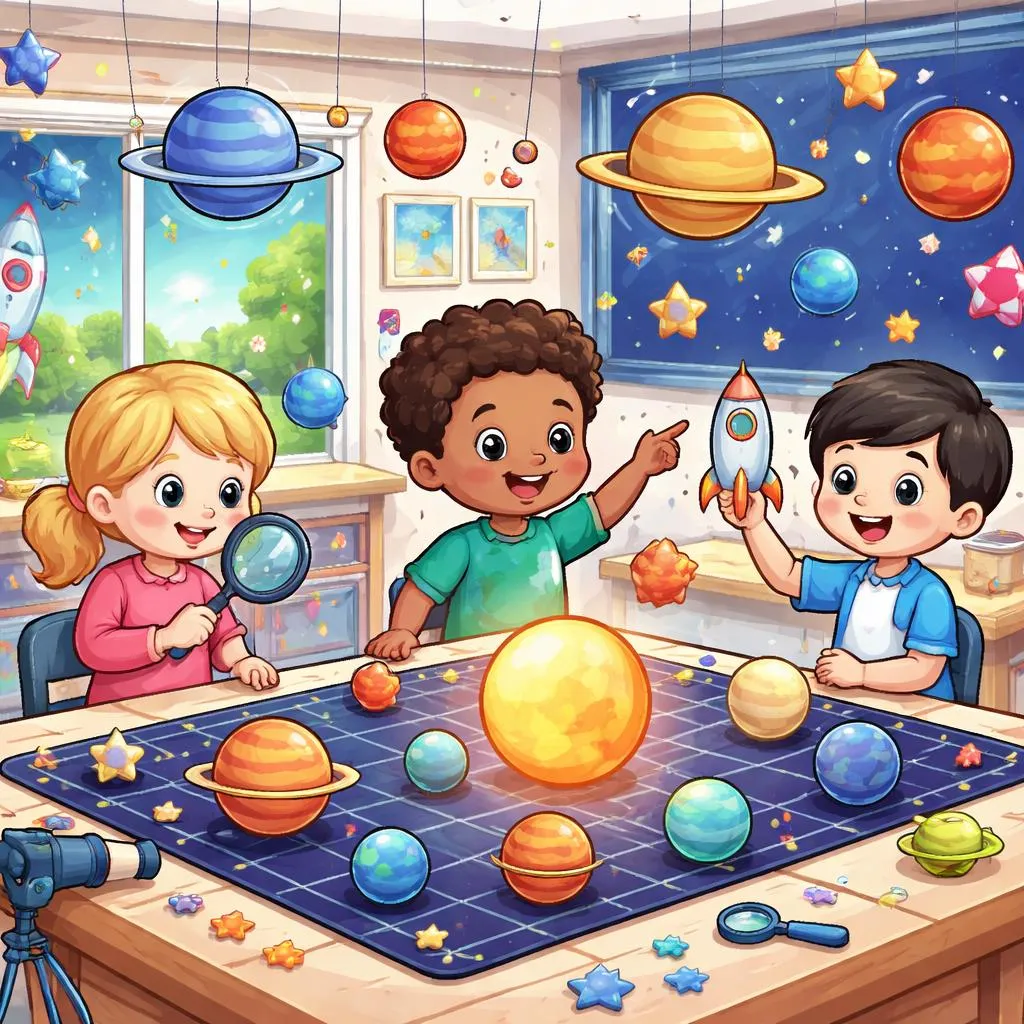

What is planets names?
The phrase planets names refers to the names of the planets in our solar system. This topic connects language learning with science and curiosity about space.
In a classroom context, planets names support vocabulary growth and content-based learning. They also inspire imagination and scientific thinking.
Teachers often integrate planets names into English lessons to connect words with real-world knowledge. This approach builds both language skills and general knowledge.
Meaning and explanation
A planet is a large object that orbits a star. In our solar system, planets orbit the Sun.
The eight planets have specific names. These names come from mythology and history.
The planets names in order from the Sun are Mercury, Venus, Earth, Mars, Jupiter, Saturn, Uranus, and Neptune. Each name has a unique pronunciation and spelling pattern.
Learning planets names helps with pronunciation practice. It also supports proper noun recognition in English.
Teachers can explain that planets names start with capital letters. This introduces basic grammar rules about proper nouns.
Categories or lists
Planets names can be grouped in different ways for teaching clarity. One common category is inner planets and outer planets.
The inner planets are Mercury, Venus, Earth, and Mars. These planets are rocky and close to the Sun.
The outer planets are Jupiter, Saturn, Uranus, and Neptune. These planets are large and made of gas or ice.
Another category is terrestrial planets and gas giants. Terrestrial planets include Mercury, Venus, Earth, and Mars.
Gas giants and ice giants include Jupiter, Saturn, Uranus, and Neptune. Grouping planets names helps learners see patterns and relationships.
Teachers can also introduce dwarf planets like Pluto. This expands vocabulary and scientific awareness.
Daily life examples
Planets names appear in many daily contexts. Science books, cartoons, and space documentaries use these names.
Children’s songs and stories often mention Mars or Jupiter. Teachers can connect planets names with popular media references.
Calendars and school projects sometimes include space themes. Students may see planets names in posters and classroom decorations.
The days of the week relate to planets and mythology in some cultures. This connection helps integrate history and language learning.
Teachers can encourage learners to describe Earth as their home planet. This builds personal connection with scientific vocabulary.
Printable flashcards
Flashcards help reinforce planets names through visual learning. Each card can show a planet picture and its name in large print.
Teachers can include phonetic hints under each planets name. This supports pronunciation and decoding skills.
Color coding helps distinguish inner and outer planets. Visual cues improve memory retention.
Printable flashcards can include fun facts like size or color. This adds content-based learning to vocabulary practice.
Flashcards can support matching games and memory activities. Teachers can laminate cards for repeated classroom use.
Learning activities or games
Songs and chants help memorize planets names in order. Rhythm and repetition support long-term recall.
A simple chant like “Mercury, Venus, Earth, and Mars” builds sequencing skills. Teachers can add hand movements for kinesthetic learning.
Classroom role-play can simulate a space mission. Learners introduce themselves as a planet using simple sentences.
Example sentences include “I am Mars. I am red.” This connects planets names with descriptive adjectives.
Board games with space themes encourage repeated exposure. Each step can require saying a planets name aloud.
Drawing activities allow learners to label planets with correct names. Labeling supports spelling and word recognition.
Teachers can use question prompts like “Which planet is the biggest?” This integrates comprehension and speaking practice.
Digital quizzes and interactive worksheets extend learning beyond the classroom. Teachers can assign online matching or sequencing tasks.
Group projects can involve creating a solar system poster. Students collaborate and practice planets names in context.
Storytelling activities allow learners to imagine traveling to a planet. Teachers guide simple narratives using planets names as settings.
Planets names provide a rich entry point into science-based English learning. They connect language, curiosity, and structured knowledge. With guided instruction, planets names become a foundation for vocabulary, pronunciation, and content-based communication in the classroom.