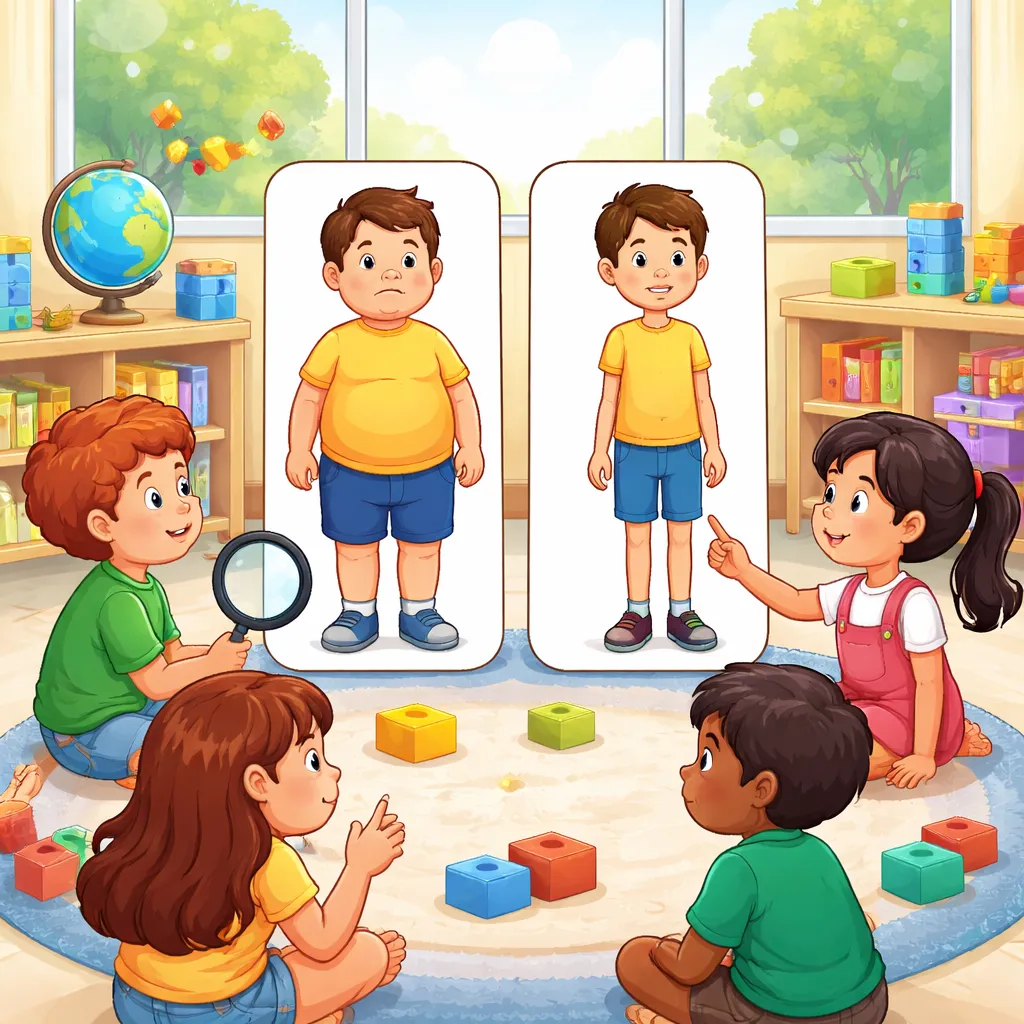

Are Similar Words Really Interchangeable?
Children often meet words that look similar in meaning. Thin and skinny are common examples. At first glance, both describe body shape. Many learners think they are the same.
But English does not always work this way. Words that seem similar can carry different feelings, tones, and usage rules.
Understanding these differences helps children speak more naturally. It also helps them avoid sounding rude or unclear in communication.
Thin and skinny are a great starting point for this learning journey.
Set 1: thin vs skinny — Which One Is More Common?
Thin appears more often in everyday English. It is used in neutral descriptions. It can describe people, objects, or materials.
For example, a pencil can be thin. A sheet of paper can be thin. A person can also be thin without any emotional judgment.
Skinny is also common, but it is more informal. Children hear it more in conversations than in books.
Thin is generally safer in formal writing. Skinny feels more casual and direct.
Set 2: thin vs skinny — Same Meaning, Different Contexts
Both words describe low body fat or narrow shape. However, context changes everything.
Thin can sound neutral or even positive. It may suggest health, balance, or elegance.
Skinny often feels more extreme. It can suggest someone is very slim. Sometimes it can sound slightly negative depending on tone.
For children, context matters more than dictionary meaning. A word is not only what it defines, but also how it feels in a sentence.
Set 3: thin vs skinny — Which Word Is “Bigger” or More Emphatic?
Skinny usually feels stronger than thin. It shows a more noticeable level of being slim.
If someone is called thin, the image is mild. If someone is called skinny, the image is more intense.
This difference helps children understand emotional strength in words.
Writers and speakers choose skinny when they want stronger impact. They choose thin when they want a softer tone.
Set 4: thin vs skinny — Concrete vs Abstract
Both thin and skinny describe physical appearance. So both are concrete in meaning.
However, thin can move beyond people and objects. It can describe abstract ideas like thin ice or thin chances.
Skinny rarely moves into abstract usage. It stays closely tied to physical appearance.
This makes thin more flexible in English. Children can see it in more situations across reading and speaking.
Set 5: thin vs skinny — Verb or Noun? First Understand the Role
Thin and skinny are adjectives. They describe nouns. They do not act as verbs or nouns in standard usage.
For example, we say “a thin book” or “a skinny cat.” The words describe the noun that follows.
However, thin can sometimes act as a verb in other forms, like “to thin out.” This is a different meaning.
Skinny does not commonly change roles like that. It stays mostly an adjective in daily English.
Understanding word roles helps children build correct sentences faster.
Set 6: thin vs skinny — American English vs British English
Both words are used in American and British English. There is no strict regional separation.
However, usage style can differ slightly. American English may use skinny more casually in speech.
British English often prefers thin in neutral descriptions. It may avoid skinny in formal settings.
Still, both regions understand both words clearly.
Children learning English do not need to worry too much about region here.
Set 7: thin vs skinny — Which Fits Formal Situations?
Thin is more suitable for formal or academic writing. It sounds neutral and respectful.
Skinny is better for informal conversations or storytelling. It may feel too casual in school essays.
For example, in a science description, “thin layer” is appropriate. “Skinny layer” would sound incorrect.
Teaching children this difference helps them choose words based on situation.
Good communication is not only about meaning. It is also about tone.
Set 8: thin vs skinny — Which One Is Easier for Kids to Remember?
Skinny is often easier for children to remember. It has a fun sound and clear spelling.
Thin is shorter, but it feels less expressive.
Children may connect skinny with cartoons, stories, or casual talk. This makes it stick in memory.
However, thin is more useful across many contexts. So both words are important for balanced learning.
A good strategy is to remember skinny as “casual slim” and thin as “neutral slim.”
Set 9: Mini Exercise: Can You Spot the Differences Between These Similar Words?
Try these simple practice sentences with children.
The paper is very ____ (thin / skinny). The cat looks ____ after winter (thin / skinny). She has a ____ notebook (thin / skinny). That boy is very ____ compared to others (thin / skinny).
Ask children to explain their choices. Encourage them to think about tone, not only meaning.
This helps build deeper vocabulary awareness.
Set 10: Parent Tips: How to Help Kids Learn and Remember Similar Words
Parents play a key role in vocabulary growth. Small daily conversations can make a big difference.
When reading books, point out words like thin and skinny. Ask simple questions about meaning and feeling.
Encourage comparison. Ask: “Does this word sound neutral or strong?”
Use real-life examples. A thin slice of bread or a skinny tree branch can help understanding.
Avoid correcting too quickly. Let children explore meaning first, then guide gently.
Repetition in natural contexts works better than memorizing lists.
Over time, children will naturally feel the difference between similar words.