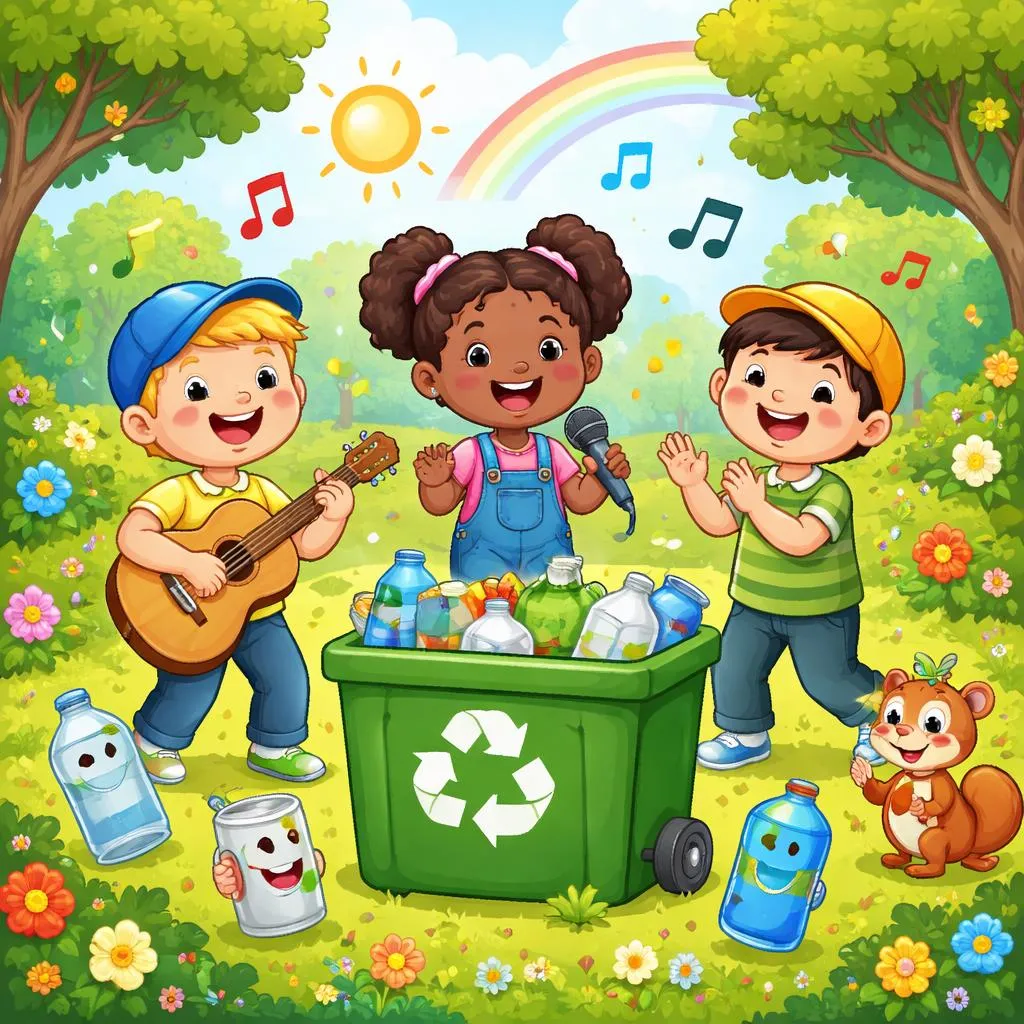

Hello, caring teachers and environmentally conscious young learners! Today we explore a wonderful song that helps protect our planet. It teaches children about taking care of the Earth. It explains how to recycle paper, plastic, and glass. A recycle song makes learning about environmental responsibility fun and memorable. Music helps children remember important messages. The catchy tune stays in their minds. The words teach them what to do. Let us discover this important song together. Let us learn how to reduce waste and help our planet grow.
What Is a Recycle Song? A recycle song is a musical piece that teaches children about recycling and caring for the environment. It explains the three R's: reduce, reuse, and recycle. It tells children what materials can be recycled. It encourages them to put trash in the right bins.
These songs often have upbeat, cheerful tunes. Children love to sing along. The repetition helps them remember the message. The actions keep them engaged.
Recycle songs are used in classrooms and at home. They make environmental education fun. Children learn that recycling is important. They learn that even small actions can help the Earth.
The Lyrics of a Popular Recycle Song Let us look at a common recycle song lyrics. Many versions exist. Here is one that children enjoy.
Reduce, reuse, recycle, Words that we all know. We can help our planet, Watch it grow and grow!
Paper, plastic, glass, and cans, We can recycle them all. Put them in the right bins, Standing straight and tall!
The Earth is our home, We must take care. Recycle every day, Show the Earth we care!
When you finish a bottle, Don't throw it away. Put it in the recycling bin, For a brand new day!
Reduce, reuse, recycle, Sing it loud and clear. Helping our dear planet, Is why we are all here!
Vocabulary Learning from the Song This environmental song teaches many important words. Let us explore them together.
The three R words: The song introduces reduce, reuse, and recycle. These are the core concepts of environmental responsibility. Children learn what each word means.
Reduce means to use less. It means not wasting things. We can reduce the amount of trash we create. We can reduce what we buy.
Reuse means to use something again. It means not throwing things away after one use. We can reuse bags, jars, and containers. We can find new purposes for old things.
Recycle means to turn old things into new things. Paper becomes new paper. Glass becomes new glass. Plastic becomes new items. This saves resources and energy.
Material words: The song mentions paper, plastic, glass, and cans. Children learn what materials can be recycled. They learn to sort their trash.
Action words: The song uses action verbs. Reduce, reuse, recycle, put, throw, help, sing. Children learn these words in a meaningful context.
Environment words: The song mentions Earth, planet, and home. Children learn to care for the world around them.
Phonics Points in the Rhyme The recycle song offers good phonics practice. Let us look at some important sounds.
Listen to the "r" sound. It appears in "reduce, reuse, recycle" throughout. The "r" sound can be tricky. Practice together. "R-r-reduce." "R-r-reuse." "R-r-recycle."
Listen to the long "e" sound. It appears in "recycle" and "need" and "dear." The long "e" says its name. Practice together. "Re-cy-cle." "N-ee-d." "D-ear" has a different sound.
Listen to the "p" sound. It appears in "paper" and "plastic" and "planet." The "p" sound is a quick popping sound. Practice together. "P-p-paper." "P-p-plastic." "P-p-planet."
The rhyming words help children notice sound patterns. Know and grow. All and tall. Care and here. Clear and here. This builds phonemic awareness.
Grammar Patterns in the Song The song contains useful grammar patterns for young learners.
Imperative verbs: The song gives gentle commands. "Reduce, reuse, recycle." "Put them in the right bins." "Show the Earth we care." This teaches the imperative form in a positive way.
Present tense: The song uses present tense throughout. "The Earth is our home." "We can help our planet." This describes facts and possibilities.
Modal verbs: The song uses "can" to show possibility. "We can recycle them all." "We can help our planet." Children learn to express what is possible.
Repetitive structure: Each verse follows a similar pattern. This helps children predict language. They can join in more easily.
Learning Activities for the Song The song lends itself to many activities. Here are some ideas to extend learning.
Recycling Sorting Game: Set up three bins labeled Paper, Plastic, and Glass. Gather various clean items. A plastic bottle, a newspaper, a glass jar. Children sort each item into the correct bin. Discuss why each item goes there. This hands-on activity makes the concepts concrete.
Classroom Pledge: After learning the song, make a class pledge. Ask children to suggest one way they can help the planet. They might say, "I will recycle my water bottles." "I will use both sides of paper." Write these on a large poster. Everyone signs the poster. Hang it in the classroom as a reminder.
Art from Recycled Materials: Collect clean recyclable items. Egg cartons, bottle caps, old magazines, cardboard tubes. Provide glue and paper. Challenge children to create art using only these recycled materials. This shows creativity and recycling in action.
Recycling Center Visit: If possible, visit a local recycling center. Children can see how materials are sorted and processed. This makes the concept of recycling real and concrete.
Printable Materials for the Song Printable resources support learning from the song. They provide visual reinforcement.
Lyrics Poster: Create a colorful poster with the full lyrics. Add pictures for key words. Reduce with a picture of using less. Reuse with a picture of a reusable bag. Recycle with a picture of a recycling bin. Display the poster during singing time.
Recycling Bin Labels: Create printable labels for recycling bins. Paper, Plastic, Glass, Cans. Children can help label bins in the classroom or at home.
Sorting Cards: Create small cards with pictures of different items. A plastic bottle, a newspaper, a glass jar, an aluminum can. Children sort them onto mats labeled with the correct material.
Coloring Pages: Create coloring pages related to recycling. Children putting items in recycling bins. The Earth smiling. Recycling symbols. Coloring reinforces the concepts quietly.
Educational Games for the Song Games make learning about recycling exciting and memorable.
Recycling Relay Race: Set up three bins at one end of the room. Label them Paper, Plastic, and Glass. At the other end, place a pile of picture cards showing different items. Children take turns picking a card, running to the bins, and placing it in the correct one. This combines movement with learning.
I Spy Recycling: Play a game of I Spy focusing on recyclable items. "I spy something made of plastic that we can recycle." The answer might be a water bottle. "I spy something made of paper that we can recycle." The answer might be a newspaper.
Musical Recycling: Play the recycle song. When the music stops, call out an item. "Plastic bottle!" Children must freeze in a pose showing what to do with it. They might pretend to put it in a recycling bin. This combines music, movement, and quick thinking.
Recycling Bingo: Create bingo cards with pictures of recyclable items. Call out item names. Children cover the matching picture. When someone gets BINGO, they name the material each item is made from.
New Verse Creation: Challenge children to create new verses for the song. What other things can we recycle? What other ways can we help the planet? "Compost, compost, food scraps too, they help the garden grow!" This builds creativity and extends learning.
Recycling Sort Race: Time children as they sort a pile of mixed recyclable pictures into the correct categories. Challenge them to beat their previous time. This builds speed and accuracy in sorting.
Through a recycle song, children learn environmental responsibility in a fun way. The catchy tune makes the message stick. The three R's become part of how children think about the world. They learn that small actions matter. They discover they can make a difference for our planet. Every time they hear the song, they remember their power to help the Earth.