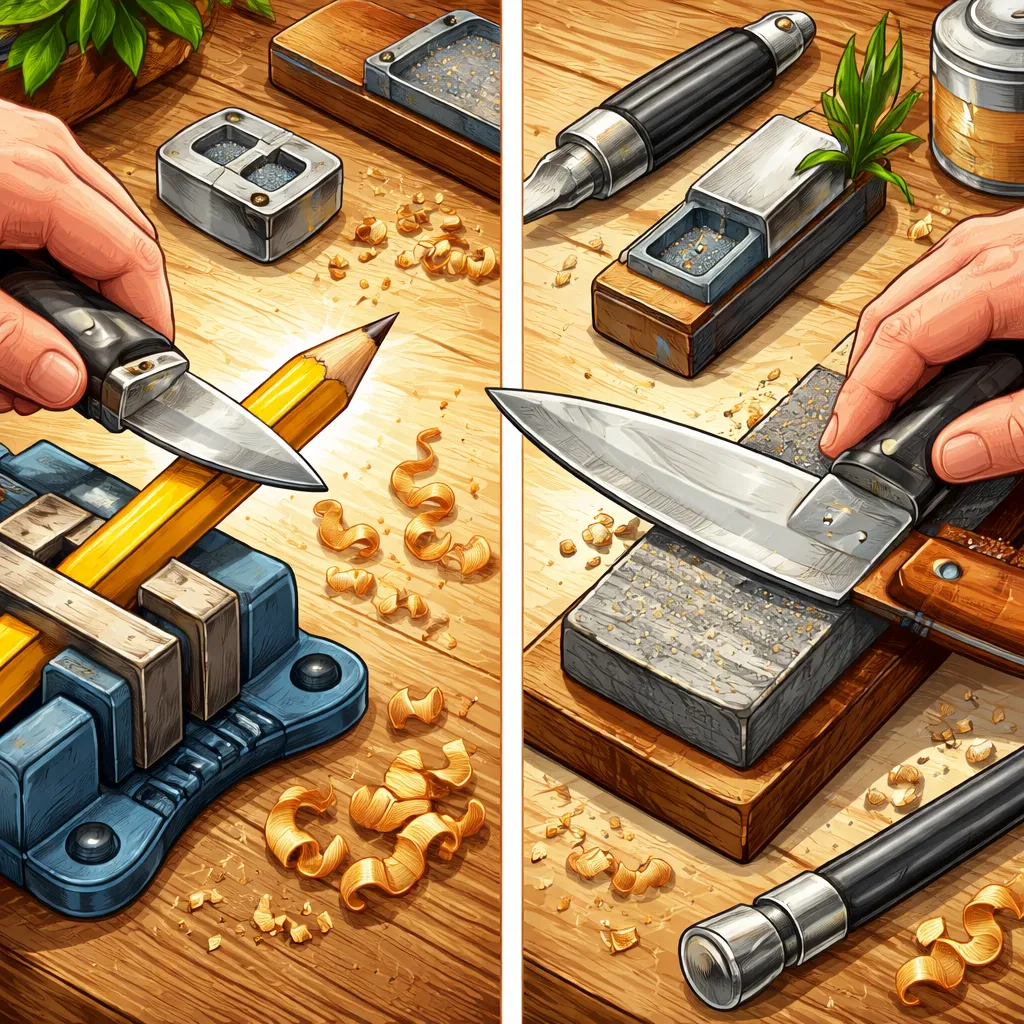

Children love sharpening pencils. They also notice pointy roofs on houses. Parents often hear kids say, “This needle is pointed.” Or “This knife is sharp.” But are these two words the same? Can we always use one instead of the other? This article helps families explore the words “pointed and sharp” together. We will compare them with similar words. We will see which one fits a pin and which one fits a blade. Let us help your child describe edges and tips with care and accuracy.
Are Similar Words Really Interchangeable? Many English words describe things that can cut or poke. But they each carry different meanings. “Pointed” and “sharp” both describe things with thin ends or edges. Yet we use them in different situations. A pointed stick has a narrow tip. A sharp knife cuts easily. You cannot always swap them. For example, a pointed remark is direct and maybe rude. A sharp remark is quick and biting. Both work, but they feel different. So similar words are not always interchangeable. Parents can show this with real objects. Point to a pointed pencil tip. Then point to a sharp blade. Ask your child: “Can I call the pencil sharp?” Yes, if it is sharpened. But a sharp pencil is both pointed and sharp. Teaching these small differences builds a strong vocabulary.
Set 1: Pointed vs Sharp — Which One Is More Common? “Sharp” appears much more often in daily English. We say sharp knife, sharp mind, sharp pain, sharp turn. “Pointed” appears less frequently. People say pointed toe, pointed hat, pointed question, pointed stick. In children’s books, “sharp” dominates. Think of sharp teeth and sharp scissors. “Pointed” shows up in stories about witches’ hats or arrows. Look at Google Ngram. “Sharp” has always been far more common. For young learners, teach “sharp” first. Use it for cutting tools and quick thinking. Save “pointed” for things with a distinct tip or end. This order helps kids build a useful vocabulary.
Set 2: Pointed vs Sharp — Same Meaning, Different Contexts Both words mean “having a thin end that can pierce.” But context separates them. “Pointed” focuses on the tip or end shape. A pointed shoe has a triangular toe. A pointed mountain peak rises to a tip. “Sharp” focuses on the ability to cut or slice. A sharp razor cuts hair. A sharp knife divides fruit. You can have a pointed stick that is not sharp. It has a tip but cannot cut. You can have a sharp blade that is not pointed. A circular saw blade is sharp but round. So one word is about shape. The other word is about function. Tell your child: “Pointed tells you how it looks. Sharp tells you what it can do.”
Set 3: Pointed vs Sharp — Which Word Is “Bigger” or More Emphatic? “Sharp” often feels more intense and dangerous. A sharp pain hurts suddenly. A sharp criticism stings deeply. “Pointed” feels more specific and deliberate. A pointed question targets one thing. A pointed finger directs attention. So “sharp” carries urgency and risk. “Pointed” carries precision and intention. For children, explain this way: “Sharp means it can hurt you easily. Pointed means it has a tip, but maybe not dangerous.” A pointed crayon is fine. A sharp knife needs care. This helps kids understand safety. They learn that “sharp” warns of danger. “Pointed” simply describes shape. Both need respect, but one is more urgent.
Set 4: Pointed vs Sharp — Concrete vs Abstract Both words work concretely and abstractly. Concrete “pointed”: a pointed stick, pointed roof, pointed chin. Abstract “pointed”: pointed remark (direct), pointed silence (meaningful), pointed look (intentional). Concrete “sharp”: sharp knife, sharp edge, sharp needle. Abstract “sharp”: sharp mind (intelligent), sharp tongue (critical), sharp pain (sudden and intense). However, abstract “sharp” often describes mental quickness. Abstract “pointed” describes deliberate focus. For children, start with concrete meanings. Show a pointed pencil tip. Show a sharp kitchen knife. Later, introduce abstract uses through stories. Explain that a “pointed question” goes straight to one topic. A “sharp mind” thinks fast.
Set 5: Pointed vs Sharp — Verb or Noun? First Understand the Role Both words are primarily adjectives. But “point” and “sharpen” are verbs. “Pointed” comes from “point.” “Sharp” comes from “sharpen.” As nouns, “point” means the tip. “Sharp” as a noun means a musical note or a dishonest person (rare). For young children, focus on adjectives. “This tip is pointed.” “This blade is sharp.” Later, teach the verbs. “Watch me point my finger.” “Watch me sharpen this pencil.” This builds grammar naturally. Also teach “point” as a noun. “The point of the needle is tiny.” This helps children see how words change families. “Sharp” also works as an adverb in “sharp at 3 o’clock.” But save that for older kids.
Set 6: Pointed vs Sharp — American English vs British English Both words work similarly in American and British English. However, small differences exist. In the UK, “sharp” can mean stylish or cool. “That suit is sharp.” Americans also use this but less often. In the US, “pointed” for shoes is common. “Pointed toe boots.” Britons say the same. Also, “sharp practice” means dishonest business behavior in British English. Americans understand but rarely use it. For children, these differences are minor. Teach the core meanings. If your child reads British books, explain “sharp” meaning stylish. A family activity: watch a US cartoon and a UK cartoon. Listen for “sharp” and “pointed.” Compare how characters use them. You will find more similarities than differences.
Set 7: Pointed vs Sharp — Which Fits Formal Situations? Both words work in formal and informal settings. “Sharp” appears in medical and scientific writing. “Sharp pain,” “sharp edge,” “sharp angle.” “Pointed” appears in design and geometry. “Pointed arch,” “pointed tip,” “pointed instrument.” For school reports, both are fine. But “sharp” is more common in safety warnings. “Pointed” is more common in art descriptions. Teach your child this rule: “Use sharp for cutting ability and quick thinking. Use pointed for shape descriptions.” In a science report about tools, “sharp” is better. In an art report about cathedral windows, “pointed” is better. This helps kids learn nuance. They understand that word choice depends on the subject.
Set 8: Pointed vs Sharp — Which One Is Easier for Kids to Remember? “Sharp” is easier for young children. Why? Because it has one syllable. It sounds like “harp” or “carp.” Children hear “sharp” in safety rules. “Don’t touch the sharp knife.” “Pointed” has two syllables. The “point” sound is simple, but “-ed” adds a step. A three-year-old can say “sharp” clearly. That same child may say “point-ed” slowly. So start with “sharp.” Use it for all dangerous edges and tips. Introduce “pointed” around age four or five. Use drawing. “Draw a pointed hat. Draw a sharp knife.” Let them see the difference. A hat can be pointed but not sharp. A knife can be both. This visual contrast works better than definitions. Let your child touch a pointed but dull stick (under supervision). Then touch a sharp pencil tip carefully. Say the words each time. Repetition builds comfort.
Mini Exercise: Can You Spot the Differences Between These Similar Words? Read each sentence with your child. Choose “pointed” or “sharp.” Answers below.
Please be careful with that _______ knife.
The witch wore a _______ hat.
She has a _______ mind and solves puzzles quickly.
His _______ question made me think.
The pencil tip is _______, but it broke.
Bonus question: Is this sentence correct? “The sharp of the needle broke.” Why or why not?
Answers: 1. sharp, 2. pointed, 3. sharp, 4. pointed, 5. pointed (or sharp if it was sharpened before breaking). Bonus: Not correct. “Sharp” as a noun does not mean tip. Say “The point of the needle broke.”
Talk about each answer. Ask your child which sentences describe danger. Which describe shape only. Which describe thinking. This discussion builds layered understanding. Do the exercise again with real objects. A nail? Pointed and possibly sharp. A scissors blade? Sharp. A party hat? Pointed.
Parent Tips: How to Help Kids Learn and Remember Similar Words You can teach “pointed and sharp” during daily moments. Breakfast time: “This fork has pointed tines. The knife is sharp.” Playtime: “Your pencil is pointed. Let us sharpen it to make it sharp.” Craft time: “Cut with the sharp scissors. Draw a pointed star.” Safety talk: “Sharp things can cut. Pointed things can poke. Both need care.” Use your body. Point your finger. Make a sharp motion with your hand like cutting. Say the words as you move. Play the “Pointed or Sharp” sorting game. Gather ten objects. A nail? Pointed and sharp. A needle? Both. A rounded butter knife? Sharp but not pointed. A cone? Pointed but not sharp. Ask your child to explain each choice. Do not correct mistakes harshly. Instead, ask “Can this cut? If yes, it is sharp. Does it have a thin end? If yes, it is pointed.” This gentle guidance works better than rules. Read books with descriptive language. “The Little Old Lady Who Was Not Afraid of Anything” has great sound words but also shape words. Pause on each page. Ask “Is this pointed or sharp? Why?” Keep a shape journal. Draw one pointed thing and one sharp thing each week. Label them. Review old entries. Praise specific observations. “You noticed that a thorn is both pointed and sharp. Excellent.” This positive feedback builds a careful eye. Your child will soon see tips and edges everywhere. They will also understand the difference between shape and function. That is a sophisticated skill for a young learner. Keep exploring words together. Every tool, every drawing, every plant offers a new chance to learn.