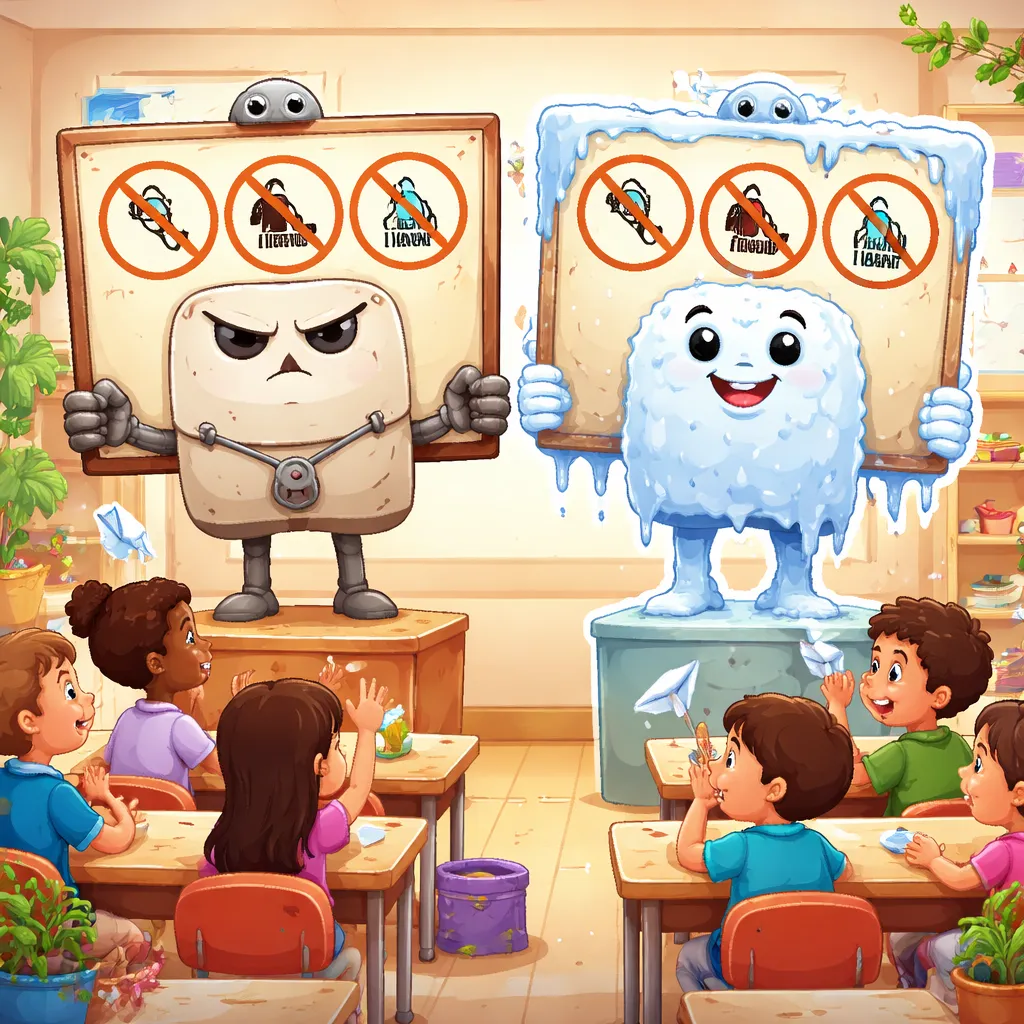

Children know stiff cardboard. They also know rigid rulers that do not bend. Parents often hear kids say, “This new shoe feels stiff.” Or “The rule is rigid.” But are these two words the same? Can we always use one instead of the other? This article helps families explore the words “rigid and stiff” together. We will compare them with similar words. We will see which one fits a steel beam and which one fits a sore neck. Let us help your child describe things that do not bend or change easily.
Are Similar Words Really Interchangeable? Many English words describe things that resist bending. But they each carry different feelings. “Rigid” and “stiff” both mean “not flexible or hard to bend.” Yet we use them in different situations. A rigid rule allows no exceptions. A stiff door hinge moves with difficulty. You cannot always swap them. For example, a rigid person refuses to change. A stiff person has sore muscles. Both describe resistance, but one is about attitude. So similar words are not always interchangeable. Parents can show this with real objects. Point to a rigid plastic ruler. Then point to a stiff new pair of jeans. Ask your child: “Can I call the ruler stiff?” Yes, but it sounds less formal. Teaching these small differences builds a strong vocabulary.
Set 1: Rigid vs Stiff — Which One Is More Common? “Stiff” appears more often in daily English. We say stiff neck, stiff drink, stiff breeze, stiff competition. “Rigid” appears less frequently. People say rigid structure, rigid rule, rigid control, rigid material. In children’s books, “stiff” dominates for physical feelings. “Rigid” shows up in science and rules. Look at Google Ngram. “Stiff” has always been more common. For young learners, teach “stiff” first for physical stiffness. Save “rigid” for strict rules and formal structures. This order helps kids describe everyday discomfort first.
Set 2: Rigid vs Stiff — Same Meaning, Different Contexts Both words mean “hard to bend or move.” But context separates formality and body parts. “Rigid” describes objects, systems, and rules. A rigid metal bar, rigid classroom policy, rigid schedule. “Stiff” describes bodies, fabrics, and movements. Stiff legs after running, stiff collar on a shirt, stiff wave goodbye. You can have a rigid rule that is not physically stiff. You can have a stiff muscle that is not rigid in structure. So one word is about strictness and structure. The other word is about physical resistance and discomfort. Tell your child: “Stiff is how your body feels after sitting too long. Rigid is how a rule feels when it never changes.”
Set 3: Rigid vs Stiff — Which Word Is “Bigger” or More Emphatic? “Rigid” often feels more absolute and formal. A rigid ideology allows no change. Rigid discipline controls everything. “Stiff” feels more temporary and physical. A stiff joint loosens with movement. Stiff resistance in a sport is strong but not permanent. So “rigid” carries a sense of permanent inflexibility. “Stiff” carries a sense of temporary or physical stiffness. For children, explain this way: “Rigid means it will not bend ever. Stiff means it is hard to bend right now.” A rigid plastic toy stays rigid. A stiff rope might become flexible later. This helps kids understand that “rigid” is stronger and more lasting.
Set 4: Rigid vs Stiff — Concrete vs Abstract Both words work concretely and abstractly. Concrete “rigid”: rigid steel frame, rigid plastic case, rigid board. Abstract “rigid”: rigid rules, rigid thinking, rigid hierarchy. Concrete “stiff”: stiff cardboard, stiff brush, stiff leg. Abstract “stiff”: stiff penalty (severe), stiff resistance (strong), stiff manner (formal). However, abstract “stiff” often means severe or strong. Abstract “rigid” means unchangeable. For children, start with concrete meanings. Show a rigid plastic lid. Show a stiff piece of new fabric. Later, introduce abstract uses through stories. Explain that a “rigid rule” never changes. A “stiff punishment” is very harsh. This shows how both words move into feelings and rules.
Set 5: Rigid vs Stiff — Verb or Noun? First Understand the Role Both words are primarily adjectives. “Rigid” has no common verb form. “Stiffen” is the verb for stiff. As nouns, “rigidity” and “stiffness” are the noun forms. For young children, focus on adjectives. “This board is rigid.” “This brush is stiff.” Later, teach the verb “stiffen.” “My back stiffens after sitting.” Also teach “stiff” as a noun in slang. “The stiff” means a dead body or a formal person. That is advanced. Keep it simple. Teach “rigid” only as an adjective for now. This prevents confusion. Your child will learn “stiffen” naturally when describing sore muscles after play.
Set 6: Rigid vs Stiff — American English vs British English Both words work similarly in American and British English. However, small differences exist. In the UK, “stiff” can mean difficult. “A stiff exam” means a hard test. Americans say “tough exam.” In the US, “stiff” for a drink means strong alcohol. Britons use the same. “Rigid” has no regional differences. Both countries use “rigid” for rules and materials. For children, these differences are minor. Teach the core meanings. If your child watches British shows, they may hear “stiff competition” meaning strong opponents. American shows use “tough competition.” A family activity: watch a US sports game and a UK one. Listen for “stiff” and “rigid.” Compare how announcers describe defenses.
Set 7: Rigid vs Stiff — Which Fits Formal Situations? “Rigid” sounds more formal and technical. Engineering reports say “rigid structure.” School policies say “rigid attendance rules.” “Stiff” sounds more casual and physical. Doctors say “stiff neck.” Cooks say “stiff dough.” For school reports, “rigid” is better for rules and materials. “Stiff” is better for body descriptions. Teach your child this rule: “Use rigid for important systems that do not change. Use stiff for bodies, fabrics, and temporary feelings.” In a science report about bridges, “rigid” is correct. In a story about a morning with a sore back, “stiff” works best. This helps kids learn register.
Set 8: Rigid vs Stiff — Which One Is Easier for Kids to Remember? “Stiff” is easier for young children. Why? Because it has one syllable. It sounds like “cliff” or “sniff.” Children feel stiffness in their bodies after running. They touch stiff cardboard. “Rigid” has two syllables. The “ri” sound is like “ridge.” The “gid” ending is less common. A three-year-old can say “stiff” clearly. That same child may say “ri-gid” slowly. So start with “stiff.” Use it for body feelings, new clothes, and hard-to-bend paper. Introduce “rigid” around age six or seven. Use examples from school and building. “The rigid ruler does not bend. The rigid rule says no running inside.” This contrast helps kids see that “rigid” often connects to rules and strong materials.
Mini Exercise: Can You Spot the Differences Between These Similar Words? Read each sentence with your child. Choose “rigid” or “stiff.” Answers below.
My neck feels _______ after sleeping in a funny position.
The school has a _______ policy about homework deadlines.
This new leather jacket is too _______. It will soften with wear.
The bridge uses _______ steel beams that do not flex.
She gave me a _______ wave when I said hello.
Bonus question: Is this sentence correct? “The rigid of the cardboard made it hard to fold.” Why or why not?
Answers: 1. stiff, 2. rigid, 3. stiff, 4. rigid, 5. stiff. Bonus: Not correct. “Rigid” is an adjective, not a noun. Say “The rigidity of the cardboard made it hard to fold” or “The stiff cardboard was hard to fold.”
Talk about each answer. Ask your child which sentences describe body feelings. Which describe rules or strong materials. Which describe formal or informal situations. This discussion builds precision. Do the exercise again with real objects. A steel ruler? Rigid. A new shoe? Stiff. A classroom rule? Rigid. A sore muscle? Stiff.
Parent Tips: How to Help Kids Learn and Remember Similar Words You can teach “rigid and stiff” during daily moments. Breakfast time: “This new bread bag is stiff to open. The school rule about hats is rigid.” Playtime: “This rigid plastic toy does not bend. My fingers feel stiff from the cold.” Nature walk: “This rigid branch broke. This stiff leaf crunches.” Body time: “After running, my legs feel stiff. A rigid posture means sitting up very straight.” Use your body. Keep your arm straight and rigid. Show a stiff movement like a robot. Say the words as you move. Play the “Rigid or Stiff” sorting game. Gather ten objects. A steel spoon? Rigid. A new pair of jeans? Stiff. A plastic ruler that bends? Neither. A cardboard box? Stiff. A school rule? Rigid. A sore knee? Stiff. Ask your child to explain each choice. Do not correct mistakes harshly. Instead, ask “Is this about a rule or a strong material? That is rigid. Is this about a body feeling or a temporary hardness? That is stiff.” This gentle guidance works better than rules. Read books about materials and rules. “The Stiff Neck” or “Rigid Rules at School.” Pause on each page. Ask “Is this rigid or stiff? Why?” Keep a stiffness journal. Draw one rigid thing and one stiff thing each week. Label them. Review old entries. Praise specific observations. “You noticed that a rigid rule can be good for safety. And a stiff neck needs a stretch. Perfect.” This positive feedback builds a precise and aware child. Your child will soon see rigid and stiff things everywhere. They will also understand the difference between permanent inflexibility and temporary physical resistance. That is a sophisticated skill for a young learner. Keep exploring words together. Every object, every rule, every body movement offers a new chance to learn about rigidity and stiffness.