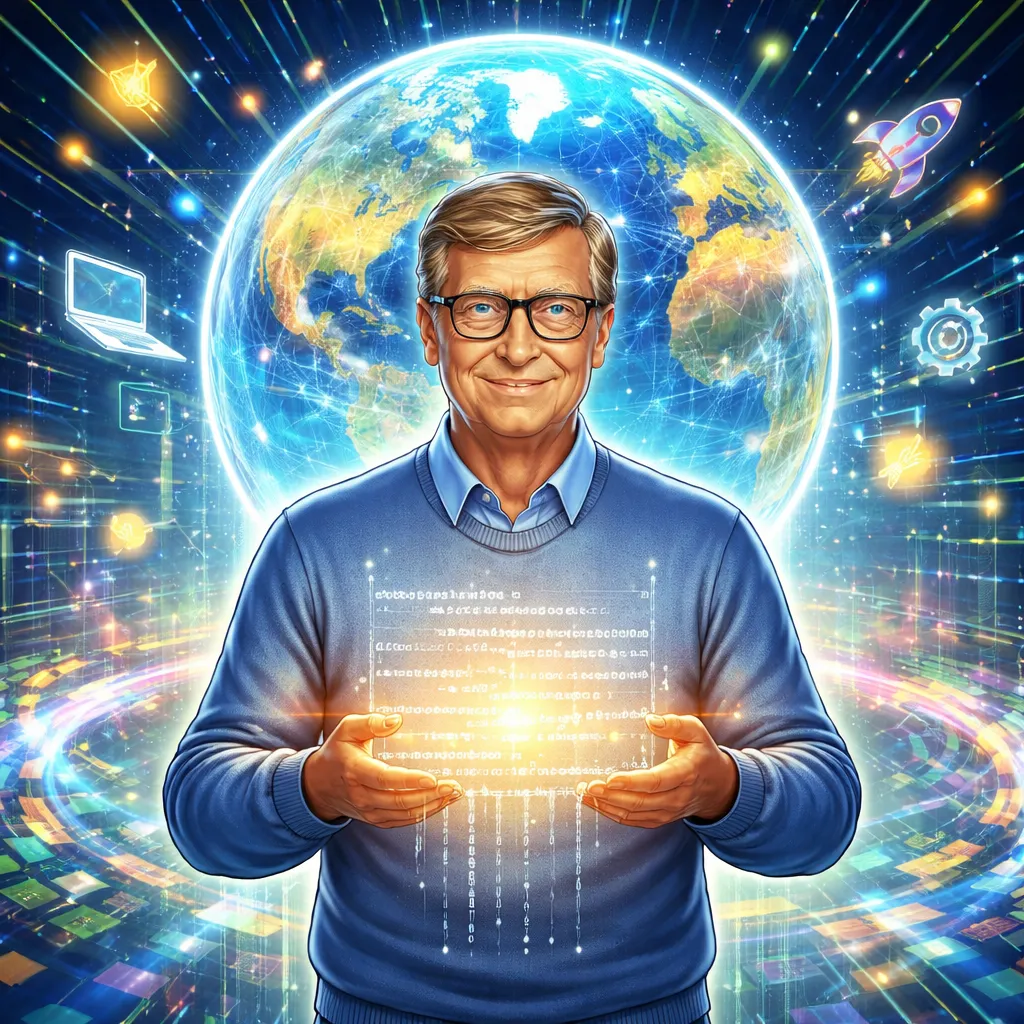

Introduction to Bill Gates
Bill Gates is an American businessman, software developer, and philanthropist. He co-founded Microsoft, the world's largest personal computer software company. This celebrity story: Bill Gates shows that writing code can lead to changing lives. Gates did not just get rich. He gave away most of his fortune to help sick and poor people. Children can learn that success means using your gifts to help others. Parents can use his story to teach hard work, curiosity, and generosity. Gates started programming at age 13. He left Harvard University to start Microsoft. He became one of the richest people on Earth. Then he started the Bill & Melinda Gates Foundation. His life proves that a person can build something huge and then share it with everyone.
Early Life and Background
William Henry Gates III was born on October 28, 1955, in Seattle, Washington. His father, William H. Gates Sr., was a lawyer. His mother, Mary Maxwell Gates, served on charitable boards. Bill had two sisters, Kristianne and Libby. The family was comfortable but not extremely wealthy. Young Bill loved reading. He read the entire World Book Encyclopedia from A to Z. He also loved math and science. At age 13, his school bought a computer terminal. Bill became obsessed. He wrote his first program, a tic-tac-toe game. He and a friend, Paul Allen, spent hours learning programming languages. They made a deal with a local computer company. They would find bugs in the software for free computer time. Bill would sneak out of his house at night to go program. His parents worried. They sent him to a therapist. The therapist said Bill should be allowed to follow his passion. In high school, Bill and Paul wrote a scheduling program for their school. They also started a small company that counted traffic for cities. Bill scored a perfect 800 on the math SAT. He entered Harvard University in 1973.
Career Highlights and Achievements
In 1975, Bill Gates read about a new computer called the Altair 8800. He and Paul Allen called the maker, MITS. They said they had written a version of the BASIC programming language for the Altair. They had not written a single line. But they worked day and night in Harvard's computer lab. They finished the software. It worked perfectly. Bill dropped out of Harvard in his junior year. He and Paul moved to Albuquerque, New Mexico, to work with MITS. They named their company Micro-Soft, short for microcomputer software. In 1980, IBM wanted an operating system for its new personal computer. Bill did not have one. He bought a simple system called QDOS for $50,000. He renamed it MS-DOS. He licensed it to IBM but kept the rights to sell it to other computer makers. That decision made Microsoft a giant. In 1985, Microsoft released Windows. It became the most popular operating system in the world. By 1990, Microsoft Office sold millions of copies. Bill Gates became the youngest self-made billionaire in history at age 31.
Famous Works or Performances
Bill Gates's most famous work is the Microsoft Windows operating system. Windows 3.0, released in 1990, made computers easy for ordinary people. Windows 95 introduced the Start button and taskbar. Millions of people remember the sound of Windows starting up. Another famous work is Microsoft Office. Word, Excel, and PowerPoint became the standard tools for business and school. Almost every office worker has used these programs. Gates also wrote a book called "The Road Ahead" in 1995. It predicted the internet, online shopping, and digital music. Many people thought his predictions were crazy. He was right. Later, Gates wrote "How to Avoid a Climate Disaster" in 2021. It explains clean energy solutions. The Bill & Melinda Gates Foundation is another famous work. It is not software. It is the largest private charity in the world. The foundation has given over $50 billion to fight disease and poverty. Gates also started The Giving Pledge with Warren Buffett. Billionaires promise to give away most of their money.
Personal Life and Fun Facts
Bill Gates has many interesting personal habits. He reads about 50 books per year. He takes a two-week reading vacation every year. He calls it "Think Week." He goes to a small cabin in the woods. He reads and thinks without interruption. A fun fact is that Gates knows his license plate number from his first car. He had a 1965 Ford Mustang. Another fun fact is that he once memorized all the airplane departure and arrival times at Seattle-Tacoma Airport. He wanted to know which flights to take without looking at a schedule. Gates married Melinda French in 1994. They have three children: Jennifer, Rory, and Phoebe. They divorced in 2021 but still work together on the foundation. Gates loves playing bridge and tennis. He plays bridge online with friends. He also loves watching "The Big Bang Theory" on TV. Gates is famous for being a messy eater. He spills food on his shirt at almost every meal. He does not care. He is too busy thinking. He once said, "I have a system. The shirt is already dirty. So I don't worry about it."
Legacy and Influence
Bill Gates changed how the world uses computers. Before Microsoft, computers were hard to use. After Windows, almost anyone could point, click, and work. Microsoft software runs on over 1.5 billion devices worldwide. That is more people than live in any country except China and India. Gates also changed how billionaires think about wealth. Before him, rich people gave money to museums and opera houses. Gates gave money to cure malaria, provide vaccines, and improve schools. The Bill & Melinda Gates Foundation has saved millions of lives. It helped reduce polio by 99 percent worldwide. It funded research for COVID-19 vaccines. It gives scholarships to minority students. Many other billionaires copied Gates's approach. Warren Buffett, Mark Zuckerberg, and Elon Musk have all signed The Giving Pledge. Gates stepped down from Microsoft's board in 2020. He now spends most of his time on the foundation and climate change. His legacy proves that making money is one skill. Giving it away wisely is another skill. He mastered both.
Quotes or Famous Sayings
Bill Gates has spoken many wise words. One famous quote is, "It's fine to celebrate success, but it is more important to heed the lessons of failure." Another powerful saying is, "We always overestimate the change that will happen in the next two years and underestimate the change that will happen in the next ten." He also said, "Success is a lousy teacher. It seduces smart people into thinking they cannot lose." Children might like this one: "I believe that if you show people the problems and you show them the solutions, they will be moved to act." Families can read these quotes together. Ask children, "What does it mean that success is a lousy teacher?" It means failure teaches us more than winning does. Parents can help children see that Gates made mistakes. His first company made traffic counters. It did not succeed. He kept learning. His quotes remind us that patience and curiosity matter more than being right today.
How to Learn from Bill Gates
Children can learn several lessons from Bill Gates. First, read a lot. Gates reads 50 books a year. He reads about science, history, and biography. Second, find a problem you love. Gates loved programming. He did it for fun, not just for money. Third, share what you earn. Gates gives away most of his fortune. He believes helping others is the best use of money. Parents can encourage young children to read one new book each month. Make a reading chart. Put a star for each book. Older children can learn basic programming. Free websites like Code.org and Scratch teach coding through games. Families can also start a "giving box." Put a small amount of money in a jar each week. Let children decide which charity to send it to. Talk about why that charity matters. Another activity is to think ten years ahead. Ask children, "What problem do you want to solve by the time you are 25?" Draw a picture of the solution. Bill Gates showed that a curious kid with a computer can change the world. He also showed that a rich adult with a kind heart can save the world. Every child holds both those powers. The power to learn. The power to give. Use them well.