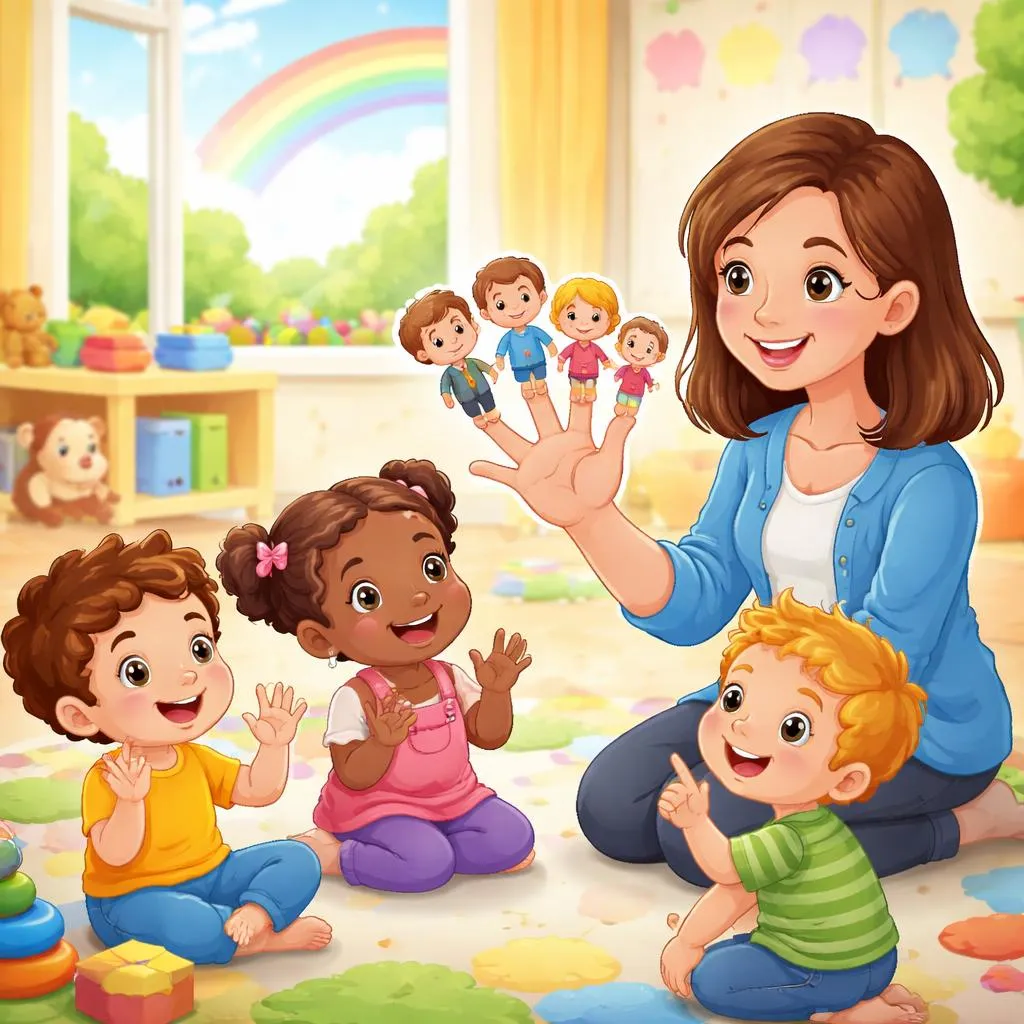

What Is the Rhyme Finger Family?
The rhyme finger family “ is a popular English nursery song. Many classrooms use this song to introduce family words and simple sentences. The melody feels playful and easy to remember. The actions with fingers make learning interactive and fun.
This rhyme connects music, movement, and language. That combination supports early communication and confidence.
The Lyrics of Finger Family
Here is a common version of the Finger Family song.
Daddy finger, daddy finger, where are you? Here I am, here I am. How do you do?
Mommy finger, mommy finger, where are you? Here I am, here I am. How do you do?
Brother finger, brother finger, where are you? Here I am, here I am. How do you do?
Sister finger, sister finger, where are you? Here I am, here I am. How do you do?
Baby finger, baby finger, where are you? Here I am, here I am. How do you do?
This version uses repetition and rhythm. The pattern helps with memory and pronunciation.
Vocabulary Learning with Finger Family “
This rhyme introduces basic family words. Daddy, mommy, brother, sister, and baby appear in every verse. The word “finger” names a body part. The phrase “Where are you?” introduces simple questions. The phrase “Here I am” models polite answers.
Family vocabulary connects with daily life. These words appear in conversations, stories, and school activities.
Meaning and Explanation of the Rhyme
Finger Family describes each finger as a family member. Each finger answers when called. This idea turns the hand into a small family story.
The song creates a playful scene. Each finger becomes a character. This storytelling element builds imagination and comprehension.
Phonics Points in Finger Family
Phonics practice appears naturally in the song. The sound /f/ appears in “finger” and “family.” The sound /m/ appears in “mommy.” The sound /b/ appears in “brother” and “baby.” The sound /s/ appears in “sister.” The sound /d/ appears in “daddy.”
Repeating these sounds improves pronunciation and phonemic awareness. Clapping syllables in “mo-mmy” or “ba-by” supports rhythm and syllable recognition.
Grammar Patterns in Finger Family “
This rhyme includes simple grammar structures. The question “Where are you?” introduces question form. The answer “Here I am” models first-person responses. The polite phrase “How do you do?” introduces greetings.
These patterns appear in early dialogues and textbooks. Practicing through singing supports natural language acquisition.
Daily Life Connections with Family Vocabulary
Family words connect with home life and relationships. Daddy and mommy connect with parents. Brother and sister connect with siblings. Baby connects with younger family members.
Teachers often use family photos or drawings to support understanding. This connection makes vocabulary meaningful and personal.
Printable Flashcards for Finger Family “
Flashcards can show each family member with a picture. Cards can include daddy, mommy, brother, sister, baby, and finger.
One side can show a picture. The other side can show the word and a simple sentence.
Flashcards support recognition, recall, and speaking practice.
Learning Activities Based on the Rhyme
Hand actions make the song engaging. Each finger can represent a family member.
Drawing activities can include a hand with labeled fingers. Students can color each finger and write the family word.
Storytelling activities can describe a finger family adventure. These activities integrate language and creativity.
Educational Games for Finger Family
A finger puppet game can use small paper puppets on fingers. Each puppet can speak a simple sentence.
A matching game can pair family words with pictures. A memory game can match word cards and picture cards.
These games reinforce vocabulary through repetition and play.
Classroom Lesson Structure with Finger Family
A lesson can begin with listening to the song. Next, introduce family words with pictures or gestures. Then sing with hand movements. Finish with a worksheet or drawing activity.
This structure supports comprehension, pronunciation, and engagement.
Using Music and Movement in Language Learning
Music supports memory and rhythm. Movement supports kinesthetic learning. Finger actions create a physical connection with words.
This approach benefits young learners and early language development.
Printable Materials for Teachers and Parents
Worksheets can include tracing family words. Coloring pages can show a hand with family labels. Fill-in-the-blank exercises can practice “Here I am.”
Printable mini-books can tell a simple finger family story.
Story Extensions with Finger Family
A story can describe each finger as a character. Daddy finger can go to work. Mommy finger can cook. Brother and sister fingers can play. Baby finger can sleep.
Stories provide context and repetition. They also encourage imagination and narrative skills.
Cross-Curricular Connections
Art lessons can include handprint crafts. Science lessons can explain body parts and senses. Social studies lessons can discuss family roles and relationships.
Integrating subjects deepens understanding and engagement.
Technology Integration for Finger Family Learning
Animated videos can show finger characters singing. Interactive apps can quiz family vocabulary. Digital flashcards can appear on tablets or smartboards.
Technology adds visual support and motivation.
Encouraging Creative Language Use
New verses can introduce new characters. Grandpa finger, grandma finger, or pet finger can join the song.
Creative verses encourage sentence building and imagination.
Family Learning at Home
Family members can sing the song together. Each person can assign a finger role.
Daily routines can include simple sentences like “Daddy finger is here.” This practice strengthens language exposure in natural settings.
Cultural Background of Finger Family
Finger Family has roots in English-speaking countries. It became popular through children’s videos and classroom activities.
The concept of using fingers as characters appears in many cultures. This shows the universal nature of music and movement in learning.
Language Skills Developed Through Finger Family
Listening skills improve through repeated singing. Speaking skills improve through choral responses. Reading skills develop when lyrics appear in print. Writing skills develop through labeling and short sentences.
This rhyme supports balanced language development.
Phonemic Awareness and Early Literacy
Repetition of sounds supports phonemic awareness. Recognizing rhymes and rhythm supports reading readiness. Finger movements support memory and word recognition.
These skills form the foundation of literacy.
Building Confidence Through Singing and Role-Play
Singing reduces anxiety in speaking. Role-play encourages expressive language. Short repetitive lines create quick success and motivation.
Confidence grows with each repetition and interaction.
Adapting Finger Family for Different Levels
Beginners can focus on singing and gestures. Intermediate learners can practice sentences and questions. Advanced learners can write stories about the finger family.
The rhyme adapts easily to different proficiency levels.
Structured Classroom Activities
A finger family chart can display each finger and word. A role-play corner can include finger puppets and props. Group singing builds teamwork and social skills.
These activities create an immersive and supportive environment.
Using Finger Family in Real Communication
Family words appear in greetings, introductions, and conversations. Understanding these words supports social interaction.
Examples include “This is my brother” or “My mommy is here.” These sentences build practical communication skills.
Long-Term Benefits of Learning with Finger Family
Early exposure to family vocabulary supports emotional and social development. Music and movement improve memory and coordination. Language patterns learned through songs support future grammar learning.
The rhyme finger family “ opens a joyful path to English vocabulary, phonics, and communication. Songs, stories, crafts, and games transform simple finger movements into meaningful language learning moments.