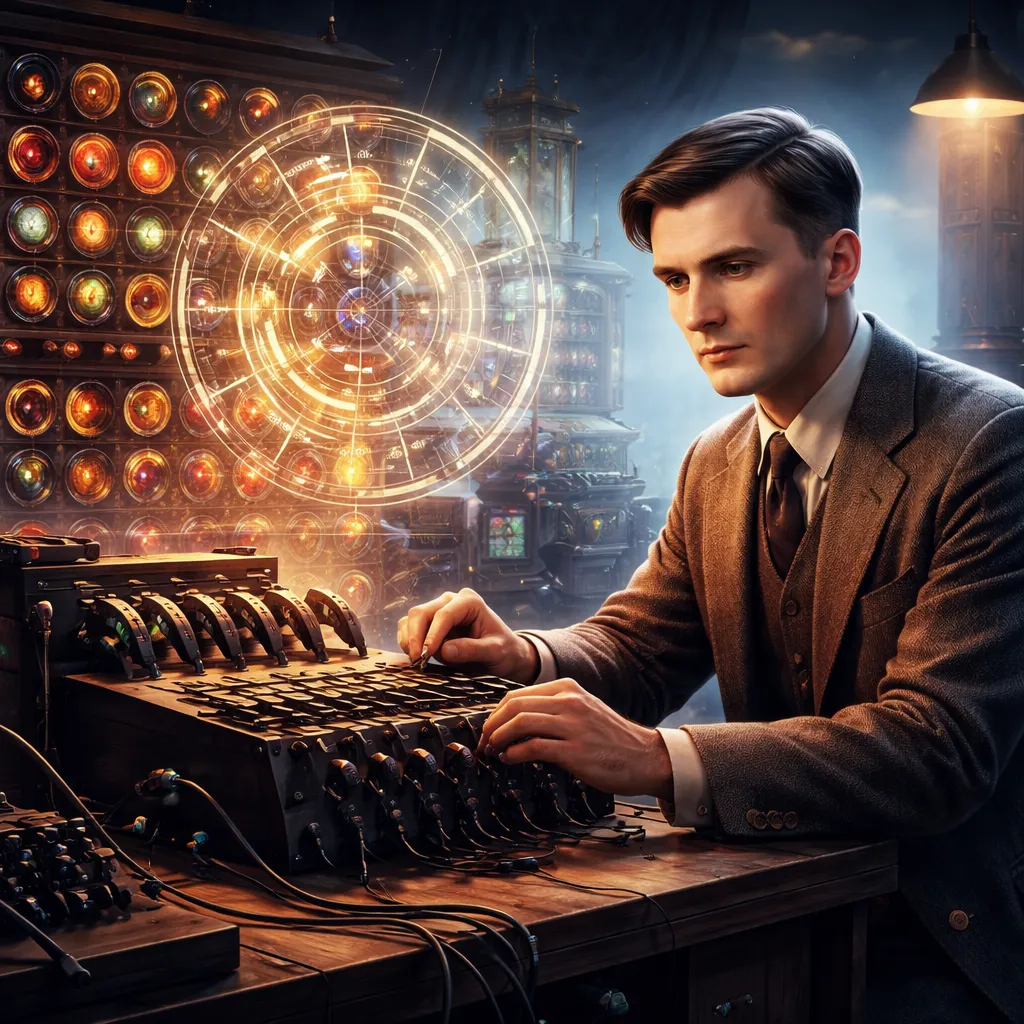

Introduction to Alan Turing
Alan Turing was a British mathematician, logician, and computer scientist. He helped crack the German Enigma code during World War Two. This celebrity story: Alan Turing shows that a quiet mind can defeat a powerful enemy. Turing did not fight with guns or tanks. He fought with mathematics and machines. Children can learn that being different can be a superpower. Parents can use his story to teach logic, persistence, and fairness. Turing created the idea of a universal machine. That idea became every computer, tablet, and smartphone. His work shortened the war by years and saved millions of lives. His life proves that one person's thinking can change the course of history.
Early Life and Background
Alan Mathison Turing was born on June 23, 1912, in London, England. His father, Julius Turing, worked for the Indian Civil Service. His mother, Ethel Turing, came from a family of engineers. Alan and his older brother, John, often stayed with family friends in England while their parents worked in India. Young Alan showed signs of genius very early. He taught himself to read in three weeks. He learned numbers by looking at street signs. He asked where numbers came from. At age six, his teacher said he was a genius. But he was also messy and disorganized. He could not write neatly. Other children bullied him. He found comfort in science and nature. He loved chemistry and performed experiments at home. He also loved running. He would run the five miles to school instead of taking the bus. At Sherborne School, his headmaster wrote, "If he is to be a scientific specialist, he is wasting his time at a public school." Alan did not care. He continued his own studies. He read Einstein's books at age 16. He understood them. He won a scholarship to King's College, Cambridge, in 1931.
Career Highlights and Achievements
At Cambridge, Alan Turing studied mathematics. He graduated with first-class honors in 1934. He won a fellowship to King's College. In 1936, he published a paper called "On Computable Numbers." This paper introduced the idea of a Turing machine. A simple, imaginary device that could perform any calculation. This idea became the foundation of computer science. Every modern computer is a Turing machine. In 1938, Turing went to Princeton University in America. He studied with the famous mathematician Alonzo Church. He returned to England in 1939. World War Two had begun. Turing went to work at Bletchley Park, Britain's secret code-breaking center. The Germans used a machine called Enigma to encrypt messages. Enigma had 159 million million million possible settings. Turing designed a machine called the Bombe. The Bombe could test possible Enigma settings quickly. By 1941, Turing's machines were breaking German naval codes. This helped Britain defeat German U-boats in the Atlantic. Winston Churchill said Turing made the single biggest contribution to Allied victory.
Famous Works or Performances
Alan Turing's most famous work is the Bombe machine. The Bombe looked like a row of metal cabinets. Inside, spinning drums simulated the Enigma rotors. Each Bombe weighed one ton. Bletchley Park had over 200 Bombes running constantly. They broke over 3,000 German messages every day. Another famous work is the Turing machine concept. This is not a physical machine. It is a mathematical idea. A Turing machine reads and writes symbols on a tape. It follows simple rules. Turing proved that a machine could solve any problem that a human could solve, given enough time and memory. That idea made digital computers possible. Turing also worked on the Delilah, a portable speech encryption system. He built it in 1943. It could encrypt a telephone conversation in real time. After the war, Turing designed the Automatic Computing Engine, or ACE. The ACE was one of the first designs for a stored-program computer. He also wrote the first programming manual. He created a chess-playing program in 1947. He had no computer to run it. He simulated the program by hand on paper.
Personal Life and Fun Facts
Alan Turing had many interesting personal habits. He was a world-class runner. He almost made the British Olympic team in 1948. His best marathon time was 2 hours and 46 minutes. That was only 11 minutes slower than the Olympic gold medal winner. A fun fact is that Turing chained his tea mug to the radiator at Bletchley Park. He did not want anyone else to use it. Another fun fact is that he cycled to work wearing a gas mask during hay fever season. He did not want pollen to slow his thinking. Turing was an atheist. He believed science explained the world. He was also shy and awkward in social situations. He preferred to work alone. But he made close friends. He proposed marriage to Joan Clarke, a fellow code-breaker. He told her he had feelings for men. She said she did not mind. They became engaged but never married. Turing loved fairy tales. He especially loved "Snow White." He would quote the evil queen's line, "Dip the apple in the brew." In 1952, Turing was arrested for being gay. That was a crime in England at that time. He accepted chemical treatment instead of prison. He died on June 7, 1954, at age 41. Many believe he took his own life.
Legacy and Influence
Alan Turing changed the world in three major ways. First, his Turing machine concept created computer science. Every laptop, phone, and game console works on Turing's principles. Second, his code-breaking work at Bletchley Park saved millions of lives. Historians say his work shortened the war by two to four years. Third, his test for artificial intelligence, the Turing Test, still challenges scientists. The Turing Test asks: Can a machine fool a human into thinking it is human? Turing's legacy grew after his death. For many years, his wartime work remained secret. The public knew almost nothing about him. In 2009, British Prime Minister Gordon Brown apologized for Turing's treatment. In 2013, Queen Elizabeth II granted Turing a royal pardon. The Bank of England put Turing's portrait on the £50 note in 2021. The note shows Turing, a Bombe machine, and his famous quote. The Alan Turing Institute in London researches data science and artificial intelligence. The Turing Award is the highest honor in computer science, like the Nobel Prize. Schools, buildings, and statues bear his name. His legacy proves that being different does not mean being less. It often means being more.
Quotes or Famous Sayings
Alan Turing left behind several powerful words. One famous quote is, "We can only see a short distance ahead, but we can see plenty there that needs to be done." Another wise saying is, "Those who can imagine anything, can create the impossible." He also said, "Science is a differential equation. Mathematics is a way of thinking about the world." Children might like this one: "Sometimes it is the people no one can imagine anything of who do the things no one can imagine." Families can read these quotes together. Ask children, "Who is someone that people might not imagine doing great things?" Turing was not a popular child. Teachers did not believe in him. He changed the world anyway. Parents can help children see that being messy, different, or quiet does not mean being weak. Turing's quotes remind us that imagination is the engine of discovery. Write a Turing quote on a card. Put it on the refrigerator. Read it when a problem feels too hard.
How to Learn from Alan Turing
Children can learn several lessons from Alan Turing. First, follow your curiosity. Turing learned to read alone. He studied Einstein as a teenager. He did not wait for a teacher. Second, use your difference as strength. Turing was bullied and misunderstood. He turned his solitude into focus. Third, fight with your mind. He did not win the war with strength. He won with logic and patience. Parents can encourage young children to solve puzzles. Crosswords, mazes, and logic puzzles build the same muscles Turing used. Older children can learn the basics of cryptography. Send secret messages using a simple Caesar cipher. Shift each letter by three places. A becomes D. B becomes E. Families can also visit a science museum with a computing exhibit. Look for early computers. Learn about binary code. Another activity is to run a Turing test at home. One person pretends to be a computer. Another person asks questions. Can the "computer" fool the questioner? Alan Turing showed that one person's mind can break unbreakable codes. He showed that kindness and justice matter as much as intelligence. He was not honored in his lifetime. We honor him now. Every child has a little Turing inside them. A mind that asks why. A heart that feels different. A spark that can light the world. Do not hide it. Use it. The world needs more people who think differently.