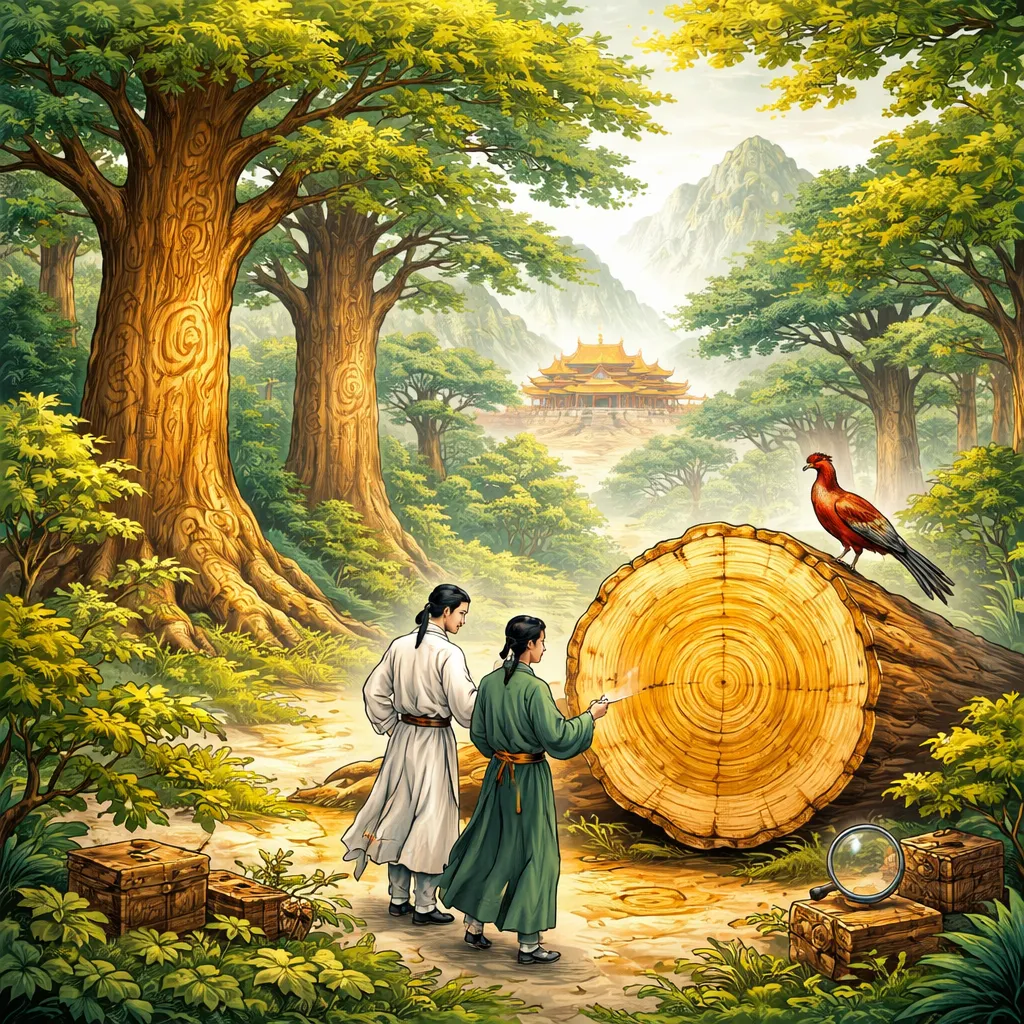

Imagine walking into a very, very old palace, a place where emperors and empresses once lived. Look up at the enormous, dark wooden pillars holding up the roof. Touch the smooth, cool wood of a table that is hundreds of years old. It doesn’t creak. It doesn’t have a single termite hole. It has a gentle, calming scent, like an ancient forest. This super-strong, beautiful, and fragrant wood comes from a very special and rare tree. This tree is a living treasure, and its name is Nanmu. Let’s go on a journey to learn about the magnificent Nanmu plant.
Let’s Learn the Word! – Open the Treasure Box of Language
Formal Name and Pronunciation
This treasure tree is called Nanmu. Its scientific name is Phoebe zhennan. You can say it like this: /ˈnɑːn ˈmuː/ (NAHN-moo). The first part, “Nan,” rhymes with “fawn,” and the second part, “mu,” sounds like the “moo” a cow makes. Nan-mu. Say it slowly: Nanmu. It’s a simple, strong, and ancient-sounding word.
The Etymology Tale
The name comes straight from China, where this tree has been loved for thousands of years. In Chinese, “Nan” (楠) is the name for this type of tree, and “mu” (木) means “wood” or “tree.” So, Nanmu simply means “the Nan tree” or “the wood of Nan.” Its name is a direct link to its homeland and its most famous gift—its incredible wood.
Nicknames and Friendly Aliases
The Nanmu has noble and descriptive names. It is often called the Zhennan tree, which is part of its scientific name and means “true Nan.” Because of its golden-yellow heartwood and its use for royalty, it is called the Golden Nanmu or the Imperial Timber Tree. Some people also call it the Chinese Phoebe, linking it to its scientific group.
Building Your Word Web: Core Parts
Let’s learn the words for a Nanmu’s noble body. The Leaf is oval, pointed, leathery, and dark green. It is an evergreen leaf, meaning it stays on the tree all year. The Bark is gray-brown and becomes rough and fissured as the tree ages. The Wood is the most famous part. The heartwood is the hard, inner wood that is a beautiful golden-brown color and has a mild, pleasant fragrance. The Sapwood is the pale, outer wood. The Trunk grows very straight and tall, perfect for making pillars. A Sapling is a young Nanmu tree, which will grow for decades before it is ready to be timber.
Action and State Words
Nanmu trees are models of steady growth. They grow slowly and steadily for hundreds of years. The wood resists decay, insects, and moisture amazingly well. The tree provides a precious resource. A Nanmu forest creates a quiet, shady, and fragrant environment. The tree is rare, valuable, durable, and majestic.
Ecosystem Friends Vocabulary
In its native mountain forests, the Nanmu is part of a rich community. Its dense, evergreen canopy provides shelter for birds and small mammals. The forest floor, covered with its fallen leaves, is home to insects and fungi. It is a keystone species in its ecosystem, meaning many other plants and animals depend on the healthy forest it helps create. Protecting Nanmu helps protect all its forest friends.
Cultural Imprint in Language
The Nanmu tree is deeply woven into Chinese culture and language. There is an old saying: “A thousand-year cedar, a ten-thousand-year Nanmu.” This means that while a cedar tree is long-lasting, Nanmu wood is even more enduring, symbolizing things that last forever. Ancient poets often wrote about the noble character of the Nanmu, comparing its straight trunk and unchanging evergreen leaves to a virtuous person who stands firm and true.
Ready for Discovery
We know its imperial and enduring name. Are you ready to uncover the secrets of this “wood of ten thousand years”? Let’s put on our detective hats and discover the Nanmu plant’s hidden world.
Discover the Plant’s Secrets! – A Nature Detective’s Notebook
The Plant Passport
The Nanmu belongs to the Laurel family, Lauraceae, the same family as the camphor tree and the avocado! Its scientific group is Phoebe. It is a giant evergreen tree that grows straight towards the sky, like a great green pillar. Its leaves are glossy, tough, and dark green. Its flowers are small and not very showy. Its fruit is a small, berry-like drupe. It grows extremely slowly, taking many, many decades to become a large tree. It is an evergreen, keeping the forest green all year round.
Survival Smarts
The Nanmu’s superpower is in its chemistry. Its wood contains special oils and compounds that make it naturally resistant to rot, fungus, and wood-boring insects like termites. This is why it can last for a thousand years without decaying! It is also very dense and hard. Another trick is its slow growth. By growing slowly, the tree makes its wood very dense and strong, building its defenses grain by grain over a long, long time.
Its Role and Gifts
In its ecosystem, the tall Nanmu is a forest giant. Its broad, evergreen canopy creates a special microclimate underneath—cool, moist, and shaded. This allows many shade-loving plants, like ferns and mosses, to grow. Its leaves eventually fall and create rich soil. Its most famous gift to people is its unparalleled wood. For centuries, it was the preferred wood for building the most important structures—imperial palaces, temples, and ancestral halls—because of its strength, beauty, and durability.
Human History and Cultural Symbol
For over two thousand years, Nanmu has been the “Imperial Wood” of China. It was so prized that its use was often restricted to the emperor and the most important buildings. The great halls of the Forbidden City in Beijing were built with giant Nanmu columns. It symbolizes nobility, longevity, resilience, and high status. Its fine, fragrant wood was also used to make the most exquisite furniture, altars, and coffins, meant to last for generations.
Fun “Wow!” Facts
Get ready for an ancient fact! Some of the Nanmu wood used in the Forbidden City is over 600 years old and still stands strong today, having survived earthquakes, fires, and weather! And here’s a rarity fact: because it grows so slowly and was used so much, old-growth Nanmu trees are now very rare and protected. It can take a tree 80 to 120 years just to reach a useful size for timber!
From Imperial Past to Hopeful Future
The story of the Nanmu plant is one of great value and great challenge. Would you like to be part of protecting and understanding this living heritage? While we cannot grow a giant at home, we can learn how to help it. Let’s explore.
Let’s Grow It Together! – A Little Guardian’s Action Guide
Good for Home Growing?
Growing a Nanmu tree at home is not practical. It is a forest giant that needs a specific mountain habitat, decades to grow, and a lot of space. It is a tree for large-scale forest conservation projects, not for a garden or a pot. However, we can learn about it and support its protection. The best “growing” we can do is growing our knowledge and helping to protect the forests where it lives.
Little Gardener’s Toolkit for Knowledge
Instead of a physical toolkit, let’s build a toolkit of understanding! You will need curiosity to ask questions. You will need research skills to look up information about rare trees. You will need awareness to understand why some plants need protection. You will need advocacy to tell others about conservation.
Step-by-Step Conservation Guide
Planting the Seed of Knowledge
The first step is to learn. Research and find out: Where do Nanmu trees grow today? Are there any protected forests or botanical gardens that have one? Learn about the threats it faces, like habitat loss. Understanding is the first step to helping.
Care Calendar for Conservation
Caring for a species means supporting its home all year. You can “water” your knowledge by reading about it each season. You can provide “sunshine” by sharing what you learn with friends and family. You can “fertilize” the cause by supporting (with an adult’s help) organizations that plant trees or protect forests in China.
Watch and Be a Friend from Afar
You may not have a Nanmu in your backyard, but you can be a long-distance friend. Follow the work of conservation groups online. Draw a picture of what you imagine a Nanmu forest looks like. Write a letter to a local botanical garden to ask if they have any trees in the Phoebe family.
Problem Diagnosis: The Challenge of Rarity
The main “problem” for the Nanmu is that it became too popular and is now rare. The “remedy” is protection, conservation, and growing new trees in the right places. This is a job for scientists, foresters, and governments, but we can cheer them on and make responsible choices about wood products.
Your Rewards and Gifts
Your gift is becoming a knowledgeable guardian of our planet’s heritage. Learning about rare trees like the Nanmu teaches you about patience (on a scale of centuries!), the impact of human choices, and the importance of conservation. You learn that being a guardian of nature sometimes means protecting things from far away.
Creative Extensions
Start a Heritage Tree Scrapbook. Collect pictures and facts about rare and famous trees from around the world, including the Nanmu. Design a “Save the Nanmu” awareness poster. Write a short story about a seed from an ancient Nanmu tree that grows into a new forest giant. Build a small model of a palace pillar from clay, imagining it is made of golden Nanmu wood.
Growing a Future of Stewardship
By learning about and advocating for the Nanmu, you are not planting a single tree. You are planting the idea of conservation. You are helping to ensure that such magnificent species have a future. You are a steward of history and nature.
Conclusion and Forever Curiosity
What a profound journey through culture and conservation! You started by learning the word “Nanmu,” you discovered its secrets as the enduring, golden timber of emperors, and you learned how to be a long-distance guardian for rare and precious species. You now know the Nanmu is not just a tree; it is a symbol of endurance, a masterpiece of natural engineering, a chapter in human history, and a call for protection. Remember, its story teaches us about the value of slow growth and the importance of preserving natural treasures. Your curiosity is the first step in a lifetime of caring for our world. Keep wondering about the stories behind the oldest things you see—a piece of wood, a building, a forest. Your adventure to learn about the Nanmu plant shows us that the most valuable lessons are about patience, respect, and our role in protecting the wonders of the natural world for the next ten thousand years.