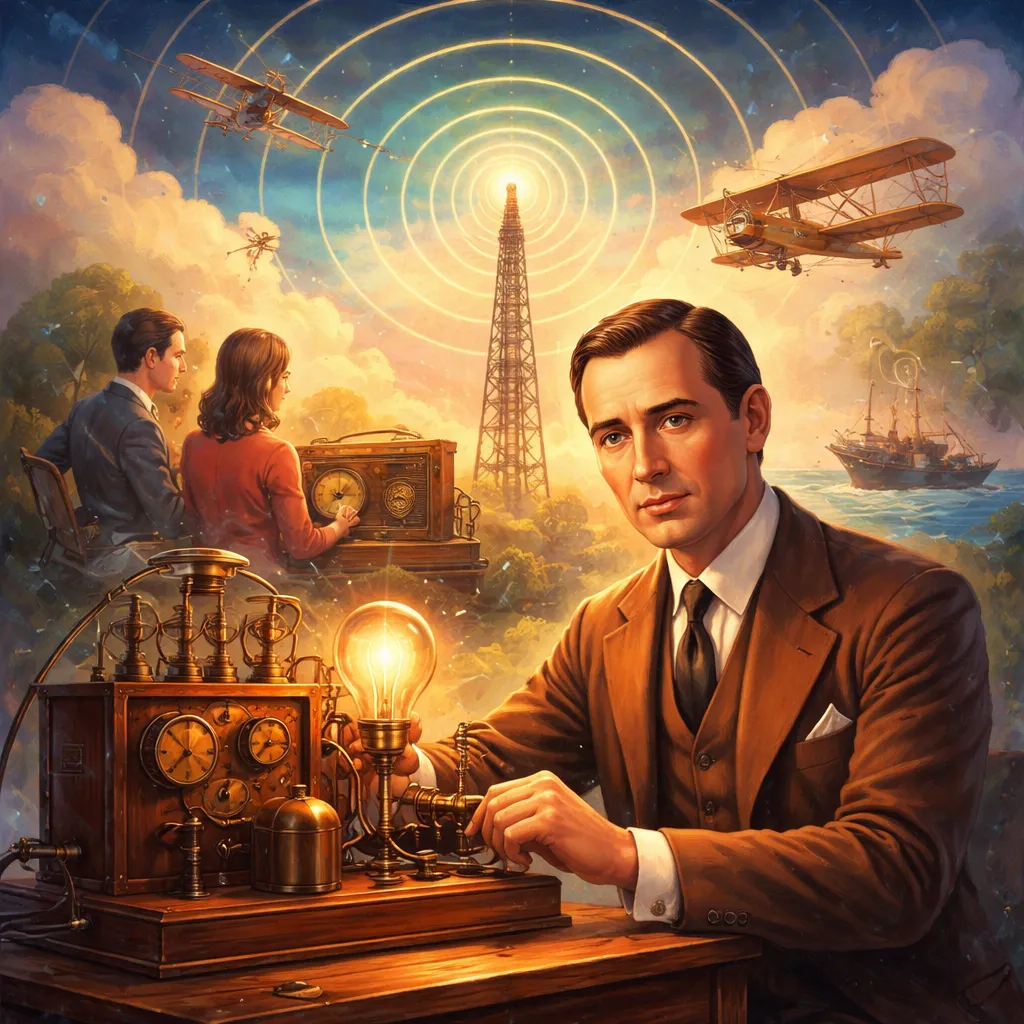

Introduction to Guglielmo Marconi
Guglielmo Marconi was an Italian inventor and electrical engineer. He created the first practical radio telegraph system. This celebrity story: Guglielmo Marconi shows how one person can send messages through thin air. Before Marconi, people used wires for communication. After Marconi, voices and signals crossed oceans without any cables. Children can learn that invisible things like sound waves can change the world. Parents can use his story to teach curiosity and patience. Marconi faced many doubters. Scientists said radio waves could not travel far. Marconi proved them wrong. His life proves that young people with big ideas can move humanity forward.
Early Life and Background
Guglielmo Marconi was born on April 25, 1874, in Bologna, Italy. His father, Giuseppe Marconi, was a wealthy landowner. His mother, Annie Jameson, was from Ireland. She was the granddaughter of the founder of the Jameson whiskey distillery. Marconi had one older brother, Alfonso. The family lived on a large estate called Villa Griffone. Young Marconi loved science and machines. He did not do well in regular school. He preferred reading books about physics and electricity on his own. His mother hired private tutors for him. One tutor, Professor Vincenzo Rosa, taught Marconi at home. Rosa let Marconi run experiments in his attic. Marconi became fascinated with the work of Heinrich Hertz. Hertz had proved that invisible electromagnetic waves existed. Marconi wondered if these waves could carry messages. He started experimenting in his attic at age 20. He used a spark transmitter and a simple receiver. His mother let him turn the villa's attic into a laboratory. She also gave him money for equipment. Marconi worked late into the night. Servants thought he was strange. But he did not care.
Career Highlights and Achievements
Marconi achieved his first breakthrough in 1895. He sent a radio signal over a distance of 1.5 miles at his family estate. He rang a bell on the other side of a hill using only radio waves. The Italian government showed little interest. Marconi's mother wrote to relatives in England. In 1896, Marconi moved to London with his mother. He brought his equipment in a wooden box. The British Post Office gave him support. In 1897, he sent signals over 12 miles across the Salisbury Plain. He formed the Wireless Telegraph and Signal Company. In 1899, he sent signals across the English Channel to France. That was 31 miles. People still doubted that waves could cross an ocean. On December 12, 1901, Marconi proved them wrong. He stood on Signal Hill in St. John's, Newfoundland, Canada. He listened for a signal sent from Poldhu, Cornwall, England. The distance was 2,100 miles. The signal was the letter "S" in Morse code. Three little dots. Marconi heard them. The world changed forever. He shared the 1909 Nobel Prize in Physics with Karl Ferdinand Braun.
Famous Works or Performances
Marconi's most famous work is the radio telegraph system. But his inventions took many forms. The magnetic detector, invented in 1902, could pick up very weak signals. This device saved ships at sea. The horizontal directional aerial, invented in 1905, sent signals farther with less power. Marconi also developed the spark-gap transmitter. This device created radio waves by making sparks jump across a gap. The sound was loud and crackly. But the message got through. In 1907, Marconi opened the first commercial transatlantic radio service. Passengers on ships could send and receive messages. Newspapers used his system to report news faster. In 1918, Marconi sent a radio signal from England to Australia. That was 11,000 miles. In 1920, radio broadcasts for entertainment began using Marconi's patents. The first public radio station, 2LO in London, used Marconi equipment. His company also developed shortwave radio in the 1920s. Shortwave could travel around the world using less power. All modern radio, television, and mobile phone networks trace back to Marconi's early work.
Personal Life and Fun Facts
Marconi had many interesting personal traits. He was very shy and hated public speaking. But he loved sailing and owned several yachts. He used his yachts as floating laboratories. A fun fact is that Marconi believed in unexplained phenomena. He experimented with detecting radio waves from outer space. Some historians think he accidentally detected cosmic radio noise in the 1920s. Another fun fact is that Marconi survived a serious car accident in 1912. He broke his leg and hurt his eye. He still traveled to give a speech two weeks later. Marconi married Beatrice O'Brien, an Irish woman, in 1905. They had three daughters. He later divorced and married Maria Bezzi-Scali, an Italian countess. They had one daughter. Marconi loved hunting and fishing. He owned large estates in Italy and Ireland. He also enjoyed playing the piano. He played classical music to relax after long experiments. Marconi refused to learn to drive. He preferred to be driven so he could think. He also loved animals. He kept dogs, horses, and even a pet eagle at his villa.
Legacy and Influence
Guglielmo Marconi changed how the world communicates. Before him, ships at sea had no contact with land. After him, distress signals saved thousands of lives. The most famous example is the Titanic disaster in 1912. Radio operators on the Titanic sent Marconi equipment distress signals. The Carpathia received the signals and rescued 705 people. Marconi testified about radio safety to the US Senate after the disaster. His company continued to lead wireless technology. Marconi's inventions led to radio broadcasting, television, radar, and mobile phones. Every Wi-Fi signal and Bluetooth connection uses the same basic physics. The term "radio" comes from the Latin word "radius," meaning ray. Marconi popularized this word. The International Marconi Day happens every April. Radio amateurs around the world send signals to celebrate. The Marconi Society gives awards to young scientists. The Italian navy named a ship after him. Many schools and streets bear his name. Marconi's original villa in Italy is now a museum. Visitors can see his attic laboratory and original equipment. His legacy proves that a curious person with a simple spark can light up the world.
Quotes or Famous Sayings
Guglielmo Marconi left several memorable words. One famous quote is, "Thanks to the progress of radio, man is no longer isolated as he once was." Another wise saying is, "The human voice can now be sent around the world without wires." He also said, "I have not failed. I have just found 10,000 ways that won't work." Children might like this one: "The more I work with wireless, the more I realize how much we do not know." Families can read these quotes together. Ask children, "What do you think Marconi meant about not knowing?" Marconi also said, "Every day sees humanity more victorious in the struggle with space and time." Parents can help children see how radio waves still help us today. Weather forecasts, GPS, and emergency alerts all use radio. Marconi's words remind us that curiosity never ends. There is always more to discover.
How to Learn from Guglielmo Marconi
Children can learn three big lessons from Marconi. First, ignore the doubters. Teachers and scientists told Marconi radio waves could not cross a hill. He kept working. Second, use what you have. He started with a small attic and his mother's support. He did not wait for a perfect lab. Third, think big. Most people wanted to send signals a few miles. Marconi dreamed of crossing oceans. Parents can encourage young children to build simple crystal radio kits. These kits need no batteries. They use only the power of radio waves. Older children can learn Morse code. Send secret messages by flashlight or tapping on a table. Families can also visit a science museum with a radio exhibit. Look for spark-gap transmitters and early radios. Another idea is to listen to an AM or shortwave radio at night. See how many different countries you can hear. Marconi proved that invisible waves connect everyone. Children can learn that big ideas start small. An attic, a bell, and a spark. That is all it took to begin. Every child has a spark inside them. They just need to let it shine.