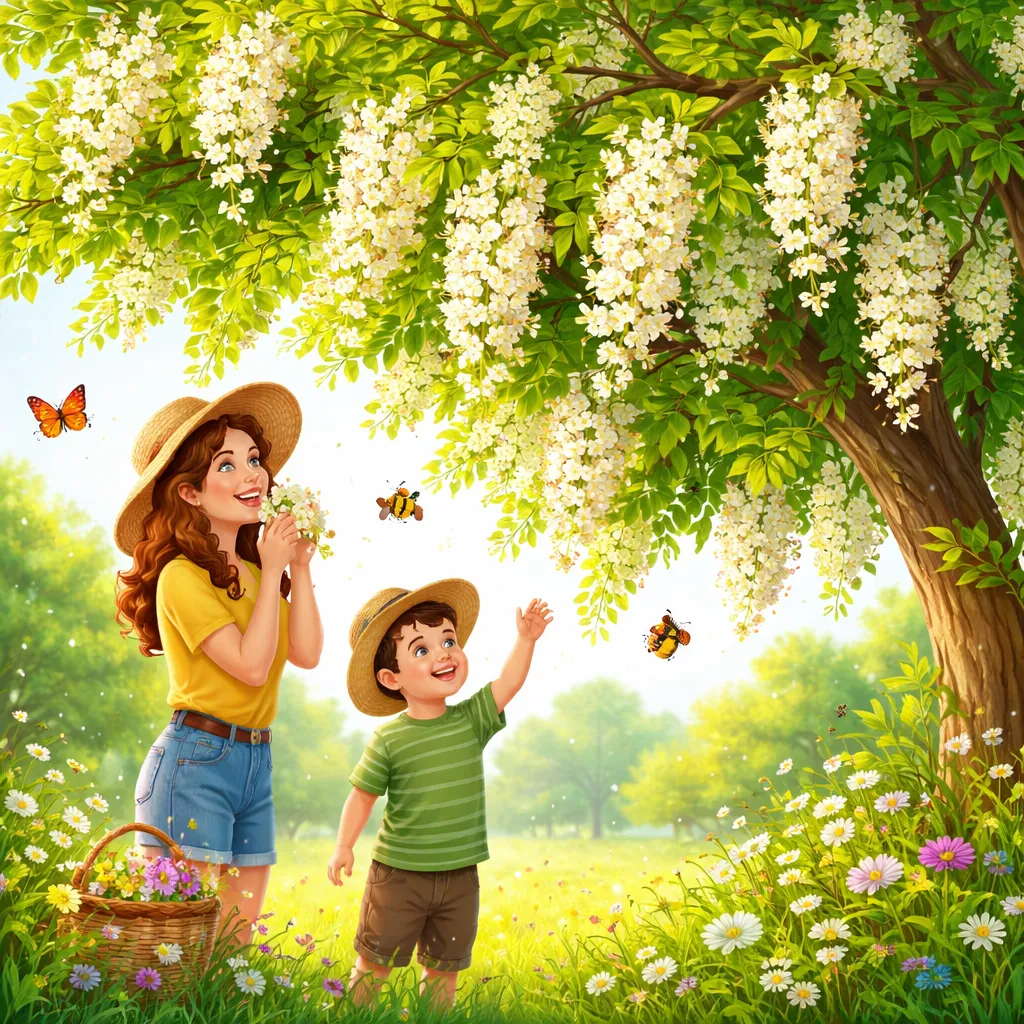

Have you ever walked outside in late spring or early summer and smelled a perfume so sweet it made you think of a candy store? The smell comes from long, white, drooping flower clusters hanging from a tree. Later, that same tree grows long, twisty, brown seed pods that rattle in the wind. This tough, fast-growing tree is a survivor. It can grow in poor soil and its wood is so strong, it was once used to build ships and fences that last a lifetime. Let’s meet the sweet-smelling, super-strong Locust Tree plant.
Let’s Learn the Word! – Open the Treasure Box of Language
Formal Name and Pronunciation This tough survivor is called a Locust tree. You can say it like this: /ˈloʊ.kəst/ (LOH-kuhst). The first part sounds like “low,” and the second part is “kuhst.” Locust. It’s a strong, crunchy-sounding word.
The Etymology Tale The name is a little mixed up! The word “locust” originally meant a type of grasshopper. When early European settlers came to America, they saw the seed pods of this tree. The pods reminded them of the long, curved body of a locust insect! So, they called the tree a “Locust tree,” even though it’s not related to insects at all. Its scientific name, Robinia, honors a royal French gardener named Jean Robin.
Nicknames and Friendly Aliases There are two main families, each with fun names. The one with dangerously big thorns and sweet flowers is the Honey Locust. The one with smaller thorns, white flowers, and very hard wood is the Black Locust or “False Acacia.” People also call them “Shipmast Locust” for their strong wood, or “Sweet Locust” for those lovely-smelling blooms.
Building Your Word Web: Core Parts Let’s learn the words for a Locust’s body. The Pod is the long, flat, brown seed case. It twists and rattles when dry. A Thorn is a sharp, woody spike on the branches and trunk, especially on Honey Locusts. They can be huge! A Leaflet is one small part of a bigger, compound leaf that looks like a delicate green feather. The Bark is deeply furrowed, with long, rough ridges. The Flower grows in long, hanging clusters called racemes that smell like sweet honey. The Trunk is often crooked and sturdy. A Sucker is a new tree that sprouts from the roots of a parent tree.
Action and State Words Locust trees are busy and tough. They fix nitrogen from the air into the soil, which helps other plants grow. They provide dense, dappled shade. They tolerate poor soil, pollution, and drought. The flowers bloom with a heavy, sweet fragrance. A locust tree is resilient, fast-growing, aromatic, and pioneering.
Ecosystem Friends Vocabulary The locust tree is a wildlife restaurant. Honeybees and bumblebees love the nectar-filled flowers. The leaves are food for the caterpillars of several butterflies and moths. Songbirds like goldfinches sometimes eat the seeds. The thorns provide protection for bird nests. Deer and other animals may nibble on the young shoots.
Cultural Imprint in Language There’s an old saying among carpenters: “As strong as locust.” It means something is incredibly tough and long-lasting, just like the wood from a Black Locust tree. The poet Vachel Lindsay wrote about “The flower of the locust, white as a cloud,” capturing the beautiful, cloud-like look of the blossoms in late spring. In some stories, its hard wood was said to be used for magical staffs because it was so durable.
Ready for Discovery We know its strong name and sweet smell. Are you ready to dig into the surprising secrets of this super-tree? Let’s play detective and uncover the story of the Locust Tree plant.
Discover the Plant’s Secrets! – A Nature Detective’s Notebook
The Plant Passport Locusts belong to the Pea family, Fabaceae. The two main groups are Robinia (Black Locust) and Gleditsia (Honey Locust). A locust tree has an open, irregular, kind of wild shape. Its leaves are compound, made of many small leaflets, giving light, feathery shade. In late spring, it is covered in drooping clusters of white, pealike flowers that smell amazing. The fruit is a flat, brown pod that hangs on the tree into winter. It grows very fast when young and can live a long time, becoming a rugged, beautiful giant.
Survival Smarts The locust tree is a soil superhero! Like other peas and beans, its roots have little nodules that host special bacteria. These bacteria “fix” nitrogen from the air, turning it into plant food. This fertilizes the soil for itself and nearby plants, letting it grow in poor ground. Those huge thorns on Honey Locusts are a defense from giant animals that don’t exist anymore, like mammoths! Today, they protect the tree from deer and other browsers.
Its Role and Gifts The locust is a great provider, especially for pollinators. Its flowers are a major nectar source for bees in early summer. Its leaves feed important caterpillars. As an environmental engineer, its nitrogen-fixing roots improve damaged soils, making them better for other plants. People often plant it to stop soil erosion on hillsides. Its dense wood burns very slowly and hot, making excellent firewood.
Human History and Cultural Symbol For Native Americans, the strong, rot-resistant wood was perfect for making bows and tool handles. Early American colonists and pioneers prized Black Locust wood for fence posts, ship pegs, and barn beams because it lasts for decades in the ground. It became a symbol of pioneer toughness and self-reliance. Today, we use its durable wood for outdoor decking and furniture. The sweet pulp inside Honey Locust pods is even edible for animals (and adventurous humans!).
Fun “Wow!” Facts Get ready for a sharp surprise! On some ancient Honey Locust trees, the thorns can grow over a foot long and are even branched, like tiny, terrifying trees growing on a big tree! And here’s a super-wood fact: Black Locust wood is so hard and rot-resistant that fence posts made from it over 100 years ago are still in the ground today, strong as ever. It’s one of the most durable woods in the world.
From Pioneer to Planter Learning about the Locust Tree plant shows us strength and sweetness can grow together. Would you like to grow a future giant? You can help a little locust start its life. Let’s see how.
Let’s Grow It Together! – A Little Guardian’s Action Guide
Good for Home Growing? Be very careful and choose the right type! Black Locust and Honey Locust trees grow very large, have aggressive roots, and (for Honey Locust) nasty thorns. They are not good for most home gardens. However, you can grow a thornless Honey Locust cultivar in a large garden with plenty of space. The best way to learn is to grow one from a seed in a large pot for a few years as a science project, knowing it will need a forever home in a park or farm later.
Little Gardener’s Toolkit You will need a few dry Locust tree pods collected in fall or winter. Get a medium-sized pot with drainage holes. Use regular potting soil. Have a small bowl of hot water, a watering can, and sandpaper ready. A clear plastic bag can help with germination.
Step-by-Step Growing Guide
Planting Your Tough Seed First, you must help the tough seed coat. Rub the hard seed gently with sandpaper or nick it with a file. Then, soak it in hot (not boiling) water for 24 hours. In early spring, plant the puffy seed about an inch deep in your pot. Water it well. You can cover the pot with a plastic bag to keep it humid until it sprouts.
Care Calendar Keep the soil moist but not wet. Once the seedling pops up, it will grow fast! It loves full, bright sunshine. As a seedling in a pot, you can give it a little liquid fertilizer every month during spring and summer. Do not over-water; let the top soil dry a bit between drinks.
Watch and Be Friends Watch for the first two leaves, which will look different from the adult leaves. Notice how fast it grows! See if the new leaves are the feathery, compound shape. Measure its height every two weeks—you’ll be amazed. Listen for the rattle of dry pods if you have one nearby.
Problem Diagnosis If the plant looks leggy and weak, it needs more direct sunlight. Move it to a sunnier spot. Locust trees are very tough and don’t get many pests. If leaves get small holes, it might be a caterpillar—observe it, as it might turn into a beautiful butterfly! This is the tree doing its job.
Your Rewards and Gifts Your gift is watching incredible resilience. You are growing a tree that can improve the earth. Caring for a locust teaches you about toughness, patience, and the amazing ways plants prepare for life (like that hard seed coat). You learn the value of strong, durable things in nature.
Creative Fun Start a Pioneer’s Logbook. Draw your fast-growing seedling. Make pod puppets by painting faces on the dry, twisty seed pods. Do a leaflet rubbing to see the delicate veins. Research how pioneers used locust wood and draw a picture of a fence or a ship made from it. Write a short pioneer diary entry about planting your tree.
Growing Strength By growing a locust, you are not just planting a tree. You are planting a lesson in natural strength, a gift to future pollinators, and a piece of living history. You are a grower of resilience.
Conclusion and Forever Curiosity What a journey of strength and sweetness! You started by learning the word “Locust,” you discovered its secrets as a nitrogen-fixing, thorn-defended pioneer, and you learned how to help a mighty little seed begin its life. You now know the Locust Tree is not just a sweet-smelling tree; it is a soil enricher, a symbol of toughness, a builder’s treasure, and a friend to bees. Remember, its gifts are strength that lasts and fragrance that fills the air. Your curiosity helps you see the superpowers in everyday plants. Keep sniffing the spring air for that sweet smell, looking for the twisty brown pods, and wondering about the quiet strength of trees. Your adventure to learn about the Locust Tree plant shows us that even plants with thorns have the sweetest gifts to give.