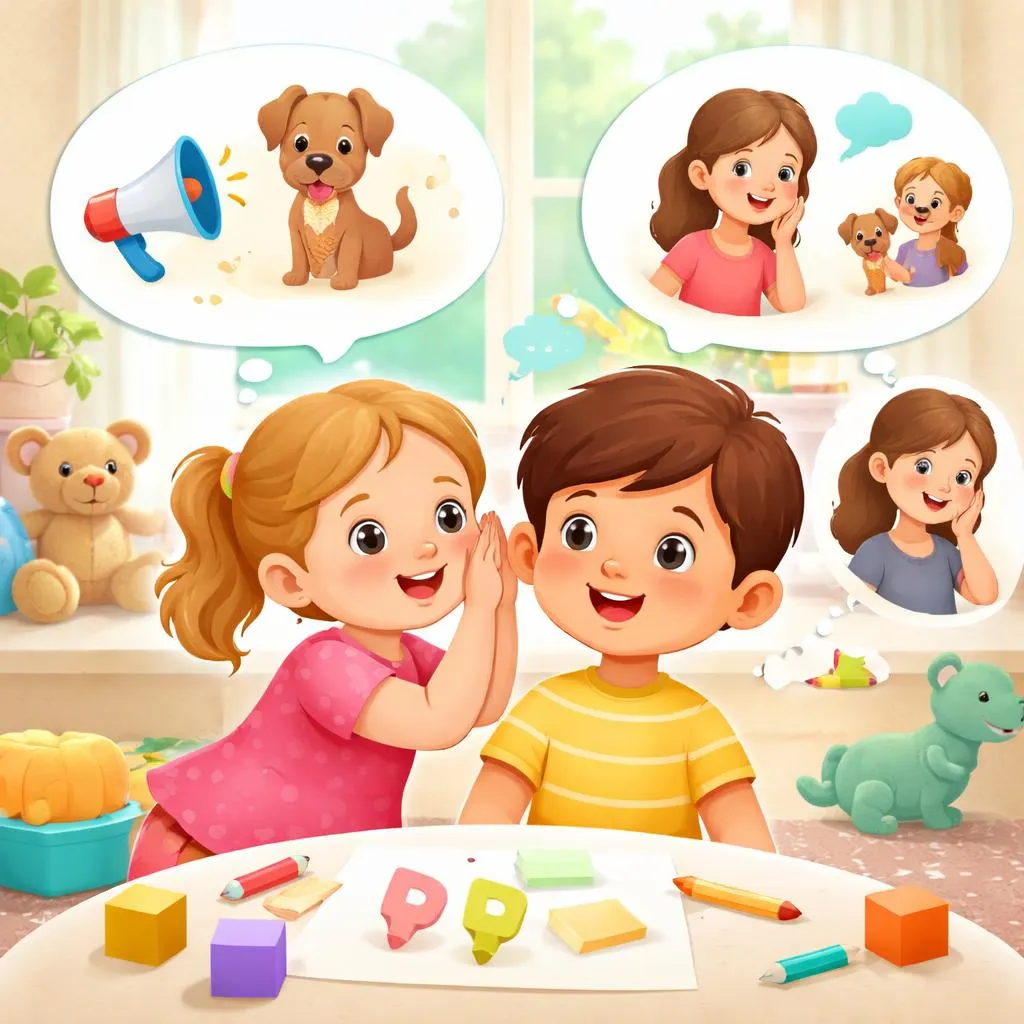

Direct and indirect speech are ways we report what someone has said. Direct speech uses the exact words someone spoke. Indirect speech tells the meaning without using the exact words. For a four-year-old, these concepts help them share stories and tell you what happened during their day. Instead of just saying "Mommy said yes," they can learn to say "Mommy said, 'Yes, you can have a cookie'" or "Mommy said that I could have a cookie." Learning the 50 most common direct and indirect speech examples for 4-year-olds gives children the tools to share conversations and tell better stories. These skills help them become better communicators and storytellers.
What Is Direct and Indirect Speech?
Direct speech repeats the exact words someone said. We use quotation marks around the words in writing. In speaking, we change our voice a little to show we are quoting someone. Direct speech is like being a reporter and telling people exactly what was said.
Direct speech: Daddy said, "Time to eat dinner."
Direct speech: Grandma asked, "Do you want a hug?"
Direct speech: My friend said, "Let's play outside."
Indirect speech reports what someone said without using their exact words. We do not use quotation marks. We often use the word that to connect the two parts. The verb tense sometimes changes. Indirect speech is like telling someone the meaning of what was said without repeating every word.
Indirect speech: Daddy said that it was time to eat dinner.
Indirect speech: Grandma asked if I wanted a hug.
Indirect speech: My friend said to play outside.
For a four-year-old, both forms are useful. Direct speech helps them act out stories and pretend play. Indirect speech helps them tell you about their day at school or what a friend told them.
When we talk about the 50 most common direct and indirect speech examples for 4-year-olds, we mean the everyday sentences children use to report what people say. These are the phrases that help them share conversations and tell stories.
Meaning and Explanation of Direct and Indirect Speech
Let us explore how direct and indirect speech work. The difference is simple once you understand the pattern.
Direct speech has two parts. The first part tells who is speaking. The second part gives the exact words. We put a comma after the speaking part and quotation marks around the exact words.
The boy said, "I am hungry."
Mommy asked, "Where is your shoe?"
The teacher said, "It is time to clean up."
When children use direct speech, they get to be the character. They can change their voice to sound like the person they are quoting. This makes storytelling more fun and expressive.
Indirect speech also has two parts, but we do not use the exact words. We change the words to fit into our sentence. We often use words like that, if, or to to connect the parts.
The boy said that he was hungry.
Mommy asked where my shoe was.
The teacher said to clean up.
Notice how the words change. In direct speech, the boy says "I am hungry." In indirect speech, he becomes "he was hungry." The pronoun changes from I to he. The verb changes from am to was. These changes happen naturally as children hear and use the language.
For young children, the most important thing is to understand the difference between telling someone's exact words and telling what they meant. They will learn the grammar rules gradually through practice.
Categories or Lists: Common Direct and Indirect Speech Examples
Here is a practical list of the 50 most common direct and indirect speech examples for 4-year-olds. These are the kinds of sentences children hear and use every day.
Statements
Direct: "I want milk," she said.
Indirect: She said that she wanted milk.
Direct: "I am tired," said the boy.
Indirect: The boy said that he was tired.
Direct: "This is fun," my friend said.
Indirect: My friend said that it was fun.
Direct: "I like cookies," said Anna.
Indirect: Anna said that she liked cookies.
Direct: "We are going to the park," Daddy said.
Indirect: Daddy said that we were going to the park.
Direct: "I can tie my shoes," he said.
Indirect: He said that he could tie his shoes.
Direct: "I will help you," said Mommy.
Indirect: Mommy said that she would help me.
Direct: "It is bedtime," Grandma said.
Indirect: Grandma said that it was bedtime.
Direct: "I have a new toy," said my friend.
Indirect: My friend said that he had a new toy.
Direct: "We saw a deer," they said.
Indirect: They said that they had seen a deer.
Questions
11. Direct: "Are you hungry?" asked Mommy.
Indirect: Mommy asked if I was hungry.
12. Direct: "Where is my bear?" the girl asked.
Indirect: The girl asked where her bear was.
13. Direct: "Do you want to play?" asked Tom.
Indirect: Tom asked if I wanted to play.
14. Direct: "Can I have a cookie?" she asked.
Indirect: She asked if she could have a cookie.
15. Direct: "Who is at the door?" asked Daddy.
Indirect: Daddy asked who was at the door.
16. Direct: "Is this your cup?" the teacher asked.
Indirect: The teacher asked if that was my cup.
17. Direct: "What time is it?" asked Grandma.
Indirect: Grandma asked what time it was.
18. Direct: "Are we there yet?" asked the boy.
Indirect: The boy asked if they were there yet.
19. Direct: "Why is the sky blue?" she asked.
Indirect: She asked why the sky was blue.
20. Direct: "Can you help me?" asked the baby.
Indirect: The baby asked if I could help her.
Commands and Requests
21. Direct: "Sit down," said the teacher.
Indirect: The teacher told us to sit down.
22. Direct: "Please share your toys," said Mommy.
Indirect: Mommy told me to share my toys.
23. Direct: "Come here," said Grandma.
Indirect: Grandma told me to come there.
24. Direct: "Don't run," said Daddy.
Indirect: Daddy told me not to run.
25. Direct: "Be careful," said my friend's mom.
Indirect: My friend's mom told me to be careful.
26. Direct: "Eat your vegetables," said Mommy.
Indirect: Mommy told me to eat my vegetables.
27. Direct: "Brush your teeth," said Daddy.
Indirect: Daddy told me to brush my teeth.
28. Direct: "Look at me," said the little girl.
Indirect: The little girl told me to look at her.
29. Direct: "Don't touch that," said the teacher.
Indirect: The teacher told us not to touch that.
30. Direct: "Wait for me," said my friend.
Indirect: My friend told me to wait for her.
More Common Examples
31. Direct: "I love you," said Mommy.
Indirect: Mommy said that she loved me.
32. Direct: "This is the best day," said the boy.
Indirect: The boy said that it was the best day.
33. Direct: "I saw a butterfly," said the girl.
Indirect: The girl said that she had seen a butterfly.
34. Direct: "We have a new puppy," said Tom.
Indirect: Tom said that they had a new puppy.
35. Direct: "I am four years old," said Anna.
Indirect: Anna said that she was four years old.
36. Direct: "This is my favorite book," she said.
Indirect: She said that it was her favorite book.
37. Direct: "I can jump high," said the boy.
Indirect: The boy said that he could jump high.
38. Direct: "We are going swimming," said Daddy.
Indirect: Daddy said that we were going swimming.
39. Direct: "I want the blue cup," said the girl.
Indirect: The girl said that she wanted the blue cup.
40. Direct: "This is too heavy," said Mommy.
Indirect: Mommy said that it was too heavy.
41. Direct: "I found my shoe," said the boy.
Indirect: The boy said that he had found his shoe.
42. Direct: "We are lost," said the children.
Indirect: The children said that they were lost.
43. Direct: "I am scared," whispered the girl.
Indirect: The girl whispered that she was scared.
44. Direct: "This is yummy," said the baby.
Indirect: The baby said that it was yummy.
45. Direct: "I want my blankie," cried the boy.
Indirect: The boy cried that he wanted his blankie.
46. Direct: "Look at the moon," said Grandma.
Indirect: Grandma told us to look at the moon.
47. Direct: "Don't forget your coat," said Mommy.
Indirect: Mommy told me not to forget my coat.
48. Direct: "Let's build a fort," said my friend.
Indirect: My friend suggested building a fort.
49. Direct: "I will be right back," said Daddy.
Indirect: Daddy said that he would be right back.
50. Direct: "Thank you," said the little girl.
Indirect: The little girl said thank you.
Daily Life Examples with Direct and Indirect Speech
The best way to teach direct and indirect speech is to use them naturally in your everyday conversations. Children learn these patterns by hearing them and by being encouraged to use them.
Talking about the day: When your child comes home from school or a playdate, you can ask questions that encourage them to report speech. "What did your teacher say?" "My teacher said, 'Good job everyone!' " "What did your friend ask you?" "She asked if I wanted to play with the dolls."
Sharing family news: When Daddy comes home from work, you can model reporting speech. "Daddy, guess what? Grandma called. She said that she is coming to visit next week." "She said, 'I can't wait to see you!' "
During pretend play: When children play pretend, they naturally use direct speech. "I am the mommy. I say, 'Time for bed, children.' " You can gently introduce indirect speech too. "The mommy said that it was time for bed."
Resolving conflicts: When children have disagreements, you can help them report what was said. "Tell your brother what you said." "I said, 'That's my toy!' " "And what did he say?" "He said that he wanted a turn."
Telling stories at dinner: Family meals are perfect for sharing stories. "Tell Grandma what happened at the park today." "A dog came! And the man said, 'Don't worry, he's friendly.' " This builds storytelling skills naturally.
Printable Flashcards for Direct and Indirect Speech
Flashcards can help children see the difference between direct and indirect speech. You can make them together, which makes the learning more meaningful.
To make the flashcards, you will need index cards or thick paper, markers, and maybe some stickers. Make pairs of cards that show the same message in direct and indirect speech.
On one card, write a direct speech example with quotation marks:
Daddy said, "Time for bed."
Mommy asked, "Are you hungry?"
The teacher said, "Line up please."
On the matching card, write the indirect speech version:
Daddy said that it was time for bed.
Mommy asked if I was hungry.
The teacher told us to line up.
Here are some fun ways to use your flashcards:
Matching game: Lay out all the cards face up and have your child match the direct speech card with its indirect speech partner. Talk about how they are different.
Memory game: Make two sets of the same cards and play memory match. When you find a match, read both cards and talk about the difference.
Sorting game: Have your child sort the cards into two piles. One pile for direct speech and one pile for indirect speech. This helps them recognize the pattern.
Act it out: Pick a direct speech card and act out the scene. Use your voice to show who is speaking. Then say the indirect speech version to report what happened.
Learning Activities or Games
Games make learning direct and indirect speech fun and natural. Here are some games you can play with your child to practice these important language skills.
The Telephone Game: This classic game is perfect for teaching reported speech. Whisper a message to your child using direct speech. "Grandma said, 'I love pancakes.' " Have your child whisper it to another person or a stuffed animal. The last person says what they heard. Then compare how the message changed. This shows why we need to report carefully.
The Puppet Show Game: Use puppets or stuffed animals to act out conversations. Have one puppet say something directly to another puppet. Then have your child report what was said. "What did the bear say to the rabbit?" "The bear said, 'Let's be friends.' " Then you can ask, "Can you tell me in another way?" "The bear said that they should be friends."
The Reporter Game: Pretend your child is a news reporter. You can be a character who has just done something interesting. "I just saw a dinosaur in the backyard!" Your child the reporter says, "You said that you saw a dinosaur in the backyard." Then they report the news to their stuffed animal audience.
The Story Chain Game: Start a story and have your child add the next part using reported speech. "The little girl went to the park. She saw her friend. Her friend said, 'Do you want to swing?' " Your child continues. "So the little girl said that she did want to swing." Keep going and see how long the story can get.
The What Did I Say? Game: Say something to your child in a funny voice. "I am the tickle monster and I say, 'I'm going to get you!' " Then have your child report what the tickle monster said. "The tickle monster said that he was going to get me." Then you can chase and tickle!
The Memory Game: After a special event like a birthday party or a trip to the zoo, sit down and remember together. "What did the zookeeper say about the lions?" "He said, 'They eat meat.' " "What did Grandma say when she saw your cake?" "She said that it was beautiful."
By using these examples, flashcards, and games, you are helping your child master the 50 most common direct and indirect speech examples for 4-year-olds in a natural and enjoyable way. These reporting skills will become a comfortable part of their language. They will use them to tell you about their day, to share funny things their friends said, and to become better storytellers. Every conversation gives them more practice. Your child will gain confidence as they learn to report what people say in different ways. The more they hear and use direct and indirect speech, the more naturally these patterns will flow in their everyday communication. Soon they will be telling you all about who said what, using both exact words and their own summaries, just like little language experts.