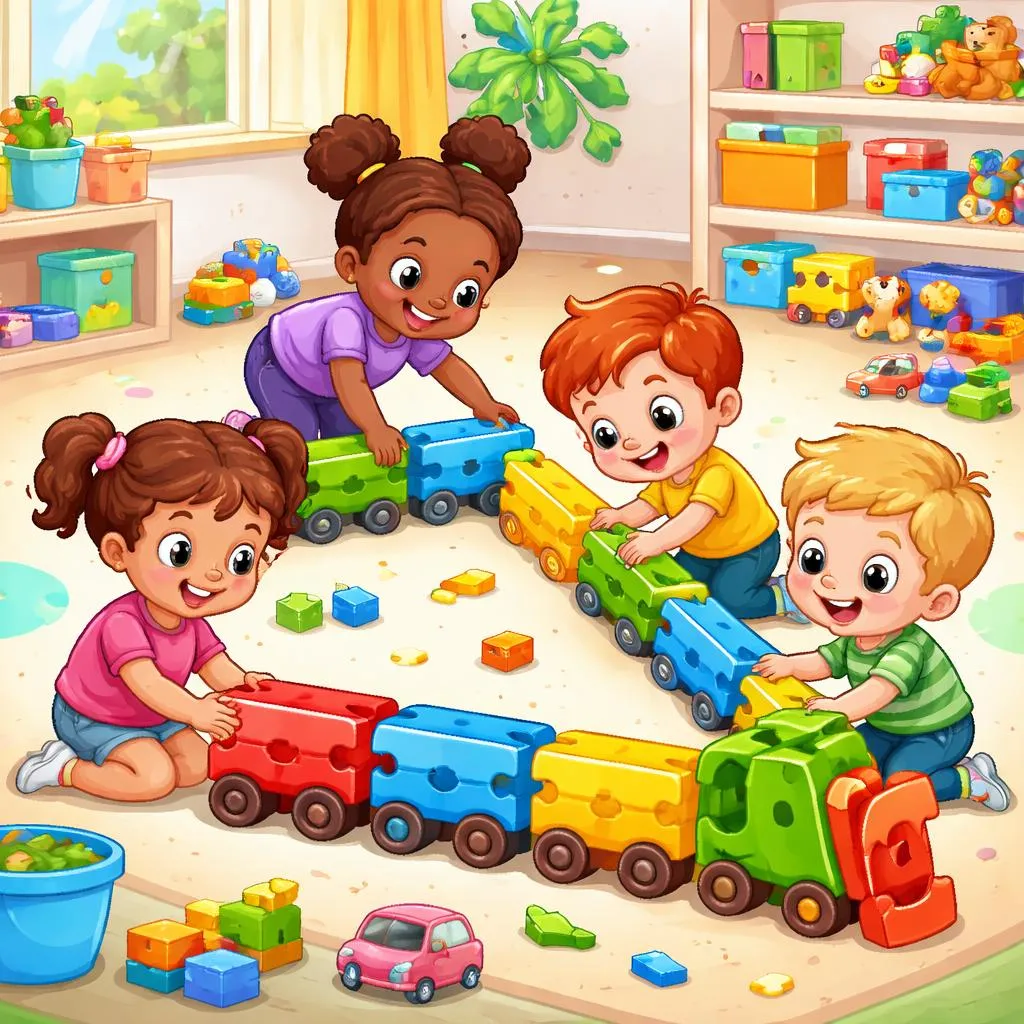

Hello, little word engineer! Do you know about a train? A train can have more than one car. The engine pulls the first car. Then comes another car. They are connected by a strong coupling. Your sentences can have two cars too! This is called a compound sentence. A compound sentence connects two simple sentences. Each simple sentence is a complete thought, like a train car. They are joined by a special connecting word. Today, we will build sixty wonderful sentence trains. Our guide is Connor the Conductor. Connor loves to connect train cars! He will show us compound sentences at home, the playground, school, and at the train yard. All aboard!
What Is a Compound Sentence?
A compound sentence is your word train. It is two simple sentences joined together. Each simple sentence is called an independent clause. That means it can be a train car that runs on its own. We connect them with a special word called a conjunction. The main couplings are: and, but, or, so. At home, you say "I like apples, and I like bananas." This is a compound sentence. "I like apples" is one car. "I like bananas" is another car. The word "and" is the coupling. At the playground, you say "I want to swing, but the swing is taken." At school, you say "I raised my hand, so the teacher called on me." In nature, Connor says "The sun is warm, and the sky is blue." "Connor drives the train, and he blows the whistle." Learning these must-know compound sentences helps you connect your ideas and tell better stories.
Why Do We Need Sentence Trains?
Compound sentences are your connection tools! They help your ears listen. You can hear how two ideas are related. They help your mouth speak. You can make your stories longer and more interesting. "I was tired, so I took a nap." They help your eyes read. You will see conjunctions connecting ideas in all your books. They help your hand write. You can write stories that flow from one idea to the next. Building sentence trains makes you a master storyteller.
What Are the Main Train Couplings?
We have four main coupling words. Each one connects ideas in a different way.
The adding coupling: and. It adds more information. "I have a ball, and I have a bat."
The difference coupling: but. It shows a contrast or difference. "I am small, but I am strong."
The choice coupling: or. It gives a choice or option. "We can read a book, or we can play a game."
The result coupling: so. It shows a cause and effect. "I was hungry, so I ate a snack."
How Can You Spot a Sentence Train?
Spotting a compound sentence is a fun game. Look for two complete sentences that could stand alone. Then, look for the connecting word in the middle. Often, there is a comma before the conjunction. Listen to Connor's train. "The train is long, and it is very fast." You can split it: "The train is long." "It is very fast." The word "and" connects them. You found a sentence train! Another trick: Say the sentence slowly. Can you find a place where you could put a period and start a new sentence? If yes, it might be compound.
How Do We Build a Sentence Train?
Building a compound sentence is about connecting two simple ideas. Take two simple sentences. Then, choose the right coupling word. Put a comma before the conjunction. The pattern is: Simple Sentence + Comma + Conjunction + Simple Sentence. "I like dogs. I like cats." becomes "I like dogs, and I like cats." Connor shows us. "I am five years old, and I go to preschool." Start with two ideas about your day. Connect them with "and".
Let's Fix Some Train Troubles.
Sometimes our sentence trains have a little trouble. Let's fix that. A common trouble is a run-on sentence. Two trains crash together without a coupling. "I played I ate I slept." This is wrong. Use conjunctions and commas: "I played, and then I ate. After that, I slept." Another trouble is using the wrong coupling. "I was cold, and I put on a jacket" is okay. But "so" might be better: "I was cold, so I put on a jacket." Also, don't forget the comma before the conjunction in a compound sentence. It helps the reader know where the coupling is.
Can You Be a Master Engineer?
You are a great engineer! Let's play a game. The "Connect the Cars" game. I will give you two simple sentences. You connect them with a conjunction. Sentences: "The sun is shining. We will go to the park." You say: "The sun is shining, so we will go to the park." Great! Here is a harder challenge. Take the conjunction "but". Make a compound sentence about yourself. "I wanted to stay, but it was time to go." You are building must-know compound sentences.
Your Train Yard of 60 Must-Know Compound Sentences.
Ready to fill your train yard? Here are sixty wonderful compound sentences. Connor the Conductor uses them all. They are grouped by the scene. Each one uses and, but, or, or so to connect two complete ideas.
Home Train Yard (15).
I brushed my teeth, and I washed my face.
My mom made lunch, and my dad set the table.
I wanted to play, but it was bedtime.
You can have juice, or you can have milk.
I finished my vegetables, so I got dessert.
The baby is crying, so Mom will feed him.
I looked for my toy, but I could not find it.
My room is messy, and I will clean it.
The dog is barking, and the cat is hiding.
I am full, so I will stop eating.
We can watch a movie, or we can read a book.
I love my mom, and I love my dad.
I was thirsty, so I drank some water.
The light is bright, but the room is cozy.
Our home is small, but it is full of love.
Playground Train Yard (15).
I went on the swing, and I went on the slide.
My friend pushed me, so I swung high.
I fell down, but I did not cry.
We can play tag, or we can play hide-and-seek.
The sun was hot, so we sat in the shade.
I threw the ball, and my friend caught it.
The slide was wet, but we played anyway.
I climbed the ladder, and I slid down fast.
I shared my shovel, so my friend was happy.
We ran out of time, and we had to go home.
You can go first, or I can go first.
I was having fun, but the bell rang.
The sand is soft, and the grass is green.
I laughed a lot, and I smiled a lot.
The park is fun, so we go there often.
School Train Yard (15).
I listened to the teacher, and I learned a lot.
My pencil broke, so I got a new one.
The book was long, but it was very good.
We can paint a picture, or we can build with blocks.
I raised my hand, and the teacher called on me.
I tried my best, so I felt proud.
The lesson was hard, but I understood it.
We sang a song, and we clapped our hands.
I finished my work, and I showed my teacher.
We have art today, so I am excited.
You can use the red crayon, or you can use the blue one.
The class was noisy, but now it is quiet.
I help my friends, and they help me.
School teaches us many things, and it is a fun place.
I made a mistake, but that is how I learn.
Nature and Animal Train Yard (15).
The sun is shining, and the birds are singing.
The flower needs water, so I will water it.
The rabbit is fast, but the turtle is slow.
We can go for a walk, or we can have a picnic.
It started to rain, so we went inside.
The tree is tall, and its leaves are green.
The bear is big, but the mouse is small.
I see a butterfly, and I see a bee.
The river is deep, and the water is cold.
I planted a seed, and now it is growing.
The day was warm, but the night is cool.
The wind is blowing, so the leaves are falling.
I love animals, and I love plants.
The world is beautiful, and we should take care of it.
Nature is amazing, so we should explore it.
These sixty sentences are your must-know compound sentences. They are your word trains. Practice connecting ideas every day.
Connecting Your Ideas into Wonderful Stories.
You did it! You are now a compound sentence expert. You know a compound sentence is a word train with two cars (independent clauses) connected by a coupling (conjunction). You know the main conjunctions: and, but, or, so. You can build them and spot them. Connor the Conductor is proud of your engineering skills. Now you can connect your ideas to tell longer, more exciting stories. Your talking and writing will be smooth and full of good connections.
Here is what you can learn from our train yard adventure. You will know what a compound sentence is. You will understand the four main conjunctions that join ideas. You can identify the two independent clauses in a compound sentence. You can use a comma and a conjunction to join two simple sentences. You have a train yard of sixty key compound sentences.
Now, let's do some life practice! Your mission is today. Be a word engineer. Listen to your thoughts. Can you connect two of them with "and" or "so"? Tell your grown-up: "I ate my snack, and now I am playing. I am tired, so I will rest soon." You just built two compound sentences! Keep connecting your word train cars every day. Have fun, little engineer!