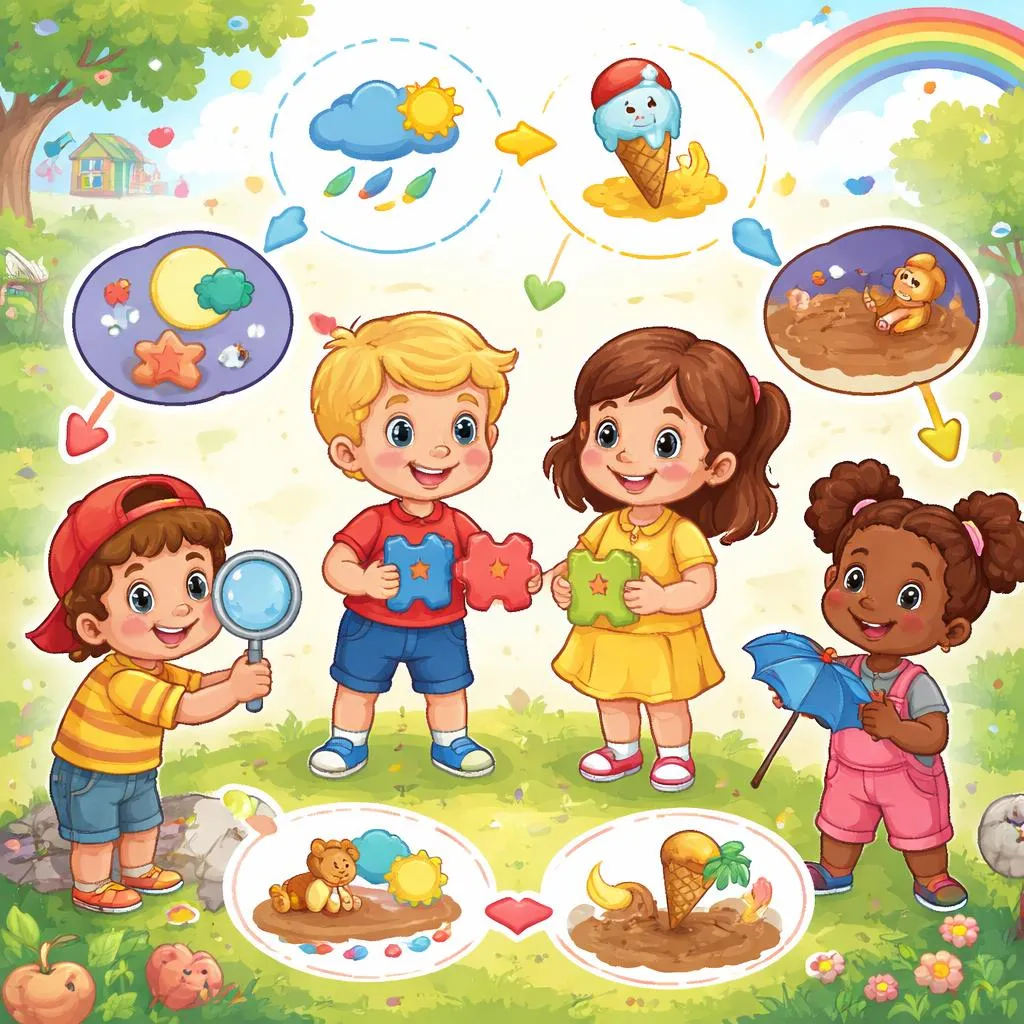

Hello, little word friend! Do you know about a promise? A promise is a deal. "If you share your toy, then I will be your friend." Your words can make promises too! These word promises are called conditional sentences. A conditional sentence talks about something that might happen. It has two parts. The "if" part is the condition. The "then" part is the result. Today, we will make sixty wonderful word promises. Our guide is Connie the Conditional Caterpillar. Connie loves to make deals! She will show us conditional sentences at home, the playground, school, and in the garden. Let's make a deal!
What Is a Conditional Sentence?
A conditional sentence is your word promise. It is a sentence that says if one thing happens, then another thing will happen. It is like a friendly deal. The word "if" is very important. At home, you say "If you eat your peas, then you can have dessert." This is a conditional sentence. The "if" part is eating peas. The "then" part is having dessert. At the playground, you say "If it rains, we will go inside." At school, you say "If you listen, you will learn." In nature, Connie says "If a caterpillar eats leaves, it will grow." "Connie knows that if she tries, she can climb the stem." Learning these must-know conditional sentences helps you understand how things are connected.
Why Do We Need Word Promises?
Conditional sentences are your logic tools! They help your ears listen. You can understand the rules and deals in your world. They help your mouth speak. You can explain what you will do in different situations. "If I finish my work, I can play." They help your eyes read. You will see conditional sentences in stories and instructions. They help your hand write. You can write about your plans and hopes. Making word promises makes you a good thinker and planner.
How Can You Spot a Word Promise?
Spotting a conditional sentence is a fun game. Use these simple clues.
First, look for the word "if". This word often starts the condition.
Second, look for two parts in the sentence. One part talks about a possible action. The other part talks about the result.
Third, the sentence often has a comma when the "if" part comes first.
Look at Connie's leaf. "If I eat this leaf, I will be full." I see "if" and two parts. You found a conditional sentence! Another trick: Sometimes the order can change. "I will be full if I eat this leaf." The meaning is the same.
How Do We Make Our Word Promises?
Making a conditional sentence is about connecting two ideas. The most common pattern for real promises is: If + present tense, will + base verb. "If you help me, I will help you." You can also use the present tense in both parts for things that are always true. "If you touch fire, it hurts." Connie shows us. "If the sun shines, we will go outside. We will go outside if the sun shines." Start with a simple "if" about your day. "If I am hungry, I will eat a snack."
Let's Fix Some Broken Promises.
Sometimes our word promises get a little mixed up. Let's fix that. A common mix-up is using "will" in the "if" part. A child might say "If I will go, I will see you." The correct way is "If I go, I will see you." Another mix-up is forgetting the comma when the "if" part is first. "If I finish my milk I can have cookies" needs a comma: "If I finish my milk, I can have cookies." Also, the two parts must make sense together. "If the sky is blue, then my shoes are red" is not a good cause and effect.
Can You Be a Promise Keeper?
You are a great keeper! Let's play the "Complete the Promise" game. I will say the "if" part. You say a good result. "If I am tired " You say: " I will take a nap!" "If I share my toy " You say: " my friend will be happy!" Great! Here is a harder challenge. Think of a rule at home. Can you say it as a conditional sentence?
Your Promise Book of 60 Must-Know Conditional Sentences.
Ready to write in your promise book? Here are sixty wonderful conditional sentences. Connie the Caterpillar uses them all. They are grouped by the scene. We will focus on real promises (first conditional) and always true facts (zero conditional).
Home Promises (15).
If you are good, you will get a sticker.
If you touch the stove, you will get burned.
If I finish my vegetables, I can have ice cream.
If the phone rings, someone will answer it.
If I am thirsty, I will drink water.
If you are tired, you should go to bed.
If you are kind to your sister, she will be kind to you.
If you make a mess, you must clean it up.
If you wash your hands, you can eat dinner.
If it is dark, turn on the light.
If you are cold, put on a sweater.
If you practice, you will get better.
If you tell the truth, everyone will trust you.
If you help me, I will help you.
If we work together, the job will be easy.
Playground Promises (15).
If it rains, we will not go outside.
If you wait in line, you will get a turn.
If you fall down, you might get a scratch.
If you share the swing, others will share with you.
If you are careful, you will not get hurt.
If you throw the ball, someone will catch it.
If the bell rings, we will go inside.
If you are a good sport, everyone will have fun.
If you climb too high, you might feel scared.
If you are hot, you should sit in the shade.
If you see litter, you can pick it up.
If you are lost, find a grown-up.
If you are patient, you will get a longer turn.
If you follow the rules, the game will be fair.
If you invite a new friend, you will have more fun.
School Promises (15).
If you listen, you will learn.
If you raise your hand, the teacher will call on you.
If you are quiet, you can hear the story.
If you try your best, you will feel proud.
If you make a mistake, it is okay.
If you finish your work, you can have free time.
If you are nice to others, they will be nice to you.
If you study, you will do well on the test.
If you ask for help, the teacher will help you.
If you line up quickly, we can go to recess sooner.
If you take care of your books, they will last a long time.
If you share the crayons, everyone can color.
If you work together, the project will be great.
If you say "please" and "thank you", people will be happy.
If you come to school, you will learn new things every day.
Nature and Animal Promises (15).
If you water a seed, it will grow.
If you are very quiet, you might see an animal.
If it snows, we can build a snowman.
If you drop food, ants will come.
If you are kind to animals, they will trust you.
If you plant a tree, it will give shade one day.
If you pollute the river, the fish will get sick.
If the sun shines, the flowers will bloom.
If you recycle, you help the Earth.
If you don't scare the birds, they will sing.
If you look up at night, you will see stars.
If you walk in the woods, you might see a deer.
If you protect nature, it will be beautiful for a long time.
If you turn off the tap, you will save water.
If you love the planet, it will give you many gifts.
Using "When" Instead of "If".
Sometimes we use "when" for things that are sure to happen. It is like a stronger promise.
When I grow up, I will be a teacher.
When the sun sets, it gets dark.
When you are five, you go to preschool.
These sixty sentences are your must-know conditional sentences. They are your word promises. Practice them every day.
Understanding Your World with Word Promises.
You did it! You are now a conditional sentence expert. You know a conditional sentence is a word promise. It uses "if" to connect a condition and a result. You can make promises about real things. You can spot them and use them. Connie the Conditional Caterpillar is proud of your promise-keeping skills. Now you can think about cause and effect. Your understanding of the world will grow.
Here is what you can learn from our promise adventure. You will know what a conditional sentence is. You will understand the two parts: the condition and the result. You can identify conditional sentences by the word "if". You can form simple real conditional sentences. You have a promise book of sixty key conditional sentences.
Now, let's do some life practice! Your mission is today. Be a word promise keeper. Make two promises about your day. Tell your grown-up: "If I finish my lunch, I can play. If I am gentle with the cat, she will purr." You just used two conditional sentences! Keep making your word promises every day. Have fun, little friend!