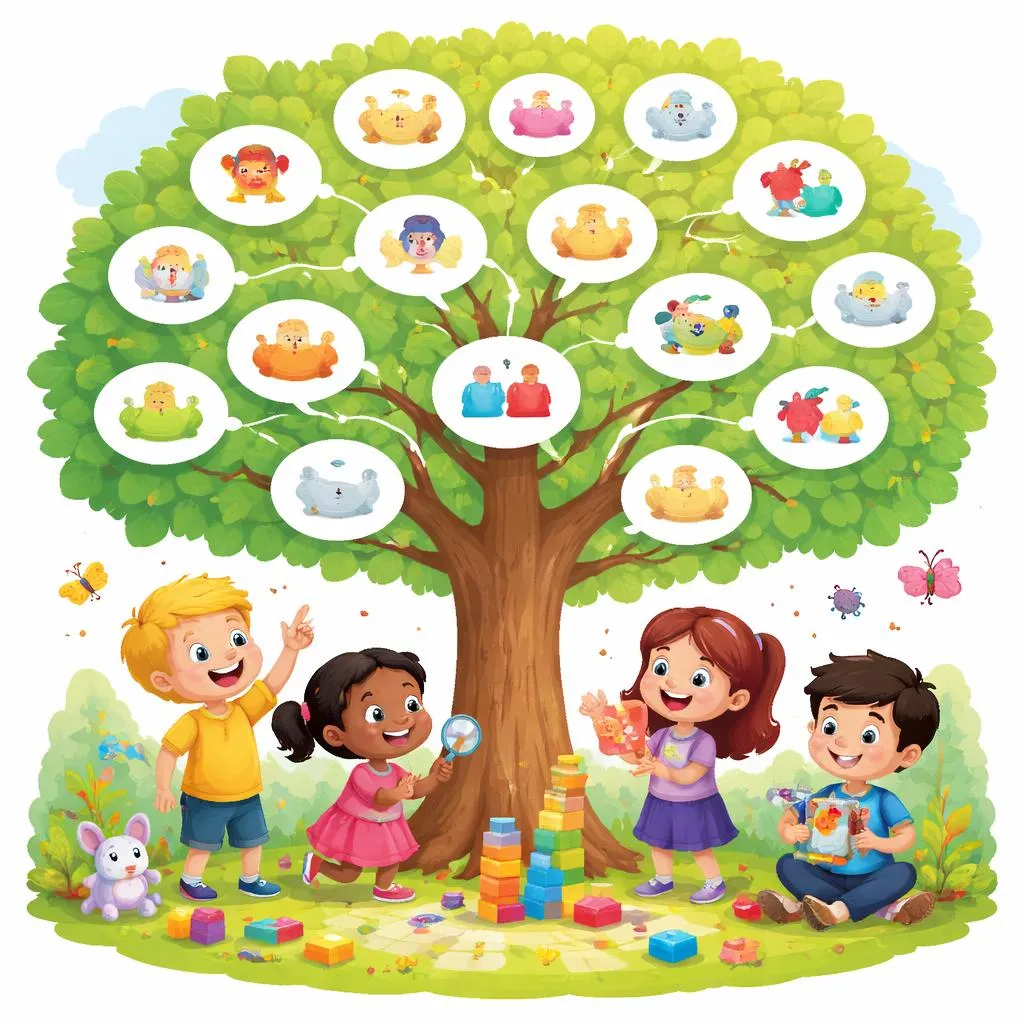

Hello, little word gardener! Do you know how a tree grows? A tree has a big, strong main branch. It also has smaller branches that grow from it. The small branch needs the big branch. Your sentences can grow like a tree too! This is called a complex sentence. A complex sentence has a main clause (the big branch) and a dependent clause (the small branch). The small branch needs the big branch to make sense. Today, we will grow sixty wonderful sentence trees. Our guide is Casey the Koala. Casey loves to climb on branches! He will show us complex sentences at home, the playground, school, and in the forest. Let's start growing!
What Is a Complex Sentence?
A complex sentence is your word tree. It has two parts. First, a main clause. This is the big, strong branch. It is a complete thought. It can stand alone. "I ate a snack." Second, a dependent clause. This is the small branch. It has a subject and verb, but it is not a complete thought. It needs the main branch. It often starts with a helper word like because, when, if, after, before, although. "When I was hungry" is a small branch. Put them together! "When I was hungry, I ate a snack." At the playground, you say "After I swing, I will slide." At school, you say "I listen because I want to learn." In nature, Casey says "Casey sleeps when the sun goes down." Learning these must-know complex sentences helps you explain reasons and tell when things happen.
Why Do We Grow Sentence Trees?
Complex sentences are your explanation tools! They help your ears listen. You can understand why or when something happened. They help your mouth speak. You can give reasons for your feelings. "I am sad because I lost my toy." They help your eyes read. You will see them in stories that explain a character's actions. They help your hand write. You can write sentences that connect ideas in clever ways. Growing your sentence trees makes you a thoughtful talker and writer.
What Are the Main Helper Branches?
Our small branches start with different helper words. Each one adds a special meaning.
The time helper: when, while, after, before. It tells when. "When the bell rings, we go inside."
The reason helper: because, since. It tells why. "I smiled because I was happy."
The condition helper: if, unless. It tells under what condition. "If it rains, we will stay inside."
The contrast helper: although, even though. It shows a surprise. "Although I am little, I can help."
For 5-year-olds, we will start with because, when, and if. They are the most useful helpers.
How Can You Spot a Sentence Tree?
Spotting a complex sentence is a seek-and-find game. Look for a helper word like because or when. Then, see if the part starting with that word cannot stand alone. That is your small branch (dependent clause). The other part that can stand alone is the big branch (main clause). Look at Casey's tree. "After I climb, I will rest." The part "After I climb" cannot stand alone. It is the small branch. "I will rest" can stand alone. It is the big branch. You found a sentence tree! Another trick: The helper word is often the signal.
How Do We Grow Our Sentence Trees?
Growing a complex sentence is about connecting the branches. You can put the small branch first or second. If the small branch comes first, use a comma after it. Pattern 1: Helper Clause + Comma + Main Clause. "Because I was tired, I took a nap." Pattern 2: Main Clause + Helper Clause (no comma). "I took a nap because I was tired." Casey shows us. "When the sun is out, I like to play. I like to play when the sun is out." Start by adding "because" to explain something you did.
Let's Fix Some Growing Pains.
Sometimes our trees have a little problem. Let's fix that. A common problem is a fragment. The small branch is left alone. A child might say "Because I said so." This is not a complete tree. It needs a big branch. "You must listen because I said so." Another problem is forgetting the comma when the helper clause starts the sentence. "When I finish I will call you" needs a comma: "When I finish, I will call you." Also, make sure your helper clause is really a small branch. It should not be a complete sentence on its own.
Can You Be a Master Gardener?
You are a great gardener! Let's play a game. The "Big Branch or Small Branch?" game. I will say a clause. You tell me if it is a main clause (big branch) or a dependent clause (small branch). "I brushed my teeth." You say: "Big branch!" "After I brushed my teeth " You say: "Small branch!" Great! Here is a harder challenge. Take the main clause "We can go to the park." Add a small branch with "if" at the beginning. "If the weather is nice, we can go to the park." You are growing must-know complex sentences.
Your Forest of 60 Must-Know Complex Sentences.
Ready to explore the forest? Here are sixty wonderful sentence trees. Casey the Koala has climbed them all. They are grouped by the scene. The helper clause is in stars. Remember, it's the small branch that needs the big branch.
Home Forest (15 Trees).
I am happy because you are here.
When I wake up, I make my bed.
If you are good, you can have a treat.
I help my mom because I love her.
After I eat dinner, I take a bath.
I feel safe when my family is near.
Although my room is small, I like it.
I will share if you ask nicely.
Before I go to sleep, I read a book.
We are a team since we are family.
Unless I am sick, I go to school.
I learn new things when I help cook.
Because Dad works hard, I thank him.
I can play after I clean up.
While the baby naps, we are quiet.
Playground Forest (15 Trees).
We go outside when the sun is shining.
If you push me, I will swing high.
I fell down because I was running fast.
After we play tag, we are very tired.
I share my toys because it is kind.
When the slide is empty, I go down.
We can't play if it is raining.
Before we go home, we clean up.
I had fun since my friends were there.
Although the ladder is tall, I climb it.
I wait for my turn when others are playing.
Because the ball is round, it bounces.
We will have a race if you want to.
While I am on the swing, I feel free.
I laugh a lot when I am at the park.
School Forest (15 Trees).
I listen because I want to learn.
When the teacher talks, we listen.
If I practice, I will get better.
I raised my hand because I knew the answer.
After we finish our work, we can draw.
I follow the rules so that we are safe.
Although counting is hard, I try.
I can be a helper if the teacher picks me.
Before I write, I think.
We learn a lot since we come to school.
When I make a mistake, I try again.
I feel proud because I did my best.
Unless we are quiet, we can't hear the story.
We work together while we build.
I know my letters because I practice.
Nature and Animal Forest (15 Trees).
Flowers bloom when spring comes.
If you water a seed, it will grow.
The bird flew away because it was scared.
After the rain stops, we see a rainbow.
Bears sleep when it is winter.
Because the sun is hot, we wear hats.
We should walk so that we don't scare animals.
Although the rock is heavy, I can lift it.
The river flows until it reaches the sea.
When the wind blows, the trees sway.
I can hear the birds if I am very quiet.
Since the flower needs sun, it faces the sky.
The caterpillar changes before it becomes a butterfly.
While the stars are out, the moon shines.
Nature is beautiful because it is full of life.
These sixty sentences are your must-know complex sentences. They are your word trees. Use them to explain your world.
Explaining Your World with Strong Sentence Trees.
You did it! You are now a complex sentence expert. You know a complex sentence is a word tree with a main clause and a dependent clause. The dependent clause starts with a helper word like because, when, or if. You can spot the branches and put them together. Casey the Koala is proud of your gardening skills. Now you can explain reasons, tell when things happen, and talk about conditions. Your stories will be deeper and more interesting.
Here is what you can learn from our forest adventure. You will know what a complex sentence is. You will understand the difference between a main clause and a dependent clause. You can identify the helper words that start dependent clauses. You can use commas correctly when the dependent clause comes first. You have a forest of sixty key complex sentences.
Now, let's do some life practice! Your mission is today. Be a word gardener. Listen for the words "because," "when," or "if" when people talk. Try to use one yourself. Tell your grown-up: "I am hungry because I played. I will wash my hands before I eat. If I finish, I can play." You just grew three sentence trees! Keep growing your word forest every day. Have fun, little gardener!