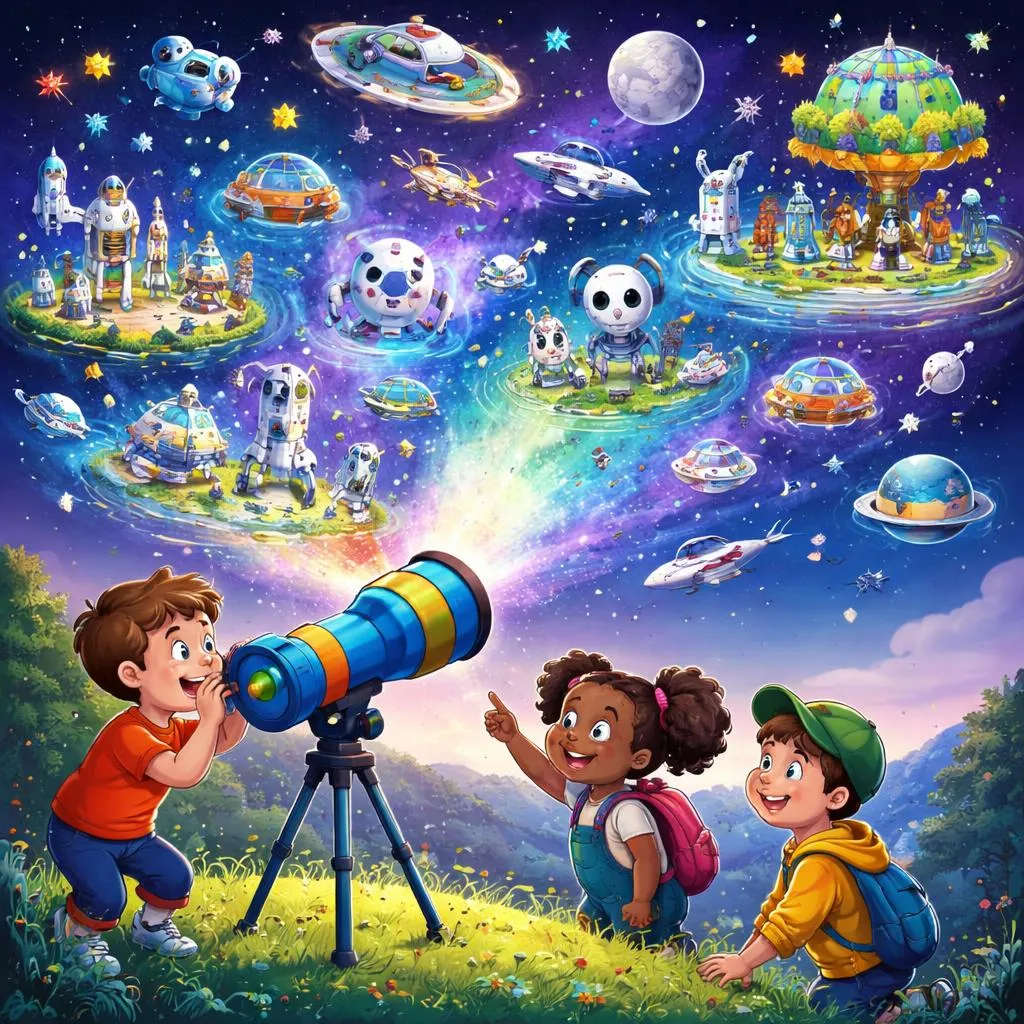

Hello, super-duper astronomer! Do you have a powerful telescope? What if it could do two amazing things? First, it can look very far into the future. Second, it can see a long, long action that started a while ago. Your words can do that! The future perfect continuous tense is your super-duper telescope. It talks about a long action that will be in progress until a certain time in the future. It shows the duration of an action looking forward from a future point. Today, we will explore eighty amazing future perfect continuous wonders! Our guide is Sammy the Starfish. Sammy grows very, very slowly! He is perfect for showing long actions. He will show us this tense at home, the playground, school, and in the ocean. Let's peer into the future!
What Is the Future Perfect Continuous Tense?
The future perfect continuous tense is your super-duper telescope. It is a verb form. It shows a long action that starts before a future time and continues up to that time. It is all about the duration of the action. At home, you say "By bedtime, I will have been playing for two hours." The words "will have been playing" are your telescope view. The playing started in the past (relative to bedtime) and continued. It focuses on the two hours of play. At the playground, you say "By 5 PM, I will have been swinging for thirty minutes." At school, you say "By the end of the year, I will have been learning English for three years." In the ocean, Sammy says "By next summer, I will have been living in this coral for five years." "Sammy's star map charts his eighty must-master future perfect continuous journeys." This tense mixes a future finish line with a long, ongoing action.
Why Do We Need a Super-Duper Telescope?
The future perfect continuous tense is your duration calculator! It helps your ears listen. You can understand how long an action will have been going on by a future time. It helps your mouth speak. You can talk about future milestones and the time spent. "Next month, I will have been going to this school for two years!" It helps your eyes read. You might see it in stories about long adventures or life events. It helps your hand write. You can write about long-term habits and projects. Using your super-duper telescope makes you a great storyteller of time and effort.
How Does the Super-Duper Telescope Work?
The future perfect continuous tense has a special, specific use. It emphasizes the duration of an action up to a point in the future. It often answers "how long?" by a certain time.
It is made of four parts. First, will have been. This is the same for everyone! Second, the main verb. Third, add "-ing" to that verb.
Formula: Subject + will have been + verb-ing.
I/You/He/She/It/We/They will have been playing.
We use it with time phrases that mark the future point ("by June", "by the time I'm ten") and duration phrases ("for two hours", "since morning").
How Can You Spot This Telescope View?
Spotting the future perfect continuous is a fun puzzle. Use these clues.
First, look for the four-word clue: will have been. This is your biggest sign. It is always the same.
Second, look for a verb that ends with "-ing" right after "been".
Third, look for the "how long" words. Words like for and since. Also look for the "by" time phrase.
Look at Sammy's star map. "By tomorrow, I will have been growing for a week. My friend will have been swimming for hours. How long will you have been waiting?" You can spot "will have been" and the "-ing" verb.
How Do We Use Our Telescope Correctly?
Using the future perfect continuous is about the right formula. Remember the rule.
Subject + will have been + verb-ing. "I will have been reading. You will have been drawing. He will have been eating. We will have been singing. They will have been studying."
To make a negative, add "not" after will. "I will not (won't) have been sleeping. She won't have been watching."
To ask a question, put "Will" at the start. "Will you have been practicing? Will it have been raining?"
Sammy shows us. "By next year, I will have been living here. The coral will have been growing. Will you have been visiting? No, I won't."
Let's Fix Some Telescope Focus.
Sometimes our telescope view gets a bit blurry. Let's fix the focus.
A common blur is forgetting the "been". "I will have playing for an hour" is wrong. Say "I will have been playing for an hour."
Another is using the wrong verb form. "I will have been eat" is wrong. After "been", we always use verb-ing. "I will have been eating" is right.
Also, using it for a short, completed future action. "I will have been finish my homework by 5" is wrong. For a single completed action, use future perfect: "I will have finished my homework by 5." Our telescope is for long, ongoing actions.
Can You Be a Super-Duper Astronomer?
You are a great astronomer! Let's play the "How Long By Then?" game. I will give you a finish line and a duration. You tell me the long action. Finish line: "By 8 PM tonight." Duration: "play for two hours." You say: "By 8 PM tonight, I will have been playing for two hours." Finish line: "By my next birthday." Duration: "go to this school for three years." You say: "By my next birthday, I will have been going to this school for three years." Great! Here is a harder task. Think of something you do every day, like brushing your teeth. How long will you have been doing it by the end of the year?
Your Star Map of 80 Must-Master Journeys.
Ready to see the star map? Here are eighty future perfect continuous sentences. Sammy the Starfish has been watching them unfold. They are grouped by the scene. Each group has twenty long journeys that will be in progress by a future time.
Home Long Journeys (20).
By bedtime, I will have been sleeping for ten hours.
By six o'clock, Dad will have been cooking for an hour.
By tomorrow, we will have been visiting Grandma for a week.
By 8 PM, I will have been brushing my teeth for two minutes.
By tonight, my sister will have been watching her show.
By noon, I will have been drinking my juice slowly.
By 4 PM, Mom will have been baking all afternoon.
By this evening, I will have been looking for my toy.
By story time, Dad will have been reading to me.
By Friday, I will have been helping Mom all week.
By the afternoon, our dog will have been barking at the squirrel.
By tonight, I will have been calling my friend for ten minutes.
By seven, we will have been eating dinner for a while.
By then, the baby will have been sleeping for hours.
By tomorrow, I will have been drawing this picture for a long time.
By the weekend, we will have been playing this game for a month.
By next month, I will have been growing all year.
By winter, our house will have been feeling warm for weeks.
By morning, I will have been dreaming all night.
By the time you come, I will have been waiting.
Playground Long Journeys (20).
By 3 PM, I will have been swinging for twenty minutes.
By then, my friend will have been climbing the wall.
By five, we will have been playing soccer for two hours.
By the end, she will have been running for a long time.
By then, he will have been jumping on the trampoline.
By tomorrow, they will have been building the fort for days.
By the weekend, the sun will have been shining all week.
By noon, the children will have been laughing for a while.
By the end, I will have been throwing the ball.
By the afternoon, we will have been having so much fun.
By the time we leave, the coach will have been teaching us.
By then, I will have been trying to reach the top.
By later, my friend will have been pushing the swing.
By morning, the birds will have been singing since dawn.
By snack time, we will have been sharing our treats nicely.
By the end, the game will have been going on and on.
By next week, I will have been learning this trick for days.
By tonight, everyone will have been getting tired.
By then, a lot of fun will have been happening.
By the time the bell rings, I will have been playing fairly.
School Long Journeys (20).
By June, I will have been learning at this school for a year.
By the end of class, the teacher will have been reading to us.
By Friday, we will have been writing in our journals.
By then, she will have been answering questions.
By art class, he will have been coloring carefully.
By the concert, our class will have been singing this song.
By the time you call, I will have been listening carefully.
By 3:05, the bell will have been ringing for a minute.
By the time we go, we will have been lining up.
By then, my friend will have been helping me with math.
By the test, I will have been thinking about it for a week.
By next month, we will have been planting seeds in science.
By tomorrow, she will have been studying for her test.
By the end of the day, the clock will have been ticking.
By then, we will have been listening to the lesson.
By the time I finish, I will have been drawing this map.
By spring, our seeds will have been growing for months.
By the end of the year, learning will have been getting easier.
By then, I will have been trying my best all year.
By graduation, the class will have been working together.
Nature and Animal Long Journeys (20).
By 7 AM, the sun will have been rising for a while.
By tonight, it will have been raining all day.
By then, the river will have been flowing for centuries.
By morning, the wind will have been blowing all night.
By May, the flowers will have been blooming for weeks.
By November, the leaves will have been falling for a month.
By spring, the bird will have been building its nest.
By dawn, the spider will have been spinning its web.
By January, winter will have been getting colder.
By 8 PM, night will have been falling slowly.
By then, the caterpillar will have been eating leaves for days.
By fall, the bees will have been making honey all summer.
By afternoon, the snow will have been melting in the sun.
By summer, the days will have been getting longer.
By the time I get home, I will have been walking the dog.
By midnight, we will have been watching the stars for hours.
By next year, the seasons will have been changing as always.
By then, nature will have been showing its beauty forever.
By the time I'm big, the forest will have been growing for a century.
Life will have been continuing its wonderful cycle.
Mapping Your Own Long Journey.
You did it! You are now a future perfect continuous tense expert. You know it is your super-duper telescope. It uses "will have been" + verb-ing to talk about the duration of an action up to a future point. You can spot it and use it to talk about long efforts. Sammy the Starfish is proud of your star-gazing. Now you can talk about how long things will have been happening. Your words will show patience and long-term action.
Here is what you can learn from our telescope adventure. You will know what the future perfect continuous tense is. You will understand it emphasizes the duration of an action up to a future time. You can form it correctly with will have been and verb-ing. You can identify it in sentences. You have a star map of eighty must-master future perfect continuous journeys.
Now, let's do some life practice! Your mission is today. Be a super-duper astronomer. Think about a habit you have. Tell someone how long you will have been doing it by a future date. Use the future perfect continuous. Say: "By my next birthday, I will have been brushing my teeth every day for eight years. By December, I will have been going to this school for two years." You just used your super-duper telescope! Keep seeing the long, wonderful journeys in your life. Have fun, little astronomer