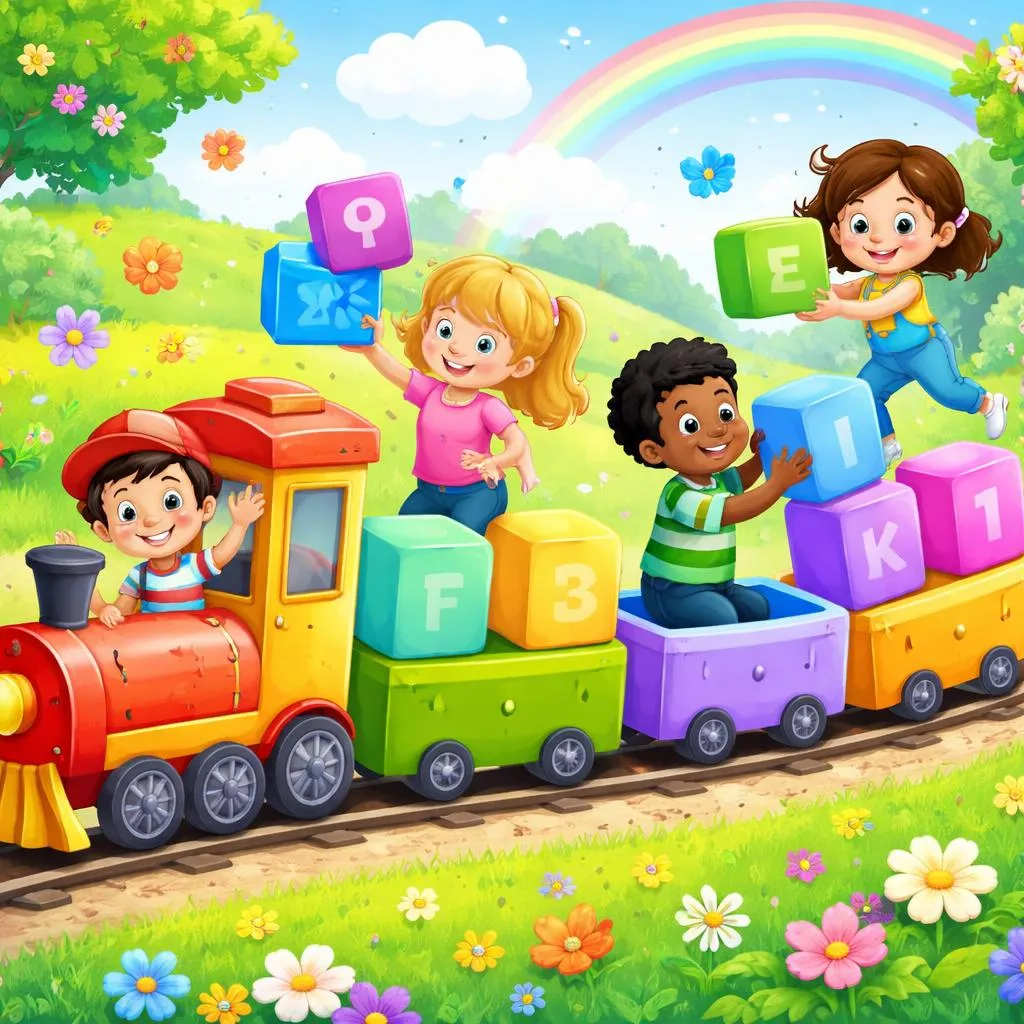

Hello, word conductor! Do you love trains? A train has an engine. It pulls many cars. The cars carry things from one place to another. Your thoughts are like things that need to move! A sentence is your word train. It carries a complete thought from your mind to someone else's. A good sentence has an engine and some cars. Today, we will build eighty wonderful word trains! Our guide is Connie the Conductor. She knows how to build strong sentence trains. She will show us sentences at home, the playground, school, and at the station. All aboard!
What Is a Sentence?
A sentence is your word train. It is a group of words. It tells a complete thought. It starts with a capital letter. It ends with a stop sign: a period (.), a question mark (?), or an exclamation mark (!). Every sentence train has two main parts. The engine is the subject. It tells who or what the sentence is about. The cars are the predicate. They tell what happens or what is. At home, "I play." is a tiny train. "I" is the engine. "Play" is the car. It carries a complete thought. At the playground, "The ball bounces." At school, "We learn." In nature, "Flowers grow." "Connie's timetable lists eighty must-master sentences for you to practice." Learning to build these trains helps you share all your amazing ideas.
Why Do We Need Word Trains?
Sentences are your communication power! They help your ears listen. You can understand stories, jokes, and instructions. They help your mouth speak. You can tell your family about your day. "I saw a big dog at the park!" They help your eyes read. Every book is full of sentence trains carrying the story. They help your hand write. You can write notes, stories, and cards. Building strong word trains makes you a great talker and writer.
What Kinds of Trains Can We Build?
We can build four main types of sentence trains. Each type has a different job.
Statement Trains: These tell or state something. They end with a period. "My name is Sam. I have a red bike."
Question Trains: These ask something. They end with a question mark. "What is your name? Do you like bikes?"
Command Trains: These tell someone to do something. They often start with a verb. They end with a period. "Close the door. Please sit down."
Exclamation Trains: These show strong feeling. They end with an exclamation mark. "I love my bike! Watch out!"
All these trains need an engine and at least one car. They must carry a complete thought.
How Can You Spot a Complete Train?
Spotting a complete sentence is easy. Ask these two conductor questions.
First, point to the engine. Ask: "Who or what is this about?" Find the main person, place, or thing.
Second, point to the cars. Ask: "What is happening? Or what is it?" Find the action or the state.
If you can answer both questions, you have a complete train! If you can't, it might just be a train car sitting alone.
Look at Connie's yard. "The fast train." What about the train? We don't know! It's just an engine. "The fast train zooms." Now we have an engine ("The fast train") and a car ("zooms"). It's a complete sentence train!
How Do We Build Our Train Correctly?
Building a sentence is about following a simple plan. Here are the basic blueprints.
Plan 1: Engine (Who/What) + Car (Action). "Dogs bark. I run. She sings."
Plan 2: Engine (Who/What) + Car (Is/Are/Am) + More Info. "Dogs are friendly. I am happy. She is my sister."
Always start your train with a capital letter. This is like the train's headlight. Always end with the right stop sign. This tells the listener when your thought is finished.
To make a question train, you often put the helper verb first. "You are here." becomes "Are you here?"
To make a command train, the engine is often "you", but it is hidden. "(You) Eat your lunch."
Connie shows us. "I drive the train. It is big. Do you like trains? Please hold on! This is fun!"
Let's Fix Some Train Troubles.
Sometimes our trains have trouble. Let's fix them.
A common trouble is a sentence fragment. This is an incomplete thought. It's like a lone train car. "The big, yellow bus." What about it? Add a car: "The big, yellow bus stops here."
Another trouble is a run-on sentence. This is two trains crashed together! "I like cake I like ice cream." Use a conjunction coupling: "I like cake, and I like ice cream." Or make two trains: "I like cake. I like ice cream."
Also, forgetting the capital letter or stop sign. "my dog is funny" needs a capital M and a period. "My dog is funny."
Can You Be a Master Conductor?
You are a great conductor! Let's play the "Complete or Not?" game. I will say a group of words. You tell me if it is a complete sentence train. "Runs very fast." You say: "Not complete! Who runs?" "The cheetah runs very fast." You say: "Complete! Engine: The cheetah. Car: runs." Great! Here is a harder task. Look at your favorite toy. Can you build a statement train and a question train about it?
Your Train Schedule of 80 Must-Master Sentences.
Ready to see the schedule? Here are eighty wonderful, complete sentences. Connie the Conductor uses them all. They are grouped by the scene. Each group has twenty sentence trains. See all the different types!
Home Sentence Trains (20).
I love my family.
My mom makes lunch.
Dad reads the news.
The baby is sleeping.
Our dog barks loudly.
The cat is on the sofa.
Dinner smells good.
My room is tidy.
Is that the phone?
Can I have a snack?
Please wash your hands.
Set the table now.
What a great day!
I help with chores.
We watch a movie.
Grandma tells stories.
My bed is very soft.
The clock ticks on the wall.
Time for bed!
Good night, everyone.
Playground Sentence Trains (20).
We play together.
The sun is shining.
Children laugh happily.
I swing high.
She climbs the ladder.
He kicks the ball.
The slide is slippery.
My friends are fun.
Do you want to play?
Can I go next?
Push me, please!
Look at that!
What a high swing!
Catch the ball!
Run fast!
The coach blows a whistle.
The game is exciting.
I am very tired.
Time to go home.
See you tomorrow!
School Sentence Trains (20).
The teacher is kind.
We learn new words.
I write my name.
She draws a circle.
He colors the sky.
Our class is quiet.
Is this your pencil?
May I go drink?
Listen carefully.
Please line up.
Open your book.
Read the story.
Who knows the answer?
What a smart idea!
Sit down now.
Walk in the hall.
My backpack is heavy.
The bell is ringing.
School is fun.
I love to learn.
Nature and Animal Trains (20).
The sun is bright.
Birds fly south.
Fish swim in water.
A flower grows.
Trees are tall.
Leaves are green.
Is that a bunny?
Can you hear the birds?
Look at the bug!
Be very quiet.
The river flows.
The wind blows hard.
I see a rainbow.
Clouds are in the sky.
The dog runs fast.
The cat chases a mouse.
What a big tree!
Feed the birds.
Do not litter.
Nature is beautiful.
Driving Your Thoughts with Word Trains.
You did it! You are now a sentence expert. You know a sentence is a word train that carries a complete thought. It has a subject engine and a predicate car. You know the four types: statement, question, command, and exclamation. Connie the Conductor is proud of your training. Now you can build strong sentences about anything. Your ideas will travel clearly to your friends and family.
Here is what you can learn from our train adventure. You will know what a sentence is. You will know the four types of sentences. You can find the subject and predicate. You can build your own complete sentences. You have a schedule of eighty must-master sentences.
Now, let's do some life practice! Your mission is today. Be a word conductor. Tell someone three things about your day. Build three different sentence trains. Say: "I ate an apple. Did you have fun? Please play with me!" You just drove three word trains! Keep building and sharing your sentence trains every day. Have fun, little conductor!