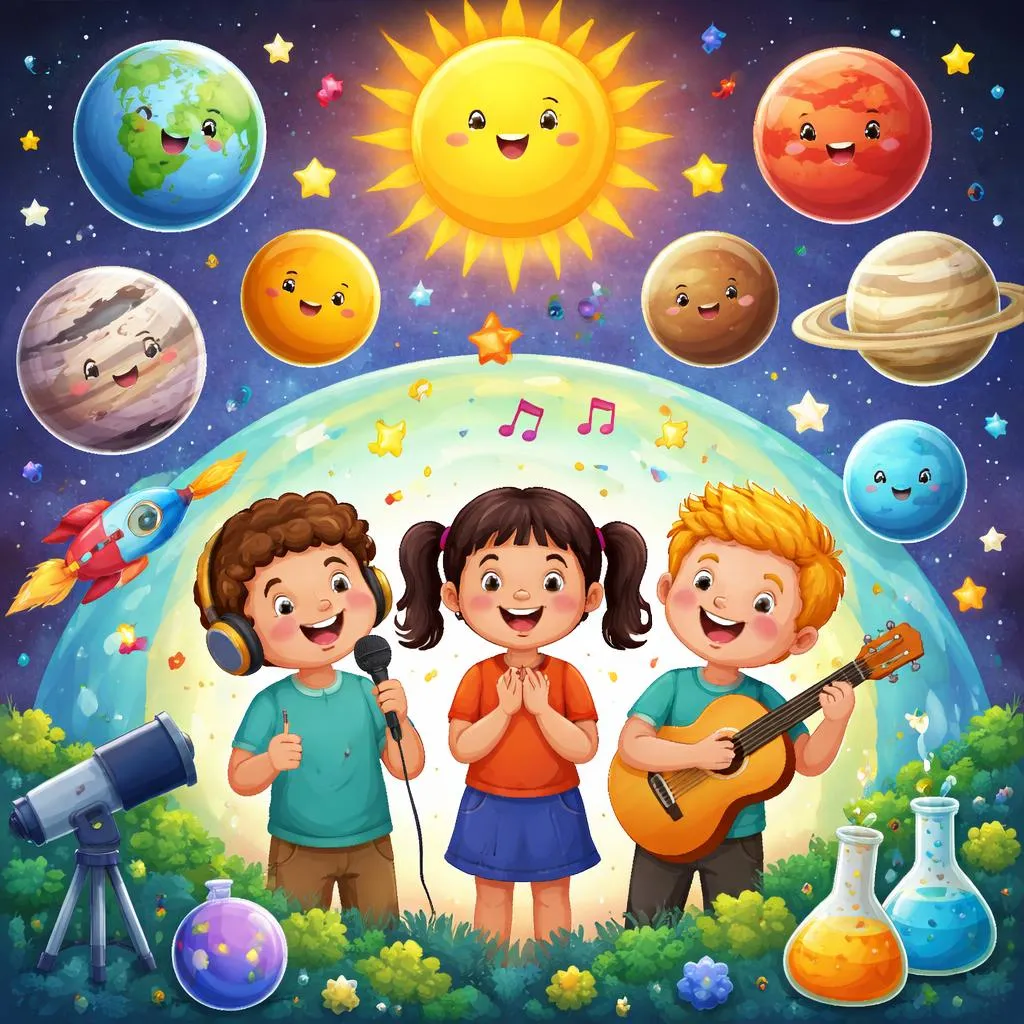

What Is The Rhyme? Many educational English songs combine music with knowledge. A classic planets song is one such rhyme. It typically introduces the planets of our solar system in order from the sun. The melody is catchy and easy to remember. The lyrics are simple and repetitive. This structure helps learners memorize complex information effortlessly. Through a well-crafted planets song, we achieve two exciting goals. We explore the wonders of space. We also practice English in a natural, engaging context. Music becomes a powerful bridge between language learning and scientific discovery.
The Lyrics of Nursery Rhymes Let's look at a common example of planets song lyrics. The verses often follow a clear, predictable pattern. "Mercury, Venus, Earth, and Mars. Jupiter, Saturn, among the stars. Uranus, Neptune, round we go. Eight planets in a row!" Some songs include Pluto with a friendly note about dwarf planets. The rhythm is steady. The rhymes are clear, like "Mars" and "stars," or "go" and "row." This musical framework is not just for fun. It provides a solid structure for embedding new vocabulary and concepts into memory.
Vocabulary Learning A planets song is a fantastic vocabulary builder. It introduces the core names: Mercury, Venus, Earth, Mars, Jupiter, Saturn, Uranus, Neptune. We can expand from there. We add descriptive words from the song or related lessons. Think of words like "sun," "star," "moon," "orbit," "round," "big," "small," "hot," "cold," and "far." We create word groups. We can sort planets by size or color. This approach moves beyond simple memorization. It helps children organize and connect new English words in a meaningful, thematic way.
Phonics Points The planet names are excellent for phonics practice. We focus on beginning sounds and syllables. The strong /m/ sound in "Mercury" and "Mars." The /v/ sound in "Venus." We can practice the soft /j/ sound in "Jupiter." Breaking down the names helps with pronunciation and spelling. "Sat-urn" has two clear parts. "U-ra-nus" has three. We also find wonderful rhyming pairs within the theme. "Mars" and "stars." "Go" and "row." "Sun" and "fun." Clapping out the syllables of each planet name to the song's beat turns phonics into a fun, physical activity.
Grammar Patterns The simple sentences in a planets song teach foundational grammar. We often see the verb "is" used for description. "Jupiter is big." "Mars is red." This reinforces subject-verb agreement for singular nouns. Prepositions of place are also common. "Earth is near the sun." "The planets go around the sun." We can introduce basic adjectives. "The giant planet," "the red planet," "the ringed planet." Singing these patterns repeatedly makes them feel natural. Children absorb the correct sentence structure without focusing on complex rules.
Learning Activities Interactive activities deepen the learning. A great starter is "Planet Charades." One child acts out a planet's characteristic, like spinning rings for Saturn or being very hot for Venus. Others guess the planet's name in English. Another activity is "Lyrics Fill-in-the-Blank." We sing the song but pause before a planet name. Children shout or hold up a card with the correct planet. For creativity, try "Write a New Verse." Children describe a planet using their own simple English sentence. "Neptune is very blue and cold." Then we sing it together.
Printable Materials Printable resources extend the song into visual and tactile learning. A "Solar System Mini-Book" is perfect. Each page features a planet picture, its name, and a simple fact. "Mars is the Red Planet." A "Word Search" with planet names builds letter recognition. We can create "Planet Cards" with a picture on one side and key words on the back. For example, "Jupiter" on the front, "big," "gas," "storm" on the back. A "Cut-and-Paste Orbit" worksheet lets children arrange planets in order, reinforcing both sequence and vocabulary.
Educational Games Games make practice joyful and effective. "Planet Hopscotch" is a lively game. Draw circles for planets on the ground. As children hop from Mercury to Neptune, they say each name aloud. "Planet Bingo" uses cards with planet pictures. The caller says, "The planet with rings." Players mark Saturn. For a digital twist, use a simple animation app. Let children record themselves singing the planets song over a moving solar system model. This combines music, vocabulary, and technology in a project they can share proudly.
The true power of a planets song lies in its ability to connect. It connects words to concepts, music to memory, and curiosity to learning. Each time we sing, we reinforce English sounds, words, and patterns. We also build a sense of wonder about our place in the universe. This joyful combination keeps learners engaged and motivated. So, find a tune, print some pictures, and start singing about the solar system. Watch as English vocabulary orbits right into their growing minds, making learning an adventure that is both educational and incredibly fun.