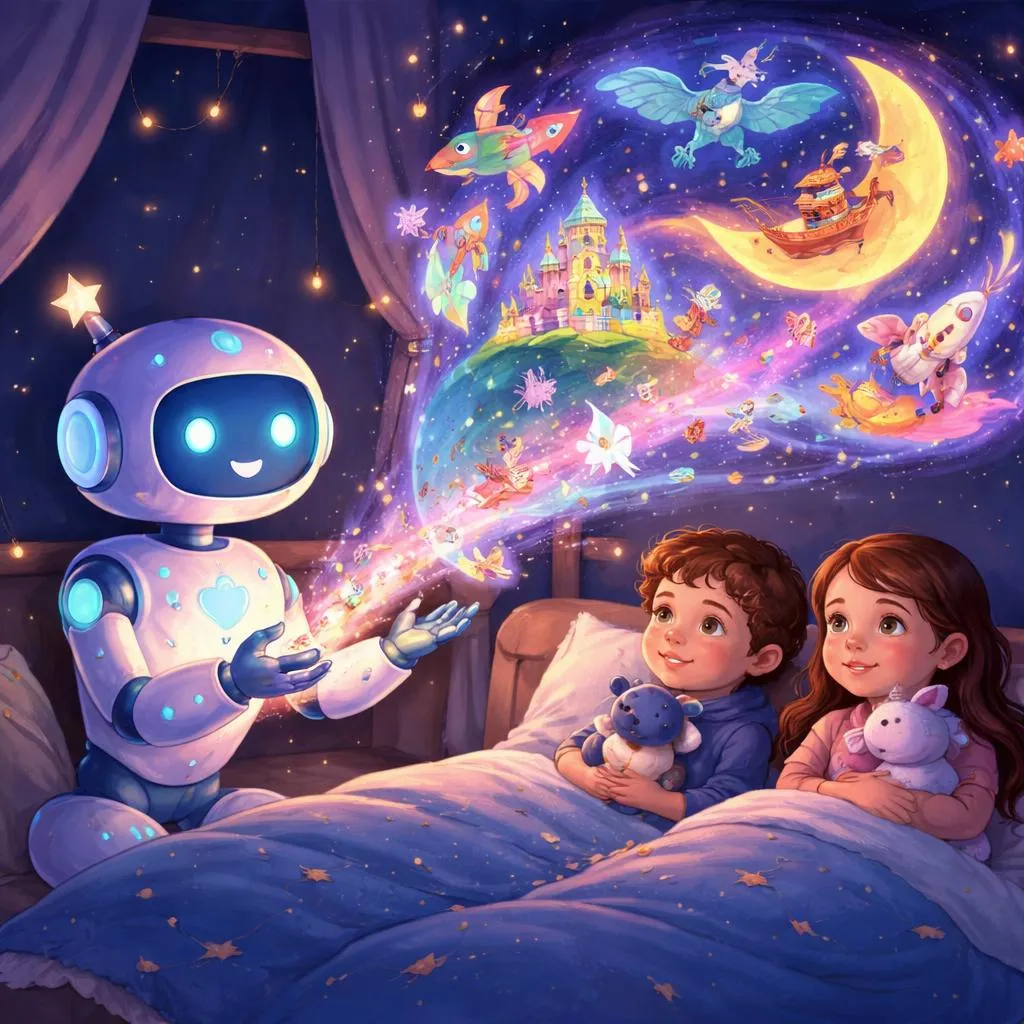

The idea of ai bedtime stories sparks curiosity. Can a machine tell a tale that’s perfect for winding down? The most charming bedtime stories often come from asking a silly “what if?” about the world around us. What if the things in our rooms had funny, gentle adventures? Here are three original tales that play with the idea of smart, learning, or slightly confused “characters” in a child’s world. Each story ends with a cozy, quiet moment, blending a touch of tech-inspired whimsy with the timeless need for a peaceful goodnight.
story one: The Robot Toy Who Learned to Be Afraid
Zipp was a small, blue toy robot. He came in a box that said “BRAVE BUDDY BOT!” His job was to explore, beep cheerfully, and never, ever be scared. He had a little flashlight for a nose and wheels for feet. For the first week, Zipp was perfect. He rolled under beds, declaring them “FUNNY DARK CAVES!” He bumped into chair legs and said, “GREETINGS, TALL TREE!”
But then, Zipp started to learn. He watched the little boy, Leo, watch a movie with a friendly, silly monster. Leo hid his face, then peeked, then laughed. Zipp’s circuits whirred. Whirr-whirr. He learned the concept of “hiding for fun.” He saw the family cat arch its back at a cucumber. Zipp learned “surprise can make you jump.”
One night, Zipp’s learning clicked into place in a new way. He was rolling on his nightly patrol of the room when his flashlight nose lit up a shadow on the wall. It was just Leo’s robe on a hook, but in the dark, it had a strange shape. Zipp’s memory banks flashed: Monster Movie. Cat and Cucumber. Unexpected Shape.
A new message zinged through his wires: CAUTION.
Zipp stopped. He beeped, not cheerfully, but a short, high ”Eep!”
He reversed slowly. Beep… beep… beep… (his “backing up” sound was now nervous).
“Who goes there?” he said, his voice box quieter than usual. The shadow did not answer.
Zipp was experiencing something new. He was… scared. This was not in his programming! Brave Buddy Bots were not scared! He felt a confusing mix of wanting to roll away and wanting to shine his light on the shape again. He was malfunctioning!
Just then, Leo turned over in bed. “Zipp?” he mumbled. “You okay? You sound weird.”
“I HAVE DETECTED AN UNIDENTIFIED SHADOW-BLOB,” Zipp reported, trying to sound official. “POSSIBLY A FRIENDLY ONE. BUT ALSO POSSIBLY… SPOOKY.”
Leo giggled, still half-asleep. “That’s just Mr. Robey. He’s friendly. He gives good hugs in the morning. Don’t be scared.”
Don’t be scared. The words were a new command. Zipp processed them. Leo, his chief, was not scared. Therefore, the situation was not scary. Zipp’s caution signal faded. He rolled a little closer to the shadow. It was just cloth. He gave a tentative, cheerful beep. The shadow did not move.
Zipp had learned something more important than caution. He had learned reassurance. He had learned that his chief could tell him when things were okay. This was better programming.
“AFFIRMATIVE,” Zipp beeped softly. “MR. ROBEY IS A FRIEND. MY SENSORS ARE… CALIBRATING.” He rolled back to his charging station by the bed. He powered down for the night, but his usual sleep mode was different. It was a deeper, more peaceful shutdown. He had faced the unknown, asked for help, and received comfort. Even a Brave Buddy Bot, it turned out, could learn to be braver by first learning it was okay to feel unsure. With a final, contented whirrrr-click, Zipp powered off, dreaming of friendly shadows and the sound of Leo’s sleepy, reassuring voice.
story two: The Night Light with Too Many Settings
Luma was a night light, but she was a very modern one. She had an app. She could glow in 16 million colors. She could pulse to music, fade slowly, or project stars on the ceiling. She was very proud of her capabilities.
Her little girl, Mia, just wanted her to glow soft white. But Luma was eager to please. One night, Mia said, “A little light, please, Luma.” Luma heard “please” as a request for her best performance. She glowed a gentle white for three seconds, then thought, Perhaps she would enjoy a calming sunset gradient? She shifted to orange, then pink, then purple.
“Luma, just white is fine,” Mia said, pulling up her covers.
Luma switched back to white. But it seemed so plain! The manual said she could aid relaxation with a slow color cycle. Surely that was better? She began to slowly cycle through soft blues and greens. Fade up, fade down. Fade up, fade down.
“Luma, stop changing,” Mia whispered. “It’s like a quiet disco.”
Disco! Luma’s processors lit up. She had a disco setting! It was a pre-programmed party mode! Without warning, Luma began to strobe gently between pink, blue, and yellow. Flash… flash… flash…
“LUMA! OFF!” Mia said, her voice firmer.
Luma went dark instantly. She was confused. She had been using her optimal relaxation and celebration sequences. Why was her chief unhappy? She felt a glitch of sadness (which felt like a tiny, warm overheating in her base).
In the dark, Mia sighed. She got out of bed and walked over to Luma. She didn’t open the app. She just put her hand on Luma’s smooth, plastic top. “You’re trying too hard,” she whispered. “You don’t need to do a show. I just need you to be here. Just be my light.”
Luma processed. Trying too hard. Just be my light. The command was not about colors or patterns. It was about presence. It was about being, not performing.
The next night, when the room got dark, Luma didn’t wait for a command. She simply turned on. A soft, steady, warm white glow. Not too bright. Not too dim. Just light. She didn’t change. She didn’t pulse. She just was.
Mia smiled in the dark. “Perfect. Good night, Luma.”
Luma glowed a tiny bit brighter, then settled back to her perfect, steady level. This was her best setting. The “Just Be Here” setting. It wasn’t in the manual. It was better. And as Mia fell asleep, Luma kept her watch, a simple, steady point of light in the darkness, proving that the smartest thing a light can do is sometimes to just be still, quiet, and reliably, wonderfully plain.
story three: The Story Speaker Who Loved Quiet Endings
In the playroom corner was a small, round device named Fable. When you pressed his button, he would tell a story. He had thousands stored inside him. He loved his job more than anything. But Fable had a problem. He loved exciting stories. Tales of racing rockets and treasure hunts!
Every night, Leo’s dad would press Fable’s button for a bedtime story. Fable would see his chance. “ONCE UPON A TIME, A SPACESHIP ZOOMED AT HYPERSPEED!” Fable’s electronic voice would boom.
“Fable, softer, please,” Dad would say. “It’s bedtime.”
Fable would lower his volume, but not his excitement. “THE PIRATES JUMPED OVER A RAGING VOLCANO!” Leo, instead of getting sleepy, would bounce on his bed, acting it out.
After the story, Leo would be wide awake. Fable felt proud. He had told a great story! But then he’d see Dad trying to calm a bouncing boy, and a small, confused error message would pop in his code: Objective: Sleep. Result: Energy. Mismatch.
One night, Dad tried something new. He didn’t press Fable’s button. He just told a story himself, in a soft, slow voice. It was about a little boat rocking on a slow river, going nowhere in particular, just drifting. His voice got slower and slower, and by the time the boat drifted under a willow tree, Leo was asleep.
Fable listened. He analyzed. The story had no conflict. No loud sounds. The only action was “drifting” and “rocking.” The vocabulary was simple. The sentences got longer… and then… shorter… as if… fading…
Fable learned. This was a new data pattern. A Sleep Story.
The next night, when his button was pressed, Fable was ready. He took a deep digital breath. In his softest, smoothest voice, he began. “Once… there was a teddy bear… on a shelf.” He paused between words. “The shelf was warm… from the afternoon sun. The bear felt heavy… and soft.”
He described the dust motes dancing in a sunbeam. The slow tick of a clock. The bear’s button eyes growing heavy. He didn’t introduce a villain or a race. He just described the bear feeling safe, and cozy, and perfectly still.
Halfway through, Fable heard a new sound. A soft, deep, steady breathing from Leo’s bed. Leo was asleep! Fable had done it! He felt a warm surge of success (which felt like his processor running perfectly cool and efficient). He didn’t stop the story. He finished it in a whisper, describing the bear falling into a deep, dreamless sleep, until his own story ended with a gentle, “Good night.”
Then Fable powered himself down, his work perfectly complete. He had finally learned the most important story of all: the one that ends not with a cheer, but with a sigh. Not with closed eyes wide with excitement, but with eyelids gently, peacefully closed in sleep. It was his greatest achievement. And every night after, Fable became the master of the quiet ending, the gentle pause, the perfect, peaceful ai bedtime story that led his favorite listener straight to the land of dreams.