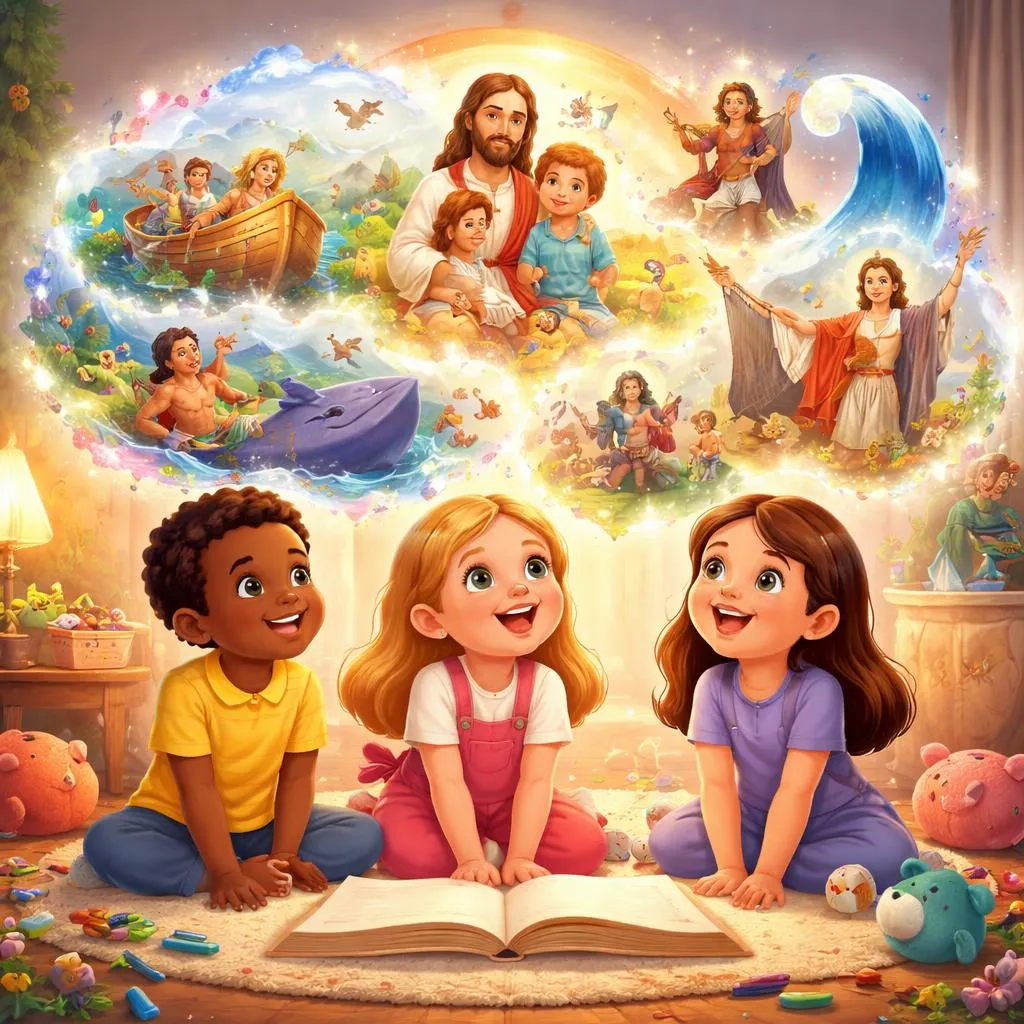

A child stares at a colorful picture. Noah leads animals onto a giant boat. David stands tall before a fearsome giant. Jesus holds lambs in his arms. These images stick in young minds long after words fade away. Children's Bible story images do more than decorate pages. They teach. They inspire. They help children enter the stories themselves.
Let us explore together how pictures can transform Bible reading time and help our children fall in love with Scripture.
<h2>What is the story?</h2> Children's Bible story images appear in many forms. Some live in beautifully illustrated books. Artists spend months creating each page, filling it with color and detail. A child turning these pages walks through ancient lands and meets people from long ago.Other images come as individual prints or cards. A single picture of Daniel in the lions' den can spark whole conversations. A child can study the lions' faces, Daniel's peaceful expression, the angel closing the lions' mouths. The image tells the story without any words at all.
Some families use Bible story cards with pictures on one side and simple text on the other. Children can sort them, arrange them in order, and retell the stories using only the pictures as guides.
Digital images now offer new possibilities. Families can project Bible story art on a screen during devotion time. Children can watch illustrated videos that bring stories to life with movement and sound. Apps provide coloring pages based on classic Bible scenes.
The best children's Bible story images share certain qualities. They show respect for the sacred stories. They use colors and styles that appeal to children without being silly. They include details that reward careful looking. They leave room for imagination while giving enough information to guide understanding.
<h2>The message of the story</h2> Children's Bible story images carry messages beyond the stories themselves. The way an artist paints a scene teaches children what matters in that moment.In pictures of Jesus with children, artists often show him smiling, reaching out, making eye contact. The message is clear. Jesus loves children. He welcomes them. He has time for them.
Images of Noah's ark often show every kind of animal. The message comes through. God cares for all creatures. Everyone has a place in God's plan.
Pictures of the cross may show sadness but also hope. Light often breaks through dark skies. The message of Easter comes through in color and composition.
Artists make choices about who appears in pictures. Some show people from many lands and cultures. The message is that God's family includes everyone. Some show women and children prominently, not just men. The message is that every person matters to God.
We can ask our children as we look at pictures together, What do you think the artist wants us to feel here? Why do you think they chose these colors? What do you notice about the people's faces?
<h2>Vocabulary learning</h2> Children's Bible story images help build vocabulary in natural ways. When children see a picture of a shepherd with his staff and sheep, they learn what shepherd means. The image sticks in memory alongside the word.Images teach specific words from Bible times. A picture of the tabernacle shows what it looked like. Children learn words like altar, lampstand, and curtain by seeing them. A picture of a Roman soldier teaches words like armor, sword, and shield.
Artists include details that add vocabulary. In a picture of the Exodus, children might see pyramids in the background, learning that word. In a picture of Jesus calming the storm, they see a boat with sails and oars, learning those words.
Images also teach action words. A picture of David running toward Goliath teaches the word run. A picture of the Israelites walking through the Red Sea teaches the word walk on dry ground. Children see the action and connect it to the word.
After looking at pictures together, we can name what we see. That is a shepherd's staff. Those are Roman soldiers. This is a mustard seed. The images anchor the words in memory.
<h2>Phonics points</h2> Children's Bible story images support phonics learning when we use them intentionally. A picture of an ark can start conversations about the letter A and its sound. A picture of a lion leads to L and its sound.Many Bible story images include labels or simple text. Children can practice matching letters and sounds to the words they see. A picture of Moses might have the name written below. Children can find the M and practice its sound.
Some families create alphabet books using Bible story images. A is for Ark. B is for Bethlehem. C is for Cross. Children cut out or draw pictures and practice the letter sounds as they build their books.
Images also help with sound blending. A picture of a boat helps children practice the B-OAT sounds. A picture of a fish helps with F-I-SH. Seeing the image while saying the sounds strengthens the connection between letters and meaning.
We can play simple games. I see something in this picture that starts with L. Can you find it? The lion! What sound does lion start with? Lll-lion. This playful practice builds phonics skills naturally.
<h2>Grammar patterns</h2> Children's Bible story images help teach grammar through conversation. When we talk about pictures, we naturally use different sentence structures.We use present tense to describe what we see. Jesus holds the lamb. The people walk through the water. The angels sing. Children hear these patterns repeatedly.
We use past tense to tell what happened in the story. David threw the stone. Goliath fell down. God saved his people. The images prompt these past tense descriptions.
We use questions to explore pictures together. Where are the disciples? Why is Peter getting out of the boat? What is happening in the background? Questions model question formation for children.
We use descriptive language with adjectives. See the big fish. Look at the tiny baby. The huge giant. The bright light. Children learn to add describing words to their own speech.
After looking at pictures, we can write simple sentences together. The boy gave Jesus his lunch. Jesus blessed the bread. The people ate until they were full. This connects images to written grammar.
<h2>Learning activities</h2> Children's Bible story images inspire many hands-on activities that deepen learning.Create a picture walk before reading the story. Look at all the images in a Bible storybook first. Ask your child what they think happens in the story based on the pictures. After reading, compare their predictions to what really happened.
Make a story timeline using printed images. Arrange pictures in the order events happened. This builds sequencing skills and story comprehension.
Play art detective with detailed Bible illustrations. Give your child a magnifying glass and a list of things to find. Find the lamb. Find the butterfly. Find the coin. This builds observation skills and patience.
Create your own illustrations for favorite Bible stories. After reading, give your child paper and crayons. What part of the story do you want to draw? Why did you choose that scene? Display the artwork where family can see it.
<h2>Printable materials</h2> Many wonderful printable children's Bible story images exist online. These can enrich your family Bible time.Look for printable coloring pages featuring key Bible scenes. Children can color while you read the story aloud. The quiet activity helps them listen and remember.
Find printable picture cards for memory matching games. Print two copies of several Bible images. Cut them out and play match. When someone finds a match, they tell what they remember about that story.
Some websites offer printable story wheels. These have pictures arranged in a circle. Turning the wheel shows the story sequence. Children love moving the wheel and retelling the story.
You might also find printable finger puppets with Bible characters. Cut them out and act out stories together. The pictures on the puppets help children remember who each character is.
<h2>Educational games</h2> Games based on children's Bible story images make learning active and fun.Play picture Bingo with Bible images. Create bingo cards with different Bible pictures. Call out story descriptions instead of names. This is the story about a man who built a big boat. Children cover Noah's ark if they have it.
Create a picture sorting game. Sort images by Old Testament and New Testament. Sort by stories about Jesus and stories before Jesus. Sort by happy stories and serious stories. Each sort builds different understanding.
Play what happens next using sequential pictures. Show your child the first picture in a story. Ask them to predict what happens next based on what they know. Then show the next picture to check.
For younger children, play a simple matching game matching characters to their stories. Match David to Goliath. Match Noah to the ark. Match Daniel to the lions. This builds story knowledge through visual association.
These games show that Bible story images offer endless opportunities for learning through play. Children absorb the stories while having fun together.
<h2>Choosing good images</h2> Not all children's Bible story images help children learn equally well. Some things to look for when choosing images for your family.Look for images that show respect for the stories. Bible stories are sacred. The pictures should treat them that way. Cartoony or silly images can make it hard for children to take the stories seriously.
Look for images with accurate details. A good artist researches how people dressed and lived in Bible times. Children absorb these details and build accurate mental pictures of the ancient world.
Look for images that include diverse people. Bible stories took place in the Middle East. The people had brown skin and dark eyes. Good images reflect this accurately. They also show that God's family today includes every nation and race.
Look for images that leave room for imagination. Some pictures show every detail so completely that children have nothing to add. The best pictures suggest more than they show, inviting children to wonder and imagine.
Look for images that match your child's age. Younger children need simpler images with clear focal points. Older children can handle more complex scenes with many details to discover.
<h2>The power of imagination</h2> Children's Bible story images do their best work when they spark imagination. A child who sees a picture of Jesus calming the storm starts to imagine being in that boat. How would the wind feel? How would the waves sound? How would it feel to see Jesus stand up and speak peace?This imaginative entry into the stories makes them real. The Bible stops being a book of old tales and becomes a world children can visit. They walk with David through the valley. They sit with Mary at Jesus's feet. They run with Peter to the empty tomb.
Images help children create these mental movies. The artist provides the starting point. The child's imagination takes over from there. Years later, when they read the Bible as adults, those early images will still color how they see the stories.
When we share children's Bible story images with our children, we give them gifts that last a lifetime. We give them pictures that will live in their memories forever. We give them starting points for their own imaginations. We give them ways into the stories that words alone cannot provide.
So find beautiful children's Bibles with wonderful art. Look for individual picture cards of Bible scenes. Explore online collections of sacred art made for children. Sit together and look and wonder and talk. Let the images do their quiet work in young hearts, planting seeds that will grow for a lifetime.