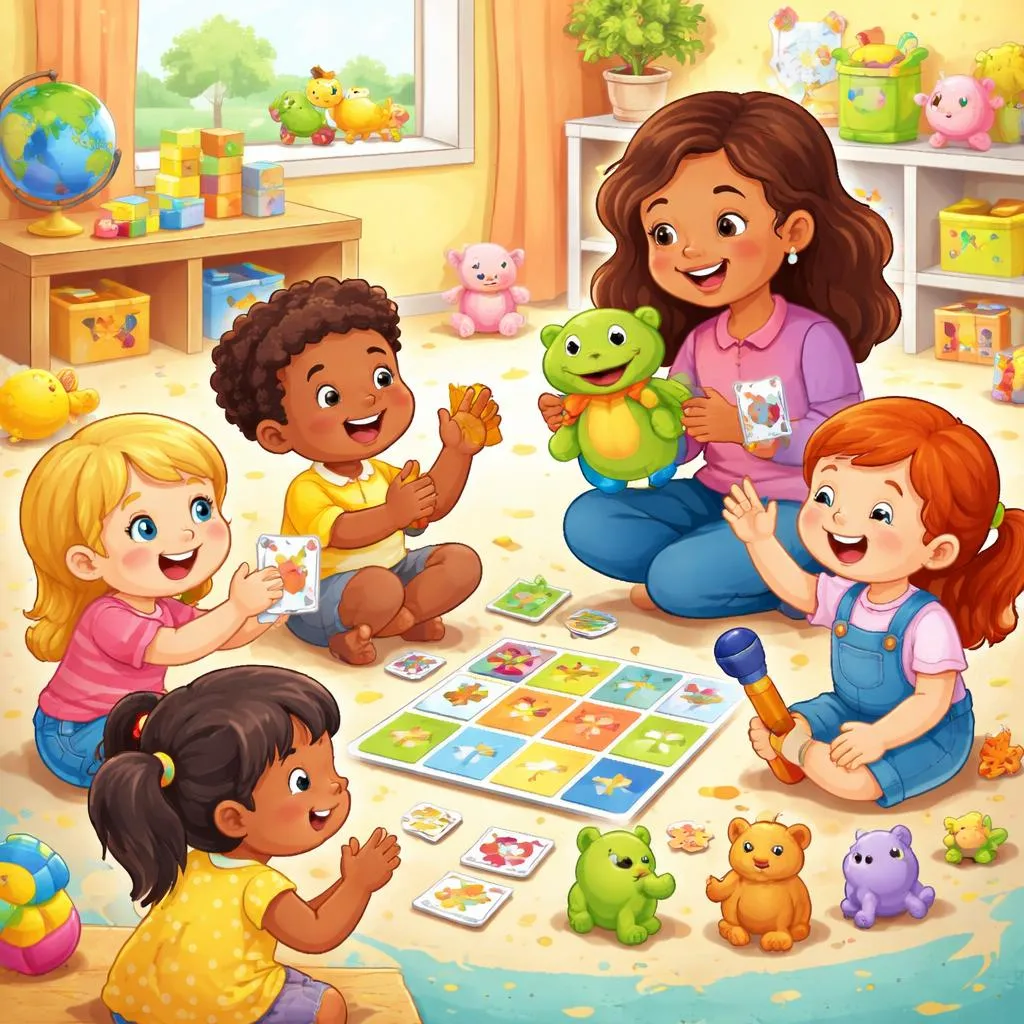

What is communication games for preschoolers?
“communication games for preschoolers” are structured play activities that promote speaking, listening, and social interaction. They combine language practice with movement, imagination, and peer engagement.
In early childhood education, communication games create a natural context for language use. They transform abstract language concepts into real social experiences.
A teacher can use these games in circle time, small groups, and free play sessions. This approach supports both linguistic and social development.
Communication games also promote turn-taking, eye contact, and cooperation. These skills are foundational for effective classroom participation.
Meaning and explanation
Communication games aim to develop expressive and receptive language. Expressive language involves speaking and sharing ideas.
Receptive language involves listening and understanding others. Games provide opportunities to practice both skills in meaningful ways.
In teaching practice, communication games support pragmatic language skills. Pragmatic skills include greeting, requesting, and responding politely.
Games also reduce anxiety around speaking. Playful contexts encourage spontaneous and confident expression.
Teachers can scaffold language with sentence frames and visual prompts. This guidance helps learners participate successfully.
Categories or lists
Communication games can focus on different language domains. Some games emphasize vocabulary and naming objects.
Other games focus on conversation patterns such as asking and answering questions. Role-play games emphasize social interaction and storytelling.
Listening games focus on following directions and identifying sounds. Turn-taking games emphasize social rules and cooperative behavior.
Teachers can organize games by skill focus. This supports systematic language instruction and assessment.
Each category can align with curriculum objectives. This ensures games serve both fun and pedagogical goals.
Daily life examples
Communication games mirror real-life conversations. For example, greeting games simulate classroom greetings.
Request games model asking for materials or help. Sharing games model talking about experiences and feelings.
Role-play games simulate shopping, visiting a doctor, or going to a park. These scenarios connect language with daily experiences.
Teachers can integrate daily routines into games. For example, discussing lunch or weekend plans through play.
Daily examples make communication authentic and meaningful. Authenticity increases motivation and retention.
Simple sentence models support participation. For example, “Can I have the ball?” or “I like apples.”
Printable flashcards
Printable flashcards can support communication games. Flashcards can show emotions, actions, and common classroom objects.
Emotion cards help practice expressing feelings. For example, happy, sad, excited, and tired.
Action cards support verbs like run, jump, and eat. Object cards support nouns like book, toy, and pencil.
Teachers can use flashcards as prompts during games. Learners pick a card and say a sentence about it.
Flashcards can also support question prompts. For example, a picture of a dog prompts “What is this?”
Visual aids reduce cognitive load and support early language production.
Learning activities or games
A greeting circle game can start the day. Learners greet each other with simple phrases like “Hello” and “How are you?”
A show-and-tell game promotes descriptive speaking. Learners bring an object and describe it in simple sentences.
A question ball game can develop conversational turn-taking. Learners throw a ball and ask a simple question to a partner.
A role-play corner can simulate real-life scenarios. Learners act as shopkeepers, doctors, or family members.
A picture guessing game supports descriptive language. One learner describes a picture while others guess.
A story-building game promotes narrative skills. Each learner adds one sentence to a shared story.
A listening and drawing game supports comprehension. Teachers describe an object and learners draw it.
A cooperative board game can include communication prompts. Landing on a square requires saying a sentence or asking a question.
These games integrate speaking, listening, and social interaction. They transform classroom language practice into authentic communication.
Communication games for preschoolers provide structured opportunities for meaningful interaction. They support vocabulary development, sentence construction, and pragmatic language skills.
In teaching practice, games create low-stress environments for oral communication. They also promote social-emotional learning and peer collaboration.
Through consistent use of communication games, learners connect English with real social purposes. They develop confidence, curiosity, and communicative competence through playful and guided interaction.