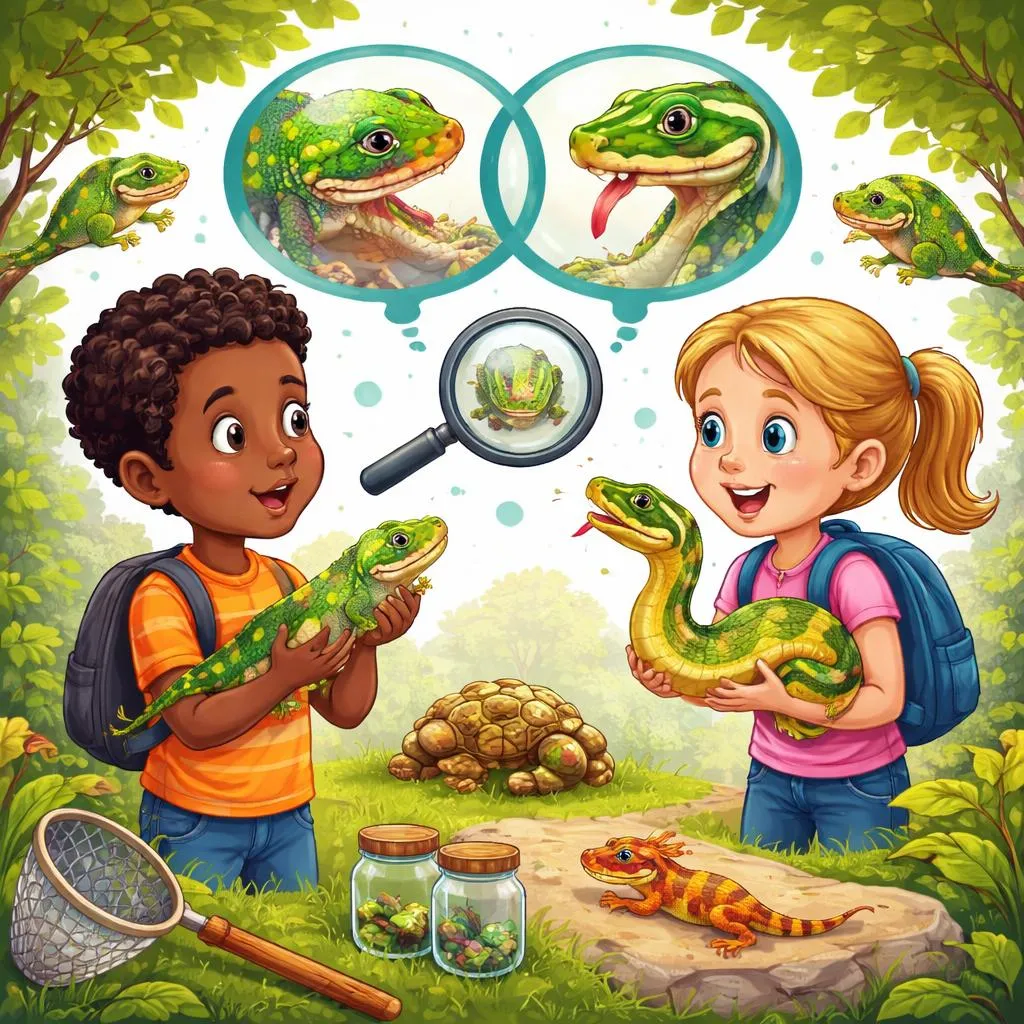

Hello, word explorer! Do you love cool animals? Think about a turtle in a pond. Think about a lizard on a rock. Think about a long, slithering creature. What do you call them all? You might say "snake" for the last one. But what about the others? This is a fun word puzzle. Today we explore a word pair. We explore reptile and snake. They are like word family members. They are related. But they are not the same! Knowing their secret is a superpower. Your animal talk will become smart and clear. Let us start our word adventure!
Be a Word Detective now. Our first clue is at home. You watch an animal show. The host says, "A turtle is a reptile." This is a science fact. Now, you see a picture book. It shows a hissing snake. This is a specific animal. They both describe scaly creatures. But do they mean the same thing? Let us test with two sentences.
"My pet lizard is a cool reptile." This tells us its animal group. "I saw a green snake in the garden!" This tells us the exact animal.
They sound like they are in the same family. And they are! But one is a big group name. The other is a member's name. Your detective mission starts. Let us crawl into their word world.
Adventure! Slither Into the Word World
Feel the Word's Texture!
Feel the word reptile. It is a smooth, cool word. It feels like a scientist's word. It is calm and factual. It is like a smart teacher. The word snake is different. It is a hissing, exciting word. It can feel smooth or scary. It is very direct and visual. Reptile is for learning and sorting. Snake is for pointing and describing. One is a textbook chapter. The other is a storybook picture. Let us see this at school.
You are in science class. Your teacher says, "Crocodiles are ancient reptiles." This is perfect. It teaches a category. Now imagine gym class. You play jump rope. A friend yells, "Move like a snake!" This is perfect too. It gives a clear, wiggly image. Saying "Move like a reptile" is not as clear. It could be a slow turtle! The feeling is different.
Compare Their Size and Family!
Think about a big box and a small toy. The word reptile is the big box. It is a large group. It holds many animals. Turtles, lizards, crocodiles, and snakes are all inside. The word snake is one specific toy inside the box. It is just one type of reptile. Reptile is the whole family name. Snake is one child's name. A snake is always a reptile. But a reptile is not always a snake. The size is different. Let us test this on the playground.
You play a guessing game. You say, "I am thinking of a reptile with a shell." Your friend guesses "turtle!" Correct. The word reptile gave a big clue. Now you say, "I am thinking of a legless reptile." Your friend might guess "snake!" Correct. Here, snake is the specific answer inside the big reptile group. The word reptile leaves room for many answers. The word snake points to one.
Meet Their Best Word Friends!
Words have favorite teams. The word reptile likes science and group words. It teams up with 'family', 'species', 'park', and 'scale'. You visit a reptile house at the zoo. You study reptile scales. The word snake likes descriptive and action words. It teams up with 'venomous', 'grass', 'charm', and 'pit'. You see a grass snake. You avoid a venomous snake. Their friends are different. Let us go back to school.
You draw for art class. You say, "I will draw a reptile habitat." This sounds right for a science project. Now, you tell a spooky story. You say, "A snake slithered in the dark." This sounds right for a tale. You would not say "A reptile slithered" in a story. It is less specific and less exciting. The word friends help set the scene.
Our Little Discovery!
We explored the animal word family. We made a clear discovery. The words reptile and snake are family. But they are not twins. The word reptile is a big category word. It is a science word for scaly animals. They are cold-blooded. They lay eggs. The word snake is a specific animal name. It is one kind of reptile with no legs. Reptile is the big team. Snake is one player on the team. One is the group. The other is a member.
Challenge! Become a Word Zoo Keeper
"Best Choice" Challenge!
Let us play in the wild. Read each scene. Pick the champion word. Scene one: You visit the zoo. You see an area with iguanas, tortoises, and pythons. The sign says, "Welcome to the ______ House." Is it Reptile or Snake? The champion is Reptile House! It fits all the animals there. Scene two: You are hiking. You see a long, thin animal move in the grass. It has no legs. You whisper, "Look, a ______!" Is it reptile or snake? The champion is snake! It is the perfect, specific word for that animal. Great job!
"My Sentence Show"!
Now, create your own sentences. Here is a fun scene: Imagine a hot, dry desert. Use the word reptile in one sentence. Use the word snake in another. Try it! Here is an example. Sentence one: "Many reptiles live in the desert sun." Sentence two: "A sidewinder snake moves in a funny way." See the difference? The first sentence talks about a whole group. The second sentence describes one special member.
"Eagle Eyes" Search!
Can you find the word that needs help? Read this sentence: "My favorite reptile is the king cobra because it is so fast." Hmm. This sentence is almost perfect. The king cobra is a reptile. But the word snake is more direct and common here. "My favorite snake is the king cobra because it is so fast." This sounds more natural. It is more specific. You made it better!
What a cool exploration! You started as a curious listener. Now you are a word biologist. You know the secret of reptile and snake. You can feel their different textures. You see their family size. You know their best word friends. This is a real language superpower.
You can learn amazing things from this article. You now know that 'reptile' is the big group name for animals like turtles, lizards, and snakes. You understand that 'snake' is the specific name for a long, legless reptile. You can explain that all snakes are reptiles, but not all reptiles are snakes. You learned to use 'reptile' for science facts and 'snake' for clear, exciting stories.
How can you use this today? It is easy and fun. Next time you visit a zoo or watch a nature show, be a detective. Point to the turtle and say, "That's a reptile!" Point to the python and say, "That's a snake and a reptile!" Read a book about animals. Find the word 'reptile' in the index. Find the word 'snake' in a story. You are using your new knowledge every day.
Keep your scientist eyes open. The world is full of amazing word families. You can explore them all. Great work, word explorer. Your English adventure is getting more exciting with every new word pair you discover!