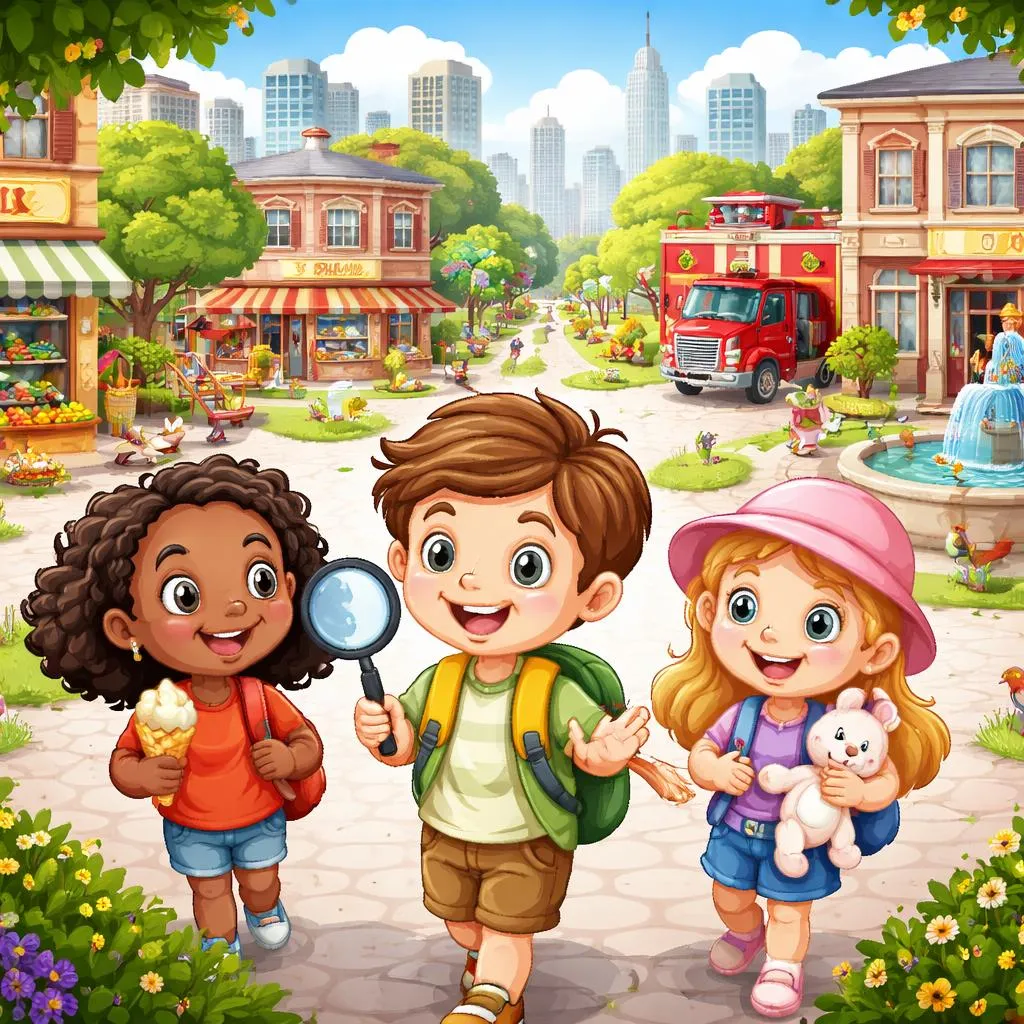

What Is The Rhyme? Many educational songs help children learn about their community. A song about the places of the city is a perfect example. This type of rhyme takes us on a musical journey through a town. It lists and describes common locations we all know. The melody is usually upbeat and easy to follow. The lyrics are simple and repetitive. They might go: "Let's go to the city, see what we can see. A park, a shop, a library!" Singing about the places of the city turns a vocabulary list into an adventure. It builds familiarity with the words in a fun, engaging way.
The Lyrics of Nursery Rhymes Typical lyrics of nursery rhymes about the city follow a clear pattern. They often use the structure "This is the..." or "Let's go to the...". For example: "This is the fire station, tall and red. This is the bakery with fresh bread." Another common lyric style is question and answer. "Where do we buy food? At the grocery store! Where do we read books? At the library door!" The rhymes are straightforward. Words like "store" and "door" or "school" and "pool" often rhyme. This predictability helps with memory and pronunciation.
Vocabulary Learning This theme is a goldmine for vocabulary. We learn the names of many places of the city. Core words include: park, school, library, hospital, fire station, police station, supermarket, bakery, restaurant, cinema, playground, bus stop. We can group these words by function. Service Places: hospital, police station. Fun Places: park, cinema, playground. Shopping Places: supermarket, bakery. We also learn related action verbs: go to, visit, buy, read, play, eat. Connecting the place to its purpose is key. "We read books at the library. We buy food at the supermarket."
Phonics Points The names of places of the city offer rich phonics practice. We focus on beginning blends and syllables. The /st/ blend in "station." The /br/ blend in "library." The /pl/ blend in "playground." We can practice the soft "c" sound in "city" and "cinema." Breaking down compound words is very useful. "Play-ground" has two parts. "Fire-station" has two parts. "Super-market" has two parts. We also notice common endings like "-ary" in library and "-ent" in restaurant. Clapping the syllables for each place name builds phonological awareness.
Grammar Patterns Singing about the places of the city introduces essential grammar. The most important is the preposition "at" for location. We say, "We are at the park." "She works at the hospital." We also use "in" for larger areas. "We live in the city." We practice the question word "Where?". "Where are you?" "I am at the bus stop." We can practice simple present tense for routines. "We go to school every day." "They play at the park on Saturday." These patterns form the basis for giving directions and describing daily life.
Learning Activities Interactive activities bring the city to life. Try "City Map Create." Draw a simple street grid on a large paper. Provide pictures or word cards for different places. Children place them on the map and say, "The hospital is next to the park." Another activity is "Who Works Here?" Show a picture of a place. Children name the community helper. "A firefighter works at the fire station." For a listening game, play "I Spy with City Places." Say, "I spy a place where we can watch a movie." Children guess, "The cinema!"
Printable Materials Printables make learning visual and hands-on. Create a "My City" mini-book. Each page says, "This is the ______." Children draw the place and write the word. "City Places Bingo" cards are always popular. Use pictures of different locations. Design a "Cut and Paste City Scene." Provide a street background and separate images of buildings. Children glue them on and label them. A "Matching Worksheet" can connect a place picture to its function. For example, a book picture matches the word "library."
Educational Games Games make practice fun and memorable. "City Charades" is a lively game. A child acts out an activity from a city place (like reading a book or buying groceries). Others guess the place. "Where Am I Going?" is another good game. One child says, "I need to mail a letter." Others say, "You are going to the post office!" For an active game, create a "City Obstacle Course." Set up stations labeled "Park," "School," "Store." Children move to each station and perform a related action, like pretending to swing at the "Park."
Mastering the places of the city does more than build vocabulary. It helps children understand their community and how to talk about it in English. From asking for directions to sharing what they did on the weekend, these words are used daily. The musical and playful approach through songs and games makes the learning process enjoyable and effective. Each new place name learned is a step toward greater confidence and fluency. So, explore your own neighborhood, sing about the places you see, and watch as a child's ability to describe their world in English grows with every new location they discover.