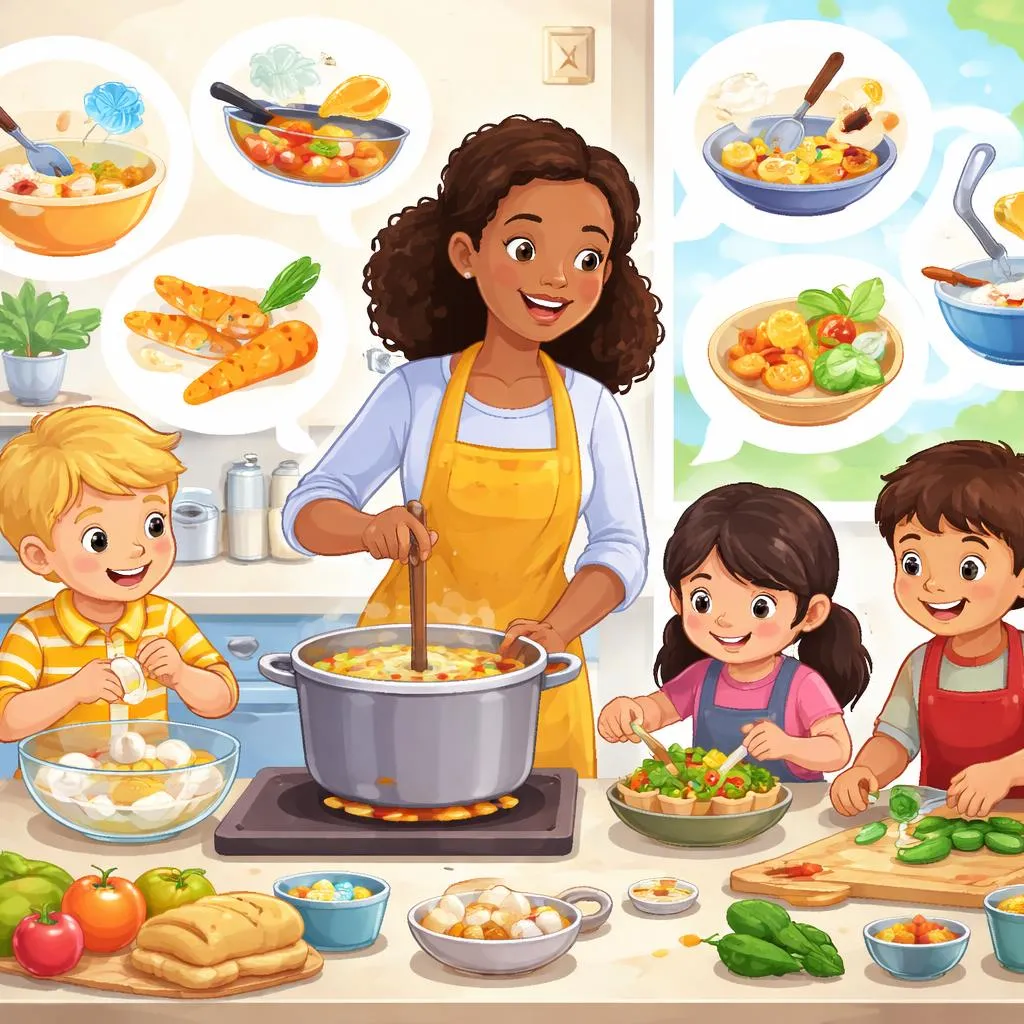

Cooking verbs describe actions used in the kitchen.
Teachers explain that cooking verbs tell what people do with food. They connect language with daily life and real actions.
Examples include cook, cut, stir, bake, and fry. These verbs help describe recipes and routines.
Teachers model sentences with clear structure. “I cut the apple.” “We bake a cake.”
Cooking verbs support both vocabulary and grammar learning.
Conjugation
Cooking verbs change form based on tense and subject.
Teachers explain base form, third person singular, and past form. Cook becomes cooks and cooked. Bake becomes bakes and baked.
Short examples help learners notice patterns. “She cooks soup.” “They baked bread.”
Teachers connect conjugation with real cooking actions. This makes grammar meaningful and concrete.
Present tense
Present tense cooking verbs describe actions happening now or usually.
“I cook dinner.” “He cuts vegetables.” “She stirs the soup.” “We wash the dishes.”
Teachers highlight subject-verb agreement. He cooks, she bakes, it boils.
Chanting patterns help internalize forms. Cook, cooks, cook. Bake, bakes, bake.
Present tense fits daily routines and classroom role play.
Past tense
Past tense cooking verbs describe finished actions.
“I cooked pasta.” “They baked cookies.” “He fried eggs.”
Teachers explain regular and irregular forms. Cooked and baked follow -ed patterns. Eat becomes ate, and make becomes made.
Short sentences keep grammar clear. Repetition strengthens recognition of past tense patterns.
Future tense
Future tense cooking verbs describe plans and predictions.
“I will cook soup.” “We are going to bake a cake.” “She will chop onions.”
Teachers link future tense with planning a meal. This supports practical communication tasks.
Classroom projects like planning a menu reinforce future tense usage.
Questions
Cooking verbs appear in questions during conversations and lessons.
“Do you cook at home?” “What do we bake today?” “Will you wash the dishes?”
Teachers model question forms and short answers. “Yes, I do.” “No, I don’t.”
Role play supports speaking confidence and real interaction skills.
Other uses
Cooking verbs appear in instructions and imperatives.
“Cut the carrot.” “Stir the soup.” “Bake for ten minutes.”
Teachers explain that imperative verbs give commands or directions. Recipes often use imperative forms.
Cooking verbs also appear in stories and songs about food. They help connect language with culture and daily life.
Teachers integrate cooking verbs into reading and writing tasks.
Learning tips
Teachers use real objects or pictures to teach cooking verbs. Visuals help connect actions with words.
Demonstration works well. Teachers pretend to cut, stir, or pour. Learners repeat the verbs aloud.
Sentence frames support structured practice. “I can ___.” “We like to ___.”
Teachers encourage simple cooking diaries. Short sentences describe what happens in the kitchen.
Frequent recycling in classroom routines builds long-term retention.
Educational games
Cooking verbs become memorable through interactive learning.
Kitchen action game
Teachers call out a verb like “stir.” Learners act out the verb with gestures.
Recipe role play
Learners pretend to be chefs and give instructions. “Cut the banana.” “Mix the milk.”
Verb card sorting
Teachers provide verb cards and tense cards. Learners match cook with cooked or will cook.
Sentence cooking game
Teachers give ingredient cards and verb cards. Learners create sentences like “I bake bread.”
Cooking verb story chain
Teachers start a story about cooking. Learners add sentences using cooking verbs.
This builds narrative skills and grammar control.
Cooking verbs connect language learning with real-world experiences. Teachers guide learners to notice meaning, tense, and sentence structure through practical examples. Cooking verbs support vocabulary growth, grammar accuracy, and communication confidence. When learners talk about cooking, language becomes concrete, purposeful, and enjoyable in every classroom interaction.