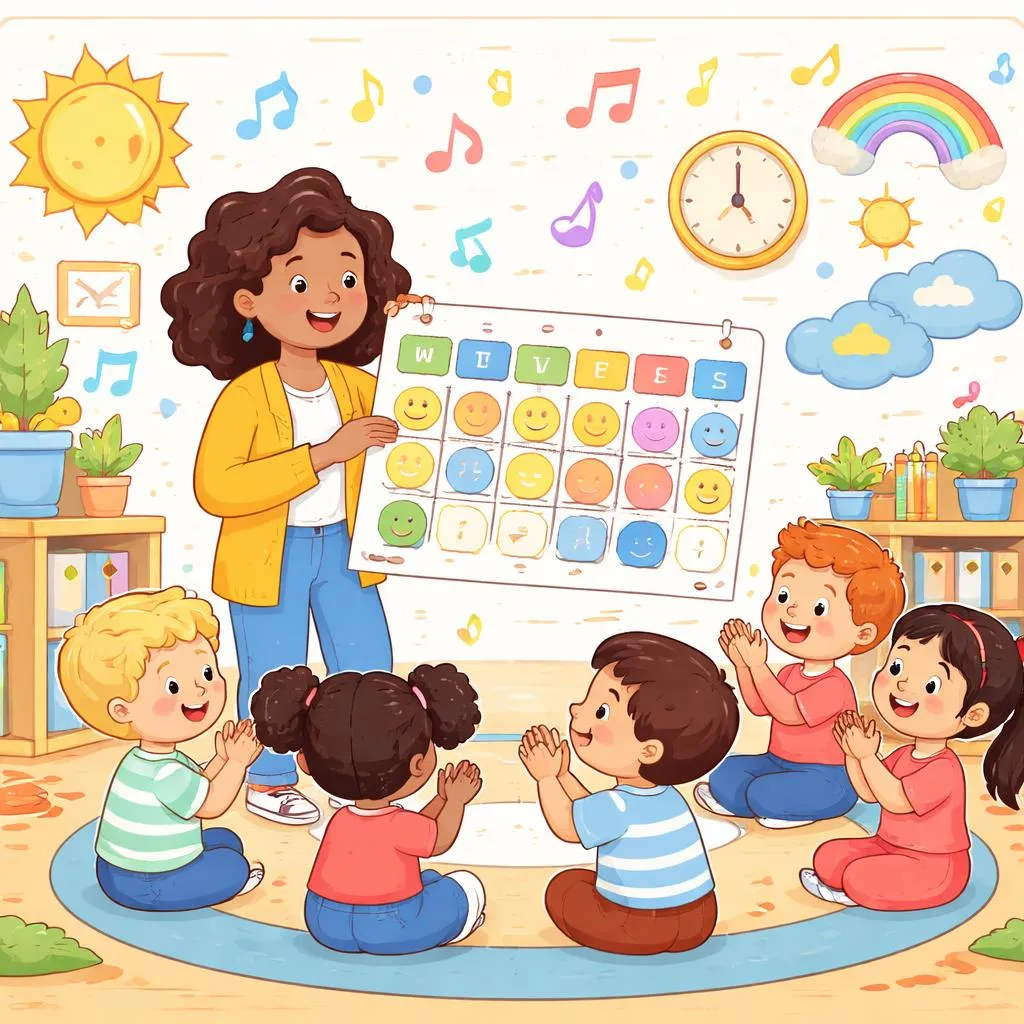

What is the rhyme?
“Days of the week lyrics” refers to songs that teach the seven days in English. These songs appear in classrooms, learning apps, and children’s videos.
Teachers use these lyrics to introduce time concepts in a friendly way. Music creates structure and rhythm that support memory and attention.
The days of the week song often follows a simple melody. Repetition helps learners recall the order of the days quickly.
This topic also connects language learning with daily routines and schedules. It creates a bridge between vocabulary and real-life communication.
The lyrics of nursery rhymes
Days of the week songs usually include the seven days in sequence. A common version follows this pattern:
“Sunday, Monday, Tuesday too, Wednesday, Thursday just for you, Friday, Saturday, that’s the week, Seven days we love to speak.”
Teachers often adapt lyrics to match classroom goals. Adaptations may include clapping or gestures for each day.
Cumulative or repetitive structures reinforce sequencing skills. Learners predict the next day and join the chant confidently.
Songs may include rhythm breaks to practice pronunciation. This approach builds listening accuracy and speaking confidence.
Vocabulary learning
Days of the week lyrics introduce time vocabulary in a natural context. The seven key words are Sunday, Monday, Tuesday, Wednesday, Thursday, Friday, and Saturday.
Teachers explain that these words are proper nouns. Each day starts with a capital letter in English.
Vocabulary can expand with phrases like weekday and weekend. Learners connect words with school days and rest days.
Daily routine words appear in classroom discussions. Examples include school, homework, play, and family.
Teachers model simple sentences such as “Today is Monday.” Contextual practice helps learners use days in real communication.
Songs also introduce sequencing language like first, next, and last. These words support logical thinking and narrative skills.
Phonics points
Days of the week lyrics support phonics through rhythm and repetition. The word day includes the long vowel sound /eɪ/.
Teachers compare day with play and say. This builds awareness of the ay spelling pattern.
Consonant clusters appear in words like Thursday. Teachers can isolate sounds like /θ/ in Thursday.
Stress patterns help learners hear syllables. For example, Wed-nes-day and Sat-ur-day show clear syllable breaks.
Syllable clapping activities improve phonological awareness. Songs provide repeated exposure to complex word structures.
Rhymes within the song reinforce sound patterns. Rhyming pairs like too and you support vowel recognition.
Grammar patterns
Days of the week lyrics introduce basic time expressions. Teachers model sentences in the present tense.
Examples include “Today is Tuesday” and “We study on Wednesday.” Present tense describes current routines and schedules.
Prepositions of time appear frequently. Words like on and at show when activities happen.
Teachers explain that English uses on with days. Simple examples clarify usage in context.
Plural forms appear in phrases like days of the week. Teachers highlight singular and plural distinctions.
Question forms support communication practice. For example, “What day is today?”
Grammar instruction becomes meaningful when linked to daily routines. Songs provide a natural framework for sentence practice.
Learning activities
Movement activities connect days with gestures. Teachers assign a clap or jump to each day in the song.
Total Physical Response strengthens comprehension. Movement links language with physical memory.
Calendar activities reinforce days of the week vocabulary. Teachers point to the calendar while singing.
Role-play activities simulate classroom routines. Learners introduce the day and describe planned activities.
Sentence-building tasks integrate grammar with vocabulary. For example, “On Friday, we play.”
Drawing and labeling activities connect visual learning with language. Learners draw a weekly schedule and label each day.
Sequencing cards allow learners to arrange days in order. This builds logical sequencing and narrative skills.
Story prompts connect days with events. Teachers guide short stories like “On Sunday, we visit family.”
Digital learning platforms offer interactive songs and quizzes. Teachers integrate technology for blended instruction.
Printable materials
Printable lyric sheets support reading practice. Teachers highlight days in bold for visual emphasis.
Flashcards with each day help with recognition and recall. Color coding distinguishes weekdays and weekends.
Phonics worksheets focus on ay and day patterns. Tracing exercises improve handwriting and spelling.
Weekly schedule templates allow learners to write routines. This integrates writing with time vocabulary.
Cut-and-paste sequencing worksheets help rebuild the week order. This strengthens comprehension and memory.
Mini-books present one day per page with a simple sentence. Learners illustrate each page to deepen engagement.
Board game templates with days prompts encourage speaking practice. Each square requires saying a sentence with a day word.
Educational games
Call-and-response singing games increase participation. Teachers pause and learners sing the next day.
Memory chain games challenge recall of the full week sequence. This strengthens working memory and listening skills.
Calendar race games ask learners to point to the correct day. Speed and accuracy improve recognition.
Question-and-answer games practice real communication. For example, “What day comes after Thursday?”
Role-play games simulate classroom announcements. Learners act as the teacher and announce the day.
Creative rewriting games encourage adding activities to each day. This integrates vocabulary, grammar, and creativity.
Digital quizzes test listening and spelling skills. Teachers use online tools for practice beyond the classroom.
Group projects involve creating a weekly poster. Learners label days and describe activities in English.
Storytelling circles connect days with personal narratives. Teachers guide sentence frames for speaking practice.
Days of the week lyrics provide a structured and joyful entry into time vocabulary. They connect rhythm, routine, and real-life communication in a meaningful way. With guided instruction, these songs support vocabulary growth, phonics awareness, grammar development, and confident daily language use in the classroom.