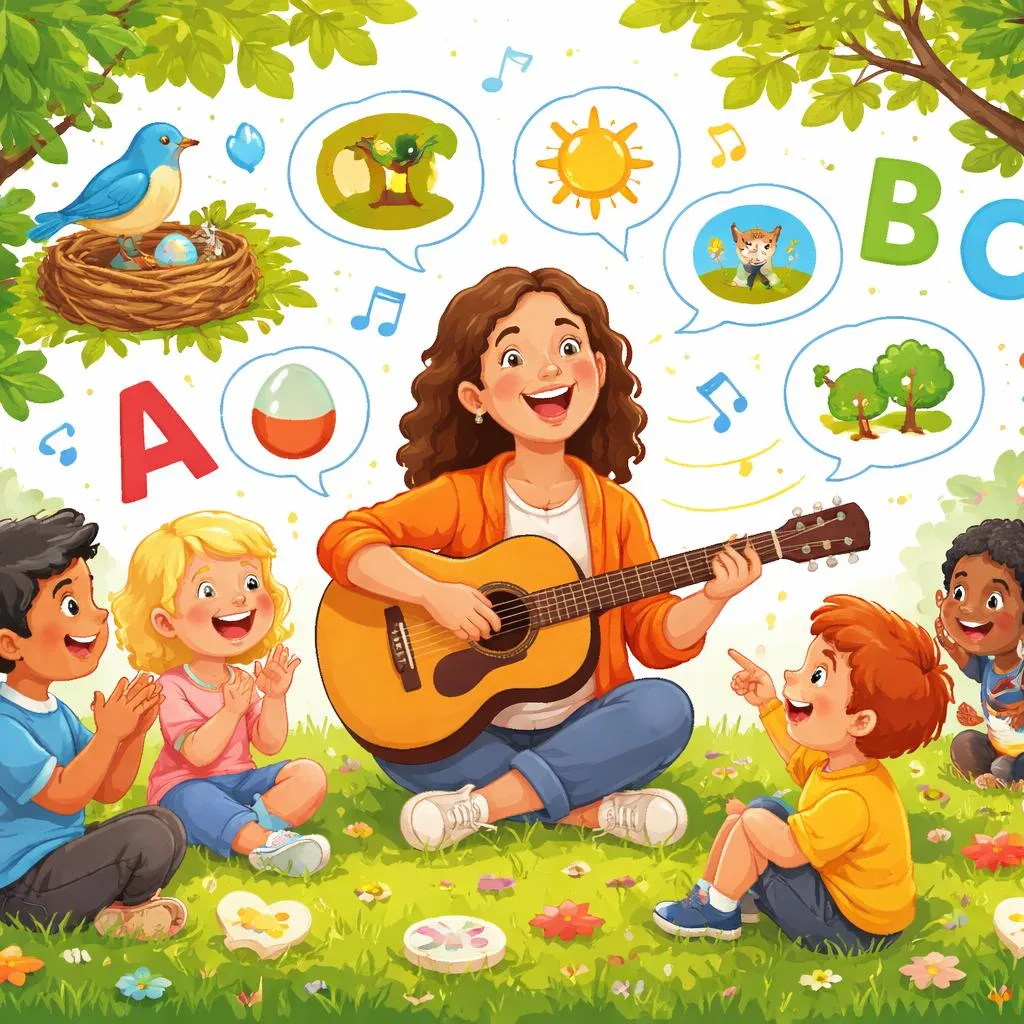

What is the rhyme?
“Lyrics and the green grass grew all around” refers to a classic cumulative folk song used in early childhood education. The song builds a chain of animals and objects that live around a tree.
Teachers use this rhyme to support listening skills, memory, and sequencing. The cumulative structure makes it ideal for repetition and language reinforcement.
This rhyme also introduces nature vocabulary and simple ecological ideas. It connects language learning with science and storytelling.
In the classroom, this song works well for group singing and movement activities. Rhythm and repetition help learners internalize English patterns naturally.
The lyrics of nursery rhymes
“The Green Grass Grew All Around” follows a cumulative storytelling pattern. Each verse adds a new animal or object in a logical chain.
Typical teaching lyrics include a tree, a nest, a bird, a cat, a dog, and a farmer. Each verse repeats all previous lines in reverse order.
This repetitive structure strengthens memory and sequencing skills. Learners predict upcoming lines and join in confidently.
Teachers often adapt lyrics to match classroom vocabulary goals. Simplified versions keep language accessible and age-appropriate.
Songs with cumulative patterns support working memory development. They also build narrative awareness and logical thinking.
Vocabulary learning
Lyrics and the green grass grew all around introduce nature and animal vocabulary. Words like tree, grass, nest, bird, cat, dog, and farmer appear in the song.
Teachers can expand vocabulary with related words such as leaf, branch, field, and farm. This builds semantic networks around nature topics.
Action verbs appear in the rhyme. Examples include grew, sat, lived, caught, and chased.
Descriptive words like green, big, and little add expressive detail. Teachers model simple sentences using these words.
For example, “The bird sat in the nest.” Contextual sentences support comprehension and meaningful use.
Phonics points
This rhyme provides many opportunities for phonics instruction. The word green highlights the long vowel sound /iː/.
Teachers can compare green with tree and see. This builds vowel pattern awareness.
Rhyming patterns appear throughout the song. Words like tree, me, and free reinforce rhyme recognition.
Consonant sounds such as gr in grass and tr in tree support blend practice. Teachers can isolate blends and practice pronunciation.
The cumulative structure encourages repeated reading and singing. Repeated exposure improves decoding and fluency.
Syllable practice can use words like far-mer and lit-tle. Clapping syllables builds phonological awareness.
Grammar patterns
Lyrics and the green grass grew all around use simple past tense forms. Words like grew, sat, and lived describe past events.
Teachers can explain that past tense talks about what happened before. Simple examples clarify the concept.
For instance, “The grass grew,” and “The bird sat in the nest.” Short sentences support early grammar understanding.
Prepositions appear frequently in the song. Words like in, on, and around show location.
Teachers can model spatial sentences such as “The cat sat on the mat.” This connects grammar with real-world spatial concepts.
Cumulative sentences also demonstrate clause chaining. Teachers can show how sentences connect ideas logically.
Learning activities
Singing with gestures helps connect language with movement. Teachers can create gestures for each animal and object.
Total Physical Response supports comprehension and memory. Movement reinforces meaning without translation.
Sequencing cards allow learners to arrange animals in correct order. This activity builds narrative structure and logical thinking.
Role-play activities encourage learners to act as animals in the song. Each role uses simple descriptive sentences.
Drawing and labeling tasks connect art with vocabulary learning. Learners draw a tree and label animals around it.
Sentence-building exercises connect grammar with the rhyme. For example, “The dog chased the cat.”
Story extension activities invite creative thinking. Teachers ask learners to add a new animal to the song.
Digital learning tools can include interactive sequencing games. Listening tasks test comprehension of cumulative lyrics.
Printable materials
Printable lyric sheets support reading practice. Teachers can highlight repeated phrases and key vocabulary.
Flashcards with animals and nature objects reinforce word recognition. Color images help visual learners.
Phonics worksheets focus on long vowel sounds in green and tree. Tracing exercises support handwriting development.
Cut-and-paste sequencing worksheets allow learners to rebuild the song structure. This strengthens comprehension and memory skills.
Mini-books can present each verse on a separate page. Learners read and illustrate each page.
Board game templates with nature themes encourage speaking practice. Each square prompts a sentence from the rhyme.
Educational games
Call-and-response singing games increase participation. Teachers pause and learners complete the next line.
Memory chain games challenge learners to recall cumulative verses. This strengthens working memory and listening skills.
Rhyming games help identify word families. Learners match tree with me and free.
Role-play games simulate a farm or nature scene. Learners describe what happens using past tense sentences.
Question games practice comprehension. For example, “Who sat in the nest?”
Creative rewriting games invite learners to add new verses. This activity integrates vocabulary, grammar, and creativity.
Digital quizzes test listening and sequencing skills. Teachers use technology for blended learning environments.
Group mural projects encourage collaboration. Learners label animals and describe the scene in English.
Storytelling circles invite learners to retell the song as a story. Teachers guide with sentence frames and prompts.
Lyrics and the green grass grew all around offer a structured, engaging, and educational tool for early English learning. The rhyme connects music, nature knowledge, and language patterns in a memorable format. With guided instruction, this classic song becomes a foundation for vocabulary growth, phonics awareness, grammar understanding, and joyful classroom interaction.