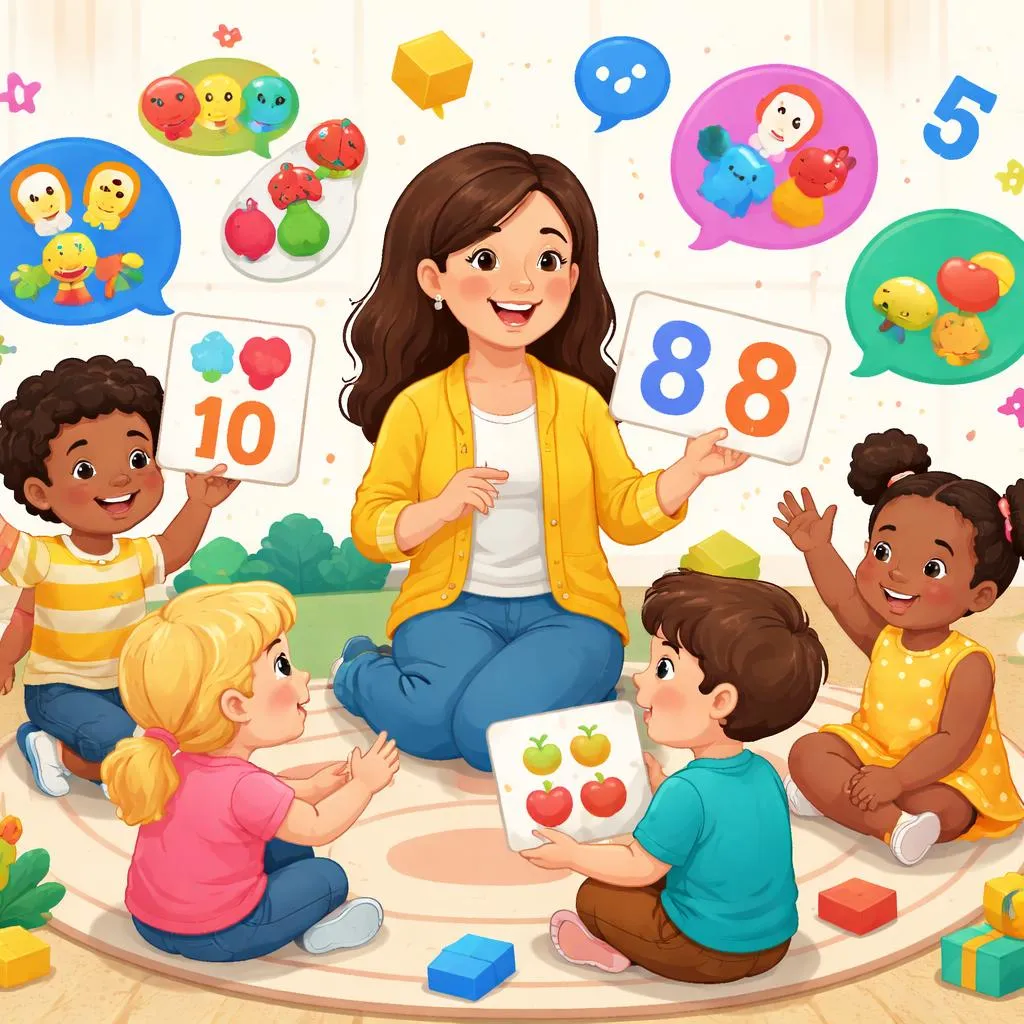

What is number learning?
Number learning refers to understanding numbers and how to use them in daily life. It includes counting, reading numbers, and using numbers in simple math.
This topic connects language learning with early mathematics. It also supports logical thinking and problem-solving skills.
Teachers often start with spoken numbers before written numbers. This helps learners link sounds with symbols.
Meaning and explanation
Number learning means recognizing numbers and understanding their meaning. It includes number names, number symbols, and quantities.
For example, “three” means a group of three objects. The symbol “3” represents that quantity.
Teachers guide learners to connect words, symbols, and objects. This triple connection strengthens comprehension.
Number learning also supports everyday communication. People use numbers to talk about age, time, prices, and dates.
Categories or lists
Numbers can be taught in clear stages to support structured learning.
Counting numbers
Counting numbers start from one and continue forward. Examples include one, two, three, four, and five.
Teachers introduce counting with real objects like blocks or toys.
Zero
Zero represents nothing. It helps explain the idea of empty sets and starting points.
This concept supports later math learning.
Even and odd numbers
Even numbers can be divided into two equal groups. Odd numbers leave one extra.
Teachers can use objects to show this visually.
Large numbers
Large numbers include tens, hundreds, and thousands. This category supports place value understanding.
Teachers can show how 10 ones make one ten.
Ordinal numbers
Ordinal numbers show order. Examples include first, second, and third.
These numbers help describe position in a line or race.
Daily life examples
Numbers appear in many real-life contexts. Teachers can model simple and meaningful sentences.
“I have two pencils.” “There are five apples.” “My age is seven.” “We start class at nine.”
These sentences connect number learning with daily communication.
Teachers can also ask questions. “How many books?” “What time is lunch?”
This practice encourages both speaking and listening.
Teachers can connect numbers with classroom routines. Counting students, counting steps, or counting days in a week builds relevance.
Printable flashcards
Printable flashcards support recognition and memory. Each card can show a number and matching objects.
For example, a card shows “4” with four stars. Another card shows the word “four.”
Teachers can use large flashcards for group instruction. Small cards work well for pair practice.
Flashcards can also include simple sentences. “Four cats run.” This integrates reading with number learning.
Teachers can laminate cards for repeated use. Durable materials support long-term classroom activities.
Learning activities or games
Number learning becomes effective through active practice.
Counting circle activity
Learners sit in a circle and count aloud in order. This builds confidence and pronunciation accuracy.
Number hunt
Place number cards around the classroom. Call out a number and invite learners to find it.
This activity combines movement and recognition.
Object counting game
Provide small objects like beads or blocks. Ask learners to count and say the number.
This connects abstract numbers with concrete quantities.
Number sentence builder
Prepare cards with numbers and simple nouns. Learners create sentences like “Three dogs.”
This activity integrates vocabulary and grammar.
Ordinal number race
Line up objects and ask which is first, second, or third. This teaches order and descriptive language.
Math chant and rhythm
Create a chant for numbers from one to ten. Rhythm supports memory and pronunciation.
Number learning supports early math skills, logical thinking, and real-world English communication. Teachers can integrate counting, speaking, reading, and writing into one coherent learning experience. With visuals, movement, and meaningful contexts, number learning becomes engaging and effective for young learners and builds a strong foundation for future academic success.