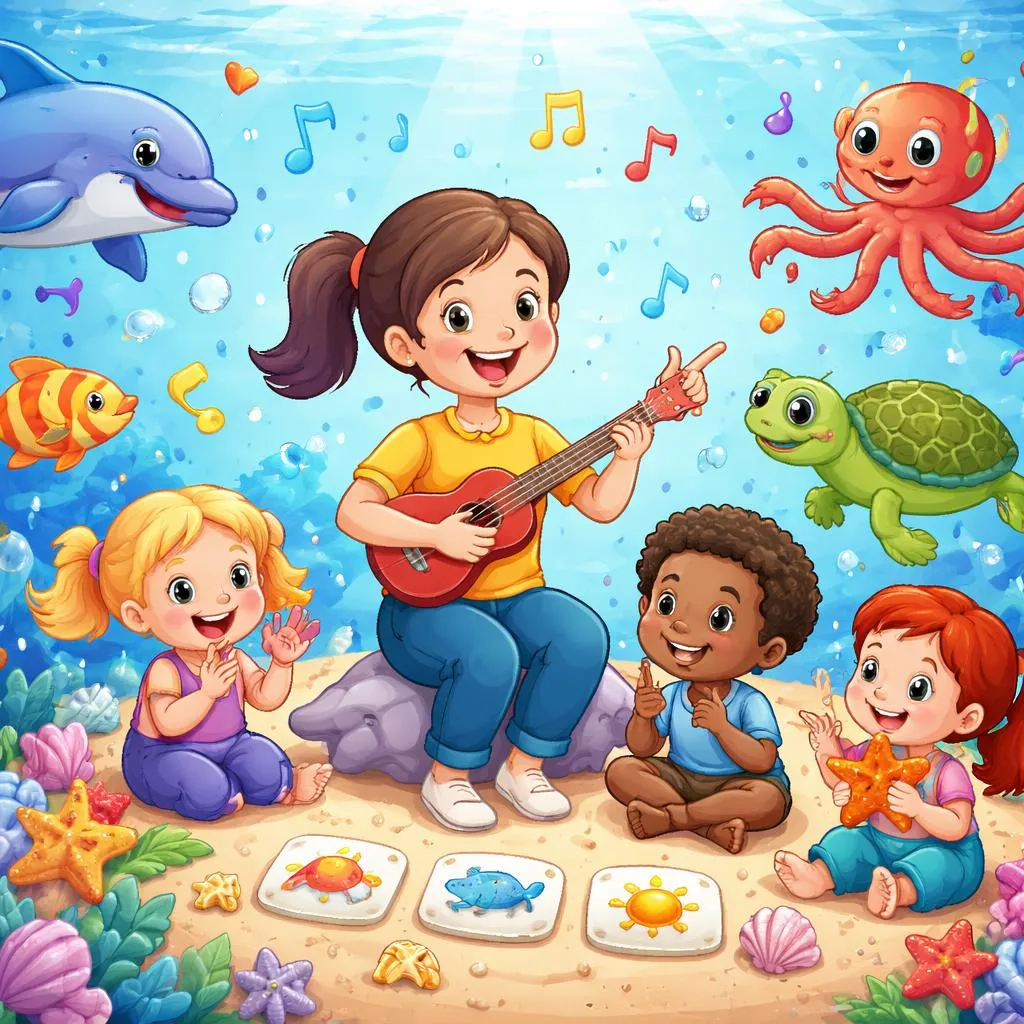

What is the rhyme?
“Under the sea song with lyrics” refers to ocean-themed songs used in classrooms and children’s media. These songs describe marine life, underwater scenes, and playful adventures in the sea.
Teachers often use this song theme to connect English learning with science and nature topics. Music creates a strong emotional connection and improves attention.
Ocean songs also provide repeated language patterns. Repetition supports memory and listening comprehension.
In early English education, ocean songs create a joyful learning environment. They encourage speaking, singing, and movement-based learning.
The lyrics of nursery rhymes
Under the sea songs often include simple repetitive lines. A teaching-friendly version may include lines like:
“Under the sea, under the sea, Fish and whales swim happily.”
Lyrics describe coral reefs, colorful fish, and gentle waves. These images stimulate imagination and descriptive language.
Teachers often adapt lyrics to match learning goals. Adaptations keep sentences short and vocabulary controlled.
Many versions use call-and-response patterns. This structure encourages participation and listening practice.
Rhythm and rhyme help learners predict language patterns. Prediction builds confidence and comprehension skills.
Vocabulary learning
Under the sea song with lyrics introduces rich ocean vocabulary. Common words include fish, shark, whale, octopus, and crab.
Teachers expand vocabulary with coral, reef, seaweed, and shell. These words connect to science and environmental topics.
Action verbs appear frequently in ocean songs. Examples include swim, dive, float, and splash.
Adjectives describe colors and size. Words like blue, deep, big, and tiny build descriptive language.
Teachers model simple sentences with this vocabulary. For example, “The whale swims under the sea.”
Contextual teaching links words with images and actions. This approach improves retention and understanding.
Ocean vocabulary also supports thematic units in science. Language learning integrates with content knowledge naturally.
Phonics points
Under the sea songs provide strong phonics practice. The word sea highlights the long vowel sound /iː/.
Teachers compare sea with see and free. This builds awareness of vowel spelling patterns.
Consonant blends appear in words like shark and shell. Teachers isolate the sh sound for pronunciation practice.
The word whale introduces the wh consonant digraph. This digraph helps learners decode question words like what and where.
Rhyming patterns appear in many ocean lyrics. Rhymes support phonemic awareness and decoding skills.
Clapping syllables in oc-to-pus and tur-tle builds syllable awareness. Syllable practice strengthens early reading skills.
Repeated singing improves fluency and pronunciation accuracy. Songs provide meaningful repeated exposure to sounds.
Grammar patterns
Under the sea song with lyrics often uses simple present tense. Sentences describe general facts and actions in the ocean.
Examples include “Fish live in the sea” and “Crabs walk on the sand.” Teachers explain that present tense describes habits and truths.
Prepositions appear frequently in ocean songs. Words like under, in, on, and near show location.
Teachers model location sentences such as “The octopus lives under rocks.” This builds spatial language and sentence structure.
Plural nouns appear often in lyrics. Words like fish, sharks, and shells teach singular and plural forms.
Songs also use simple imperative sentences. Examples include “Swim with the fish” and “Look at the coral.”
Teachers connect these patterns to classroom instructions. Grammar becomes meaningful when tied to actions and visuals.
Learning activities
Movement-based activities enhance ocean song learning. Teachers assign gestures for swimming, diving, and floating.
Total Physical Response connects language with body movement. Movement supports comprehension and long-term memory.
Call-and-response singing builds listening and speaking skills. Teachers sing a line and learners repeat with rhythm.
Role-play activities create an underwater world in the classroom. Learners act as fish, whales, or divers.
Sentence-building activities integrate grammar with ocean vocabulary. For example, “I am a shark. I swim fast.”
Drawing and labeling tasks connect art with language learning. Learners draw ocean scenes and label animals.
Sequencing activities use lyric strips for comprehension practice. Learners arrange lines in correct order.
Storytelling prompts encourage creative language use. Teachers ask learners to imagine a day under the sea.
Digital learning platforms offer interactive ocean songs and quizzes. Teachers integrate technology for blended learning environments.
Group projects include creating a classroom ocean mural. Learners label animals and describe habitats in English.
Printable materials
Printable lyric sheets support reading practice. Teachers highlight key vocabulary and repeated phrases.
Flashcards with ocean animals reinforce word recognition. Colorful images support visual learning styles.
Phonics worksheets focus on vowel patterns in sea and deep. Tracing exercises improve handwriting and spelling.
Matching worksheets connect pictures with vocabulary words. This strengthens word-meaning associations.
Mini-books about ocean life provide structured reading practice. Each page includes a simple sentence and illustration.
Cut-and-paste worksheets help learners build ocean scenes. This integrates fine motor skills with language learning.
Printable board games with ocean themes encourage speaking practice. Each square prompts a sentence using target vocabulary.
Educational games
Singing games increase motivation and listening accuracy. Teachers pause the song and learners say the next word.
Rhyming games help identify word families. Learners match sea with free and me.
Memory card games use ocean pictures and words. This reinforces recall and spelling.
Role-play games simulate a submarine or underwater adventure. Learners describe what they see using simple sentences.
Question-and-answer games practice grammar and comprehension. For example, “What lives under the sea?”
Creative rewriting games invite learners to add new animals to the song. This integrates vocabulary, grammar, and creativity.
Digital quizzes test listening and sequencing skills. Teachers use technology for extended practice.
Group competitions involve building the largest labeled ocean poster. Collaboration encourages communication and peer learning.
Storytelling circles encourage oral language development. Teachers guide sentence frames and vocabulary usage.
Under the sea song with lyrics provides a rich platform for integrated English learning. It connects music, science, vocabulary, phonics, and grammar in a meaningful way. With guided instruction, ocean songs transform the classroom into an engaging learning environment where language grows through rhythm, imagination, and structured practice.