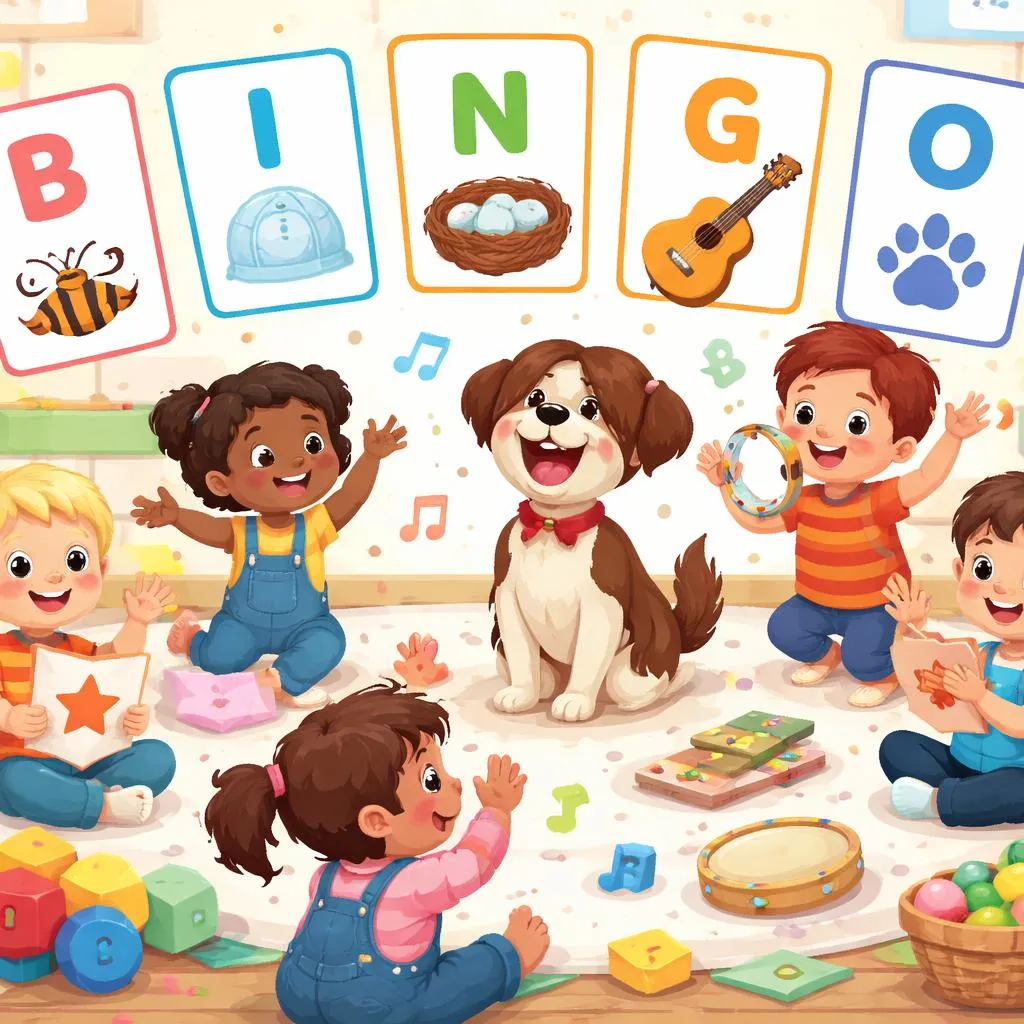

What is the rhyme?
The b-i-n-g-o song is a traditional English nursery rhyme. It tells a simple story about a farmer and a dog named Bingo. The song uses repetition and spelling patterns.
Teachers often use this rhyme in early English lessons. It supports letter recognition and rhythm awareness. It also encourages active singing and clapping.
The repetitive structure makes it ideal for young learners. Each verse removes one letter and replaces it with a clap. This pattern supports memory and sequencing skills.
The lyrics of nursery rhymes
The lyrics of the b-i-n-g-o song follow a predictable pattern. The first verse spells the name B-I-N-G-O. Later verses replace letters with claps.
“There was a farmer had a dog, And Bingo was his name-o. B-I-N-G-O, B-I-N-G-O, B-I-N-G-O, And Bingo was his name-o.”
In later verses, “B” becomes a clap, then “I,” then “N,” and so on. This progressive pattern keeps attention high. It also creates opportunities for kinesthetic learning.
Teachers can slow down the tempo to support clarity. Gestures and claps make abstract letters concrete.
Vocabulary learning
The b-i-n-g-o song introduces useful vocabulary. “Farmer” and “dog” connect language to real-world animals and jobs. “Name” introduces identity language.
Teachers can expand vocabulary with pictures. Show a farmer, a dog, a farm, and a house. Connect each word to a visual image.
Simple sentence models help comprehension. “This is a dog.” “The farmer has a dog.” “The dog’s name is Bingo.”
Repetition strengthens retention. Contextual teaching links new words to familiar concepts.
Phonics points
The b-i-n-g-o song strongly supports phonics instruction. Each letter in B-I-N-G-O represents a sound. Teachers can model letter names and letter sounds.
“B” sounds like /b/ in “ball.” “I” sounds like /ɪ/ in “in.” “N” sounds like /n/ in “nose.” “G” sounds like /g/ in “go.” “O” sounds like /oʊ/ in “open.”
Clapping for missing letters builds phonemic awareness. Learners notice sounds even when letters disappear. This supports decoding and early spelling skills.
Teachers can pair letters with flashcards. Say the sound while showing the letter. Then sing the verse again for reinforcement.
Grammar patterns
The b-i-n-g-o song contains simple grammar structures. The sentence “There was a farmer” models past tense. This introduces basic narrative language.
“And Bingo was his name-o” introduces possessive structure. It shows how names identify people or animals.
Teachers can highlight sentence patterns. “There was a .” “ was his name.”
Students can substitute new nouns. “There was a teacher.” “There was a cat.”
This encourages creative language production. It also builds early sentence-building confidence.
Learning activities
The b-i-n-g-o song supports many classroom learning activities. Clapping games support listening and rhythm skills. Letter cards help visual recognition.
Teachers can use a dog puppet named Bingo. Introduce a short story about the dog. Connect storytelling with the song.
Role-play activities add communicative practice. One student becomes the farmer. Another student becomes the dog.
Teachers can integrate drawing tasks. Draw Bingo the dog and label the letters B-I-N-G-O. This combines art with literacy.
Movement-based learning increases engagement. Jump for each letter. Clap for missing letters.
Printable materials
Printable worksheets support structured practice. Letter tracing sheets for B, I, N, G, and O reinforce handwriting. Matching worksheets link letters to pictures.
Sentence-building strips allow sentence practice. “There was a farmer.” “Bingo was his name.”
Coloring pages with a farm scene connect visuals to lyrics. Cut-and-paste activities help sequencing. Place letters in order to spell B-I-N-G-O.
Teachers can create mini-books. Each page shows one letter and a picture. This supports independent reading practice.
Educational games
Games deepen understanding and motivation. A “Bingo Letter Hunt” game works well. Hide letter cards around the room. Call out letters and ask learners to find them.
A rhythm game builds listening skills. Clap the rhythm of the song. Students echo the rhythm.
A spelling relay game adds movement. Teams arrange letter cards to spell B-I-N-G-O. Speed and accuracy encourage focus.
A story-building game integrates grammar. Say, “There was a farmer.” Ask learners to add a new sentence about Bingo.
Digital games can extend practice. Interactive songs with missing letters reinforce phonics. Simple quizzes check vocabulary understanding.
The b-i-n-g-o song supports early English development through music, movement, and repetition. It connects phonics, vocabulary, and grammar in a playful format. When teachers guide singing with visuals, gestures, and structured activities, language learning becomes meaningful and memorable.