
Certain stories appear in classrooms generation after generation. Their themes remain relevant across time. The david and goliath children's story represents one such enduring narrative. A young shepherd faces a giant warrior. The odds seem impossible. The outcome surprises everyone. This article explores practical teaching applications for this powerful tale. The focus remains on language development through story. Let us examine how this ancient narrative supports English learning.
What Is the David and Goliath Children's Story? The david and goliath children's story comes from ancient texts. It tells of a giant warrior who challenges the Israelite army. Goliath stands over nine feet tall. He wears heavy armor. He carries massive weapons. The Israelite soldiers feel afraid. No one volunteers to fight.
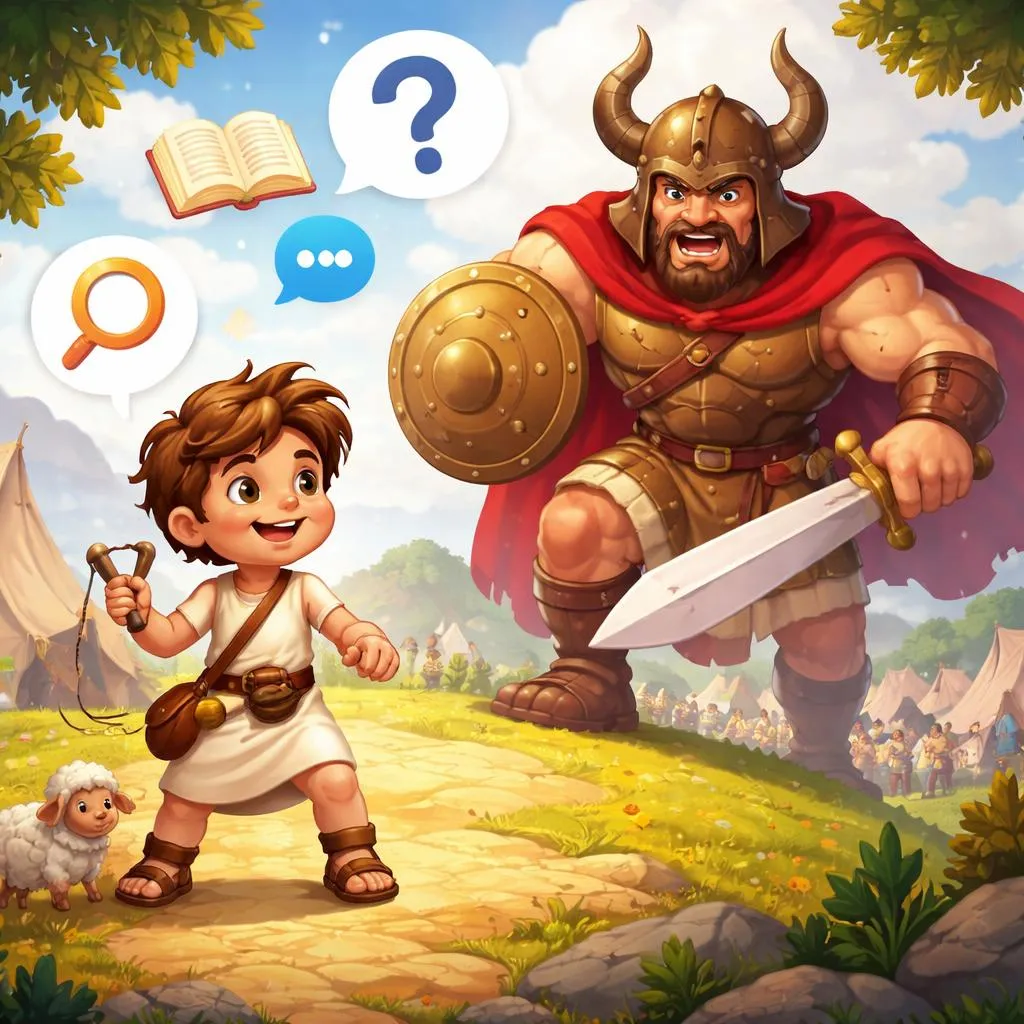
A young shepherd named David arrives at the camp. He brings food for his brothers. He hears the giant's insults. David volunteers to fight. King Saul offers armor and a sword. David refuses. He trusts his skills with a sling and stones. He gathers five smooth stones from a stream. He faces the giant with simple tools. The stone strikes Goliath's forehead. The giant falls. David wins without a sword.
Vocabulary Learning from the Story The david and goliath children's story introduces rich vocabulary. Size words appear throughout. "Giant," "massive," "enormous," and "tall" describe Goliath. Contrast words describe David. "Small," "young," "ordinary," and "shepherd" show his humble status.
Weapon vocabulary creates clear images. "Sword," "spear," "armor," and "shield" belong to Goliath. "Sling," "stones," and "staff" belong to David. Students see the contrast through concrete objects.
Emotion words drive the plot. The soldiers feel "afraid" and "terrified." David feels "brave" and "confident." The king feels "doubtful." Goliath feels "angry" and "insulted." These feeling words support social-emotional vocabulary development.
Action words move the story forward. "Challenge," "insult," "volunteer," "refuse," "trust," "gather," "strike," and "fall" describe key moments. Each action connects to a clear story image.
Phonics Points in the Story The david and goliath children's story contains useful phonics patterns. The "g" sound appears in key words. "Giant," "Goliath," "great," and "ground" offer practice opportunities. The hard "g" repeats throughout.
The "s" blend appears in descriptive language. "Sling," "stone," "smooth," "stream," and "strike" share the initial sound pattern. Students can collect these words.
Long vowel sounds appear in character names. "David" contains the long "a" sound. "Goliath" contains the long "i" sound. These names provide memorable examples.
Rhyming possibilities extend from story vocabulary. "Tall" rhymes with "small," contrasting the characters. "Stone" rhymes with "alone," describing David's solitary challenge.
Grammar Patterns in the Story The david and goliath children's story models essential grammar structures. Past tense dominates the narrative. "Goliath stood." "David gathered." "The stone struck." Students encounter regular and irregular past forms naturally.
Comparative language appears frequently. "Taller than," "stronger than," "bigger than" describe Goliath's advantage. "Smaller than," "younger than," "weaker than" describe David's apparent disadvantage. The story reverses these expectations.
Question forms appear in dialogue. "Who will fight me?" challenges Goliath. "Why aren't you fighting?" asks David. "How can you defeat him?" wonders the king. Students see questions in natural contexts.
Contrastive conjunctions structure the plot. "But David trusted God." "However, Goliath fell." "Yet the giant lost." These connecting words show story turning points.
Learning Activities for the Story Several activities work well with the david and goliath children's story. Character comparison charts organize understanding. Create two columns labeled David and Goliath. List physical characteristics, weapons, and attitudes. Students see the contrast visually.
Story sequencing builds comprehension. Provide sentence strips describing key events. Students arrange them in correct order. David arrives at camp. David hears Goliath. David volunteers. David refuses armor. David gathers stones. David defeats Goliath.
Point of view writing extends language practice. Ask students to retell the event from Goliath's perspective. What did the giant see? What did he feel when the stone struck? This builds empathy and creative language use.
Modern application discussions connect the story to daily life. What giants do people face today? What small stones can help overcome big problems? This transfers story themes to personal experience.
Printable Flashcards for Story Vocabulary Flashcards reinforce key vocabulary from the david and goliath children's story. Create cards for character names. "David" on one side. His picture on the other. "Goliath" with his image. Students match names to characters.
Weapon flashcards build concrete understanding. Show pictures of sling, stone, sword, spear, shield, and armor. Add labels. Students connect words to objects.
Feeling word flashcards support emotional vocabulary. Create cards with "brave," "afraid," "confident," "doubtful," "angry," and "surprised." Students match feelings to story moments when characters experienced them.
Action word flashcards capture story movement. Illustrate "gather," "strike," "fall," "shout," "run," and "cheer." Students can act out each action.
Educational Games for Story Learning Games transform the david and goliath children's story into interactive experience. Story charades works well. Write character names and actions on cards. Students act out while others guess. David using a sling. Goliath falling. Soldiers cheering.
Memory match pairs reinforce vocabulary. Create cards with story words and matching pictures. Students find pairs while saying the words aloud. The game format encourages repetition without boredom.
Board games along a story path work well. Create a simple board showing story events in order. Players move forward by answering comprehension questions. First to reach David's victory wins.
Hot seat questioning builds deeper understanding. One student sits in the "character chair." Others ask questions to that character. "David, why weren't you afraid?" "Goliath, what surprised you most?" This builds perspective taking and question formation.
Printable Materials for Story Lessons Printable materials support structured learning with the story. Story summary templates guide comprehension. Provide spaces for characters, setting, problem, actions, and solution. Students complete after reading or listening.
Comic strip templates allow creative retelling. Provide blank panels. Students draw key scenes and add simple dialogue. This combines artistic expression with language production.
Word searches using story vocabulary provide independent review. Include "David," "Goliath," "giant," "shepherd," "sling," "stone," "armor," "sword," "brave," and "victory." The puzzle format feels like play.
Fill-in-the-blank passages check comprehension. Remove key words from a story summary. Provide a word bank. Students choose correct words to complete the text.
Character Education Connections The david and goliath children's story naturally supports character education. Courage appears as the central theme. David shows courage despite his size. Students discuss what courage means in their lives.
Preparation matters in the story. David practiced with his sling. He knew how to use it. Preparation builds confidence. Students connect this to practicing skills for their own challenges.
Trust in personal strengths appears throughout. David refused armor he could not use. He trusted his own abilities. Students identify their own unique strengths.
Perspective changes everything. The soldiers saw an impossible problem. David saw an opportunity. Students practice reframing challenges as opportunities.
Cross-Curricular Connections The story connects to multiple subject areas beyond language arts. History lessons explore the ancient world. What was life like for shepherds? How did armies fight? What armor did warriors wear?
Science connections appear through the sling. How does a sling work? What makes a stone fly far? Simple machines and force become relevant.
Art projects extend the narrative. Students draw the confrontation. They sculpt figures from clay. They create dioramas of the valley. Visual expression reinforces verbal understanding.
Music connections appear through the shepherd theme. David played the harp. Students explore music as expression. They create songs about courage.
The david and goliath children's story has traveled through centuries for good reason. Its themes resonate across cultures and generations. The language remains accessible while carrying depth. Vocabulary builds through clear contrasts. Grammar appears in meaningful contexts. Characters become memorable references for discussing courage. Young learners carry this story with them. They return to it when facing their own giants. The words become tools for expressing their own experiences. This is the power of a well-told tale in language education.