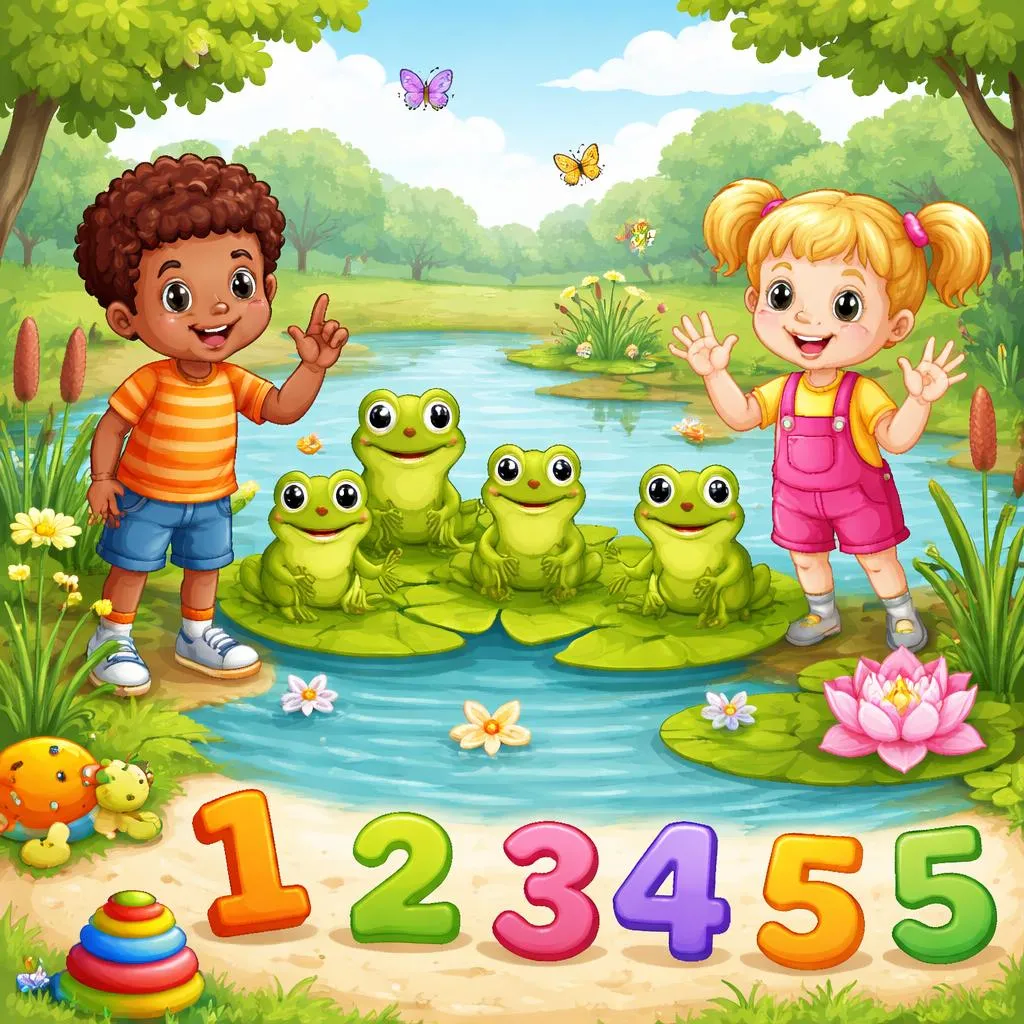

What Is The Rhyme? "Five Little Frogs" is a classic counting-out nursery rhyme. It tells a simple, repetitive story about five frogs sitting on a log. The rhyme is an action song. Children use their fingers to represent the frogs. With each verse, one frog jumps into the pool. This countdown from five to zero makes the five little frogs rhyme a perfect tool for teaching early math. More than that, its predictable structure and engaging story provide an excellent foundation for learning English vocabulary, verbs, and sentence patterns in a joyful, musical way.
The Lyrics of Nursery Rhymes The lyrics of nursery rhymes for "Five Little Frogs" are wonderfully structured. A common version begins: "Five little speckled frogs, sat on a speckled log. Eating the most delicious bugs, yum yum! One jumped into the pool, where it was nice and cool. Now there are four little speckled frogs, glub glub!" The lyrics use clear, descriptive language. They repeat the same pattern with four frogs, then three, and so on. This extreme repetition allows children to quickly learn the words. They can confidently sing along, anticipating the next number and action.
Vocabulary Learning The five little frogs rhyme introduces a rich set of thematic vocabulary. Key nouns include: frogs, log, pool, bugs. Descriptive adjectives make the story vivid: speckled, delicious, nice, cool. We learn action verbs central to the story: sat, eating, jumped. We also learn the sound effect glub glub. The numbers from five down to zero are the core of the song. We can expand on this. We talk about other pond life: lily pad, water, fish. We discuss opposites: on/off, in/out, hot/cool. This builds a complete mini-topic of words for young learners.
Phonics Points This rhyme offers excellent opportunities for phonics practice. We can focus on initial consonant sounds. The /f/ sound in five, frogs. The /l/ sound in little, log, lily. The /j/ sound in jumped. The blend /sp/ in speckled. The rhyme also features wonderful onomatopoeia. The "glub glub" sound practices the /gl/ blend. Words like yum and cool highlight short and long vowel sounds. The "-ed" ending in speckled is a gentle introduction to past tense sounds. Clapping the rhythm of the song helps children feel the syllables in words like "de-li-cious."
Grammar Patterns The five little frogs rhyme models several foundational grammar patterns. It uses the simple past tense to narrate a completed story: "One jumped into the pool." It uses the present continuous for an ongoing action: "…eating the most delicious bugs." The phrase "sat on a log" teaches the preposition "on" for location. The structure "Now there are four…" introduces the "There is/There are" pattern for stating existence or quantity. We can also practice questions: "How many frogs are left?" "Where did the frog go?" This exposes children to essential English sentence structures.
Learning Activities Interactive activities bring the five little frogs to life. A perfect activity is "Frog Finger Puppets." Children can make simple puppets on their fingers. As they sing, one finger "jumps" down behind their back. This combines fine motor skills with counting and singing. Another is "Pond Scene Create." Use blue paper for a pool, a stick for a log, and five frog cut-outs. Children move the frogs as the story progresses. Also, "Action Charades" lets children act out "sitting on a log," "eating bugs," or "jumping into the pool" for others to guess.
Printable Materials Printable resources make the lesson tangible. Create a "Five Little Frogs" counting booklet. Each page has the number (5, 4, 3…), the corresponding number of frogs to color, and a line from the song to trace. Design "Story Sequence Cards." Children put pictures in order: five frogs on a log, one frog jumping, four frogs on a log. A "Number Match" worksheet can connect the numeral "5" to a picture of five frogs. Also, provide a frog life cycle coloring page to expand the science connection and related vocabulary (tadpole, froglet).
Educational Games Games make the learning playful and memorable. Play "Frog Pond Hop." Place lily pad cut-outs on the floor numbered 1-5. Children hop from pad to pad, saying the number. When the music stops, they call out their number. "Frog Bingo" uses pictures from the rhyme (log, bug, pool, frog). The caller says a word or makes a sound ("glub glub"), and players mark their cards. For a whole-body game, do a "Frog Jump Relay." Children squat like frogs and jump to a target, practicing the verb "jump" and counting their leaps.
Using the five little frogs rhyme is about combining math, music, and language in a seamless, engaging package. The countdown structure builds early numeracy skills. The repetitive, rhythmic lyrics make English words and grammar patterns easy to absorb and remember. By adding finger play, crafting, and games, we cater to kinesthetic and visual learners. This multi-sensory approach ensures that children are not just passively listening but actively participating. They learn subtraction, animal vocabulary, action verbs, and sentence patterns—all within the joyful context of a song about five friendly frogs having a snack and taking a swim. It turns a simple counting rhyme into a powerful, fun-filled English lesson.