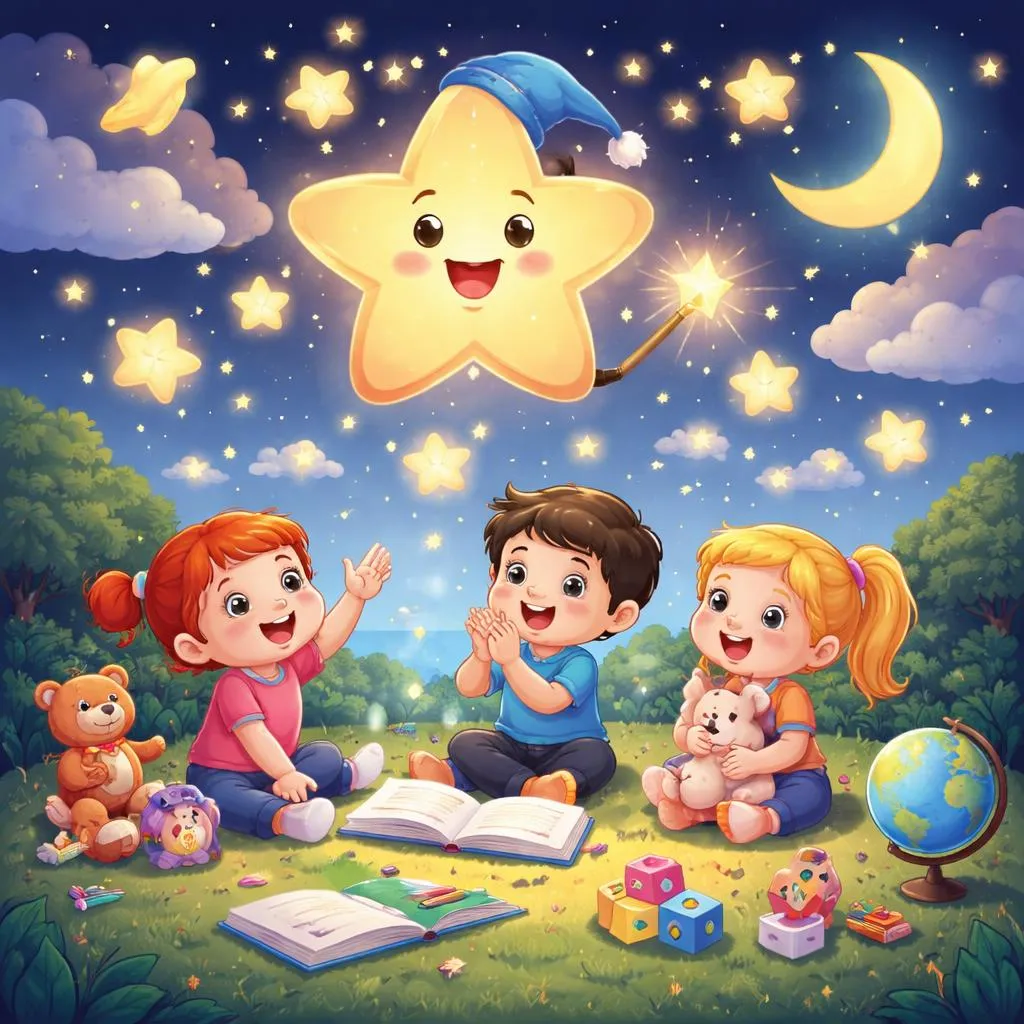

What Is The Rhyme? "Twinkle, Twinkle, Little Star" is one of the most beloved nursery rhymes in the English language. Its melody is simple, gentle, and instantly recognizable. The rhyme poses a wonder-filled question to a star. It explores curiosity about the natural world. The song's slow, rocking rhythm makes it perfect for bedtime or quiet time. As a cornerstone of early childhood, Twinkle Twinkle Little Star nursery rhymes offer more than a soothing tune. They provide a familiar and comforting framework for introducing foundational English concepts in a magical context.
The Lyrics of Nursery Rhymes The lyrics of nursery rhymes for "Twinkle, Twinkle, Little Star" are poetic and repetitive. The first verse is: "Twinkle, twinkle, little star, How I wonder what you are! Up above the world so high, Like a diamond in the sky." The second verse often continues the metaphor. The structure uses a clear AABB rhyme scheme (star/are, high/sky). This predictability is excellent for language learners. The lyrics are a mix of direct address ("little star") and vivid simile ("like a diamond"). This introduces children to descriptive language and poetic devices in a very accessible way.
Vocabulary Learning This rhyme introduces a beautiful set of vocabulary. Key nouns include star, world, sky, diamond. We learn descriptive adjectives: little, high. The core verb is twinkle, a wonderful, specific word for light. We also see wonder, a verb expressing curiosity. We can expand from here. We talk about night, moon, sun, light, shine. We introduce opposites: high/low, above/below. We can connect it to other celestial words. The rhyme provides a perfect springboard to discuss what we see in the night sky, building a thematic vocabulary set around wonder and observation.
Phonics Points "Twinkle, Twinkle, Little Star" is rich with phonics opportunities. We focus on the initial consonant blend /tw/ in twinkle. We practice the /l/ sound in little. The long 'i' sound is prominent in I, high, sky. We can highlight the /w/ sound in wonder and world. The rhyme also features the r-controlled vowel /ar/ in star and are. The repetitive nature lets us isolate these sounds. We can clap the two-syllable words: twin-kle, won-der, a-bove, dia-mond. Finding rhyming pairs (star/are, high/sky) strengthens phonemic awareness and prediction skills.
Grammar Patterns The rhyme models several important grammar patterns. It begins with an exclamation, showing strong feeling. It uses the present simple tense to describe a constant state: "you are," "you are." The line "How I wonder what you are!" is an exclamatory sentence structure. The prepositional phrase "Up above the world so high" teaches location. The simile "Like a diamond in the sky" introduces the conjunction "like" for comparison. We can practice transforming the statement into a question: "What are you, little star?" This exploration of sentence variety is valuable for young learners.
Learning Activities Engaging activities can extend the rhyme's theme. Try "Star Gazing Description." Use a flashlight and dark paper to project "stars." Ask, "What do you see? The star is twinkling. It is high in the sky." Another is "Rhyme Replacement." Keep the melody but change the subject. "Sparkle, sparkle, little wave, How I wonder how you behave." This encourages creative use of the grammatical structure. A "Night Sky Collage" activity lets children create their own sky with stars, moons, and other objects, then label them in English.
Printable Materials Printable resources bring the starry theme to life. Create a "Twinkle Twinkle" lyric sheet with illustrated keywords (star, diamond, sky). Design "Word Shape Cards" where the word star is written inside a star shape. This reinforces word recognition. A "Matching Worksheet" can connect the word "twinkle" to a picture of shining stars. A "My Night Sky" drawing sheet has prompts: "Draw something high in the sky. Write its name." Also, simple "Star Cut-Outs" with letters or vocabulary words can be used for sorting and spelling games.
Educational Games Games make the learning stellar. Play "Wishing Star." Children toss a beanbag onto a large mat with pictures (moon, cloud, star). They say a sentence about where it lands. "The beanbag is on the moon!" "Flashlight Phonics" is fun in a dim room. Shine a flashlight on a letter or word card on the wall. Children must say the sound or word the "star light" reveals. For a music game, sing the song at different speeds or volumes (slow, fast, whisper, loud), which builds listening skills and rhythmic awareness.
The enduring magic of Twinkle Twinkle Little Star nursery rhymes lies in its perfect blend of simplicity and depth. It captures a universal sense of wonder that resonates with every child. This emotional connection makes it a powerful vessel for language learning. From its clear phonics to its gentle grammar, the rhyme lays a foundational stone. It shows that English can be used to ask beautiful questions and paint pictures with words. By building activities around this familiar favorite, we validate the child's existing knowledge while stretching their skills. The journey from simply singing the song to understanding its words, and then to creating new verses, marks a beautiful path in language acquisition—a path that starts with a twinkle and leads to a universe of expression.