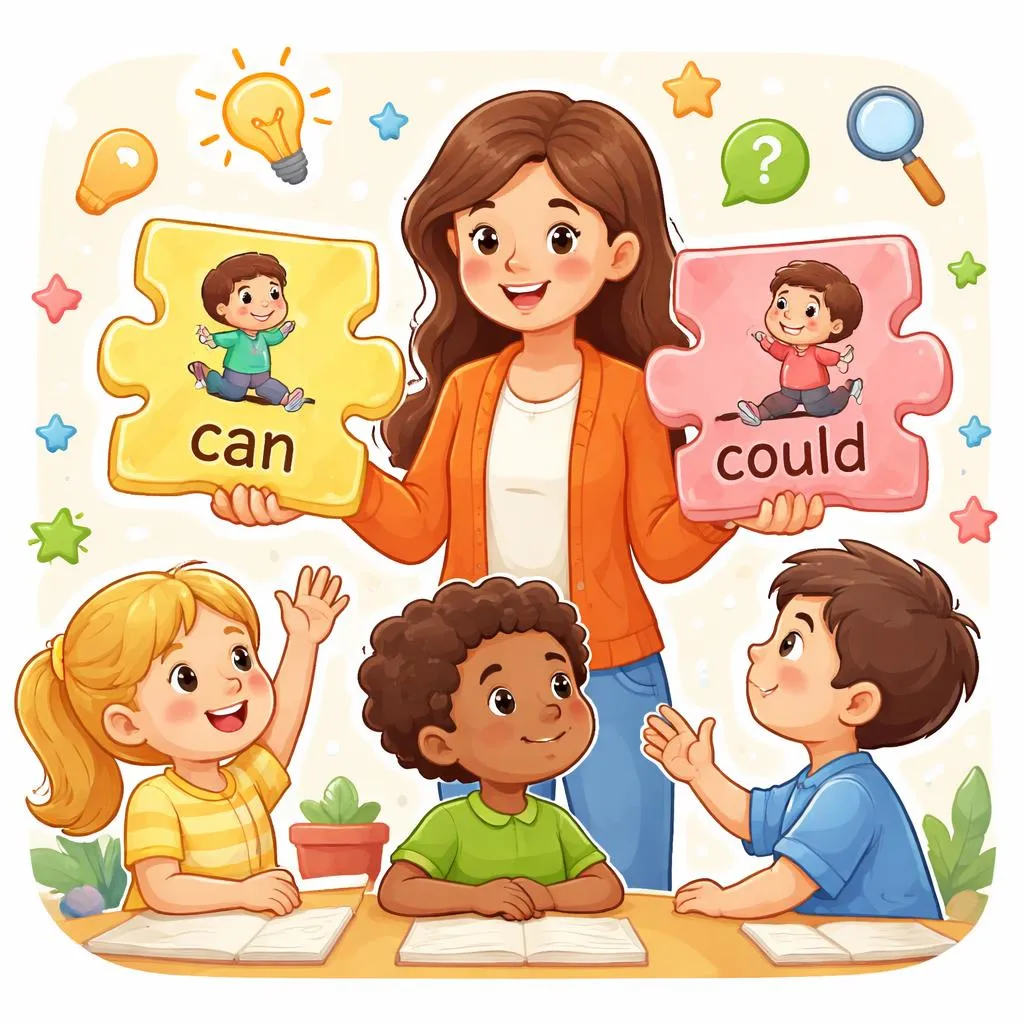

Hello, wonderful educators and language guides! Today, we’re going to unpack a word that adds politeness, possibility, and past ability to our sentences. We’ll explore the question: is could a verb? The simple answer is yes, but it's a special type of verb. Understanding that could is a verb—specifically a modal verb—is a key step in mastering polite and nuanced English. Let's discover how to teach this concept in a clear, friendly, and effective way.
Meaning First, let's clarify what “could” means. Could is a verb, but it is a “modal auxiliary verb.” This means it cannot work alone. It must always team up with a main verb to complete its meaning. Its core meaning relates to ability, possibility, or permission, but in a less direct way than “can.” We often use could to talk about general ability in the past. For example, “When I was five, I could ride a bike.” We also use it for polite requests, as in “Could you help me?” which is softer than “Can you help me?” Finally, we use it to express a future possibility, like “It could rain later.”
Conjugation As a modal verb, could has a very simple conjugation. It does not change form for different subjects. We say “I could,” “you could,” “he could,” “she could,” “it could,” “we could,” and “they could.” It remains the same. The main verb that follows is always in its base form without “to.” For example, “She could sing.” Not “She could to sing” or “She coulds sing.” The negative form is “could not,” almost always contracted to “couldn’t.” This lack of change makes it easier to teach than many other verbs.
Present tense We do not typically use could for present ability. For present ability, we use “can.” For example, “I can swim now.” However, we use could in the present for two main things. First, for very polite requests: “Could I have some water, please?” Second, for present or future possibility: “He could be at the park.” This means it is possible he is there now. So, while could often feels present in these polite or possible situations, it originates from a past form of “can.”
Past tense One of the primary uses of could is to express general ability in the past. It describes something you were able to do over a period of time. “When I was little, I could count to one hundred.” “My grandfather could speak three languages.” For a single, specific event in the past that someone managed to do, we often use “was/were able to.” For example, “Yesterday, I was able to finish my project.” But for repeated or general past abilities, could is perfect and very common.
Future tense We use could to talk about future possibility, not future ability. To express future ability, we use “will be able to.” For possibility, could suggests something might happen. “It could snow tomorrow.” “We could go to the zoo next week.” This use is about a chance or an option, not a confirmed skill. It’s a wonderful way to talk about plans that are not yet fixed, making it a useful verb for imaginative and speculative language.
Questions Forming questions with could is simple. We use it at the beginning of the question. “Could you pass the butter?” “Could they come with us?” “Could it be true?” This is its most common and practical use in everyday conversation—making polite requests. Negative questions are also common for emphasis or surprise: “Couldn’t you see the sign?” Teaching learners to start requests with “Could you…?” is a fantastic lesson in everyday politeness.
Other uses Beyond past ability and polite requests, could has a few other important uses. We use it to make suggestions. “We could watch a movie.” This is softer than “Let’s watch a movie.” We use it in conditional sentences. “If I had time, I could help you.” This expresses a possible result of an unreal condition. We also use it to express slight disbelief. “That couldn’t be right!” Introducing these uses gradually shows learners the versatility of this small but powerful word.
Learning tips A great tip is to contrast “can” and “could” for politeness. Role-play two scenarios: asking a friend for a pencil (“Can I borrow your pencil?”) and asking a teacher (“Could I borrow a pencil, please?”). Discuss how could sounds more formal and polite. Another tip is the “Past Ability” interview. Have learners ask each other, “What could you do when you were four years old?” This personalizes the past tense use and generates lots of “I could…” sentences.
Educational games “Polite Request Charades” is a fun game. Write down simple needs on cards (“need a drink,” “want the door opened,” “need a book”). A learner picks a card and must ask the group for help using “Could you…?” The group only helps if the request is polite and correct! “Could you open the door, please?” This practices the key social function of could.
“Could It Happen?” is a possibility game. Show pictures or say scenarios. Learners decide if it “will” happen, “could” happen, or “can’t” happen. “The sun will rise tomorrow.” (Will). “It could rain this afternoon.” (Could). “A cat could fly.” (Can’t). This clarifies the meaning of possibility versus certainty and impossibility.
Mastering the verb could equips learners with a tool for politeness, reflection, and imagination. It allows them to speak about the past respectfully, make gentle suggestions, and ponder what might be. When we hear them say, “Could you help me?” or “I could try that,” we see them using English with greater social awareness and subtlety. Celebrate this step towards more sophisticated communication. Keep practice light, focus on its friendly and polite nature, and watch their confidence in navigating social situations grow.