
What is the story
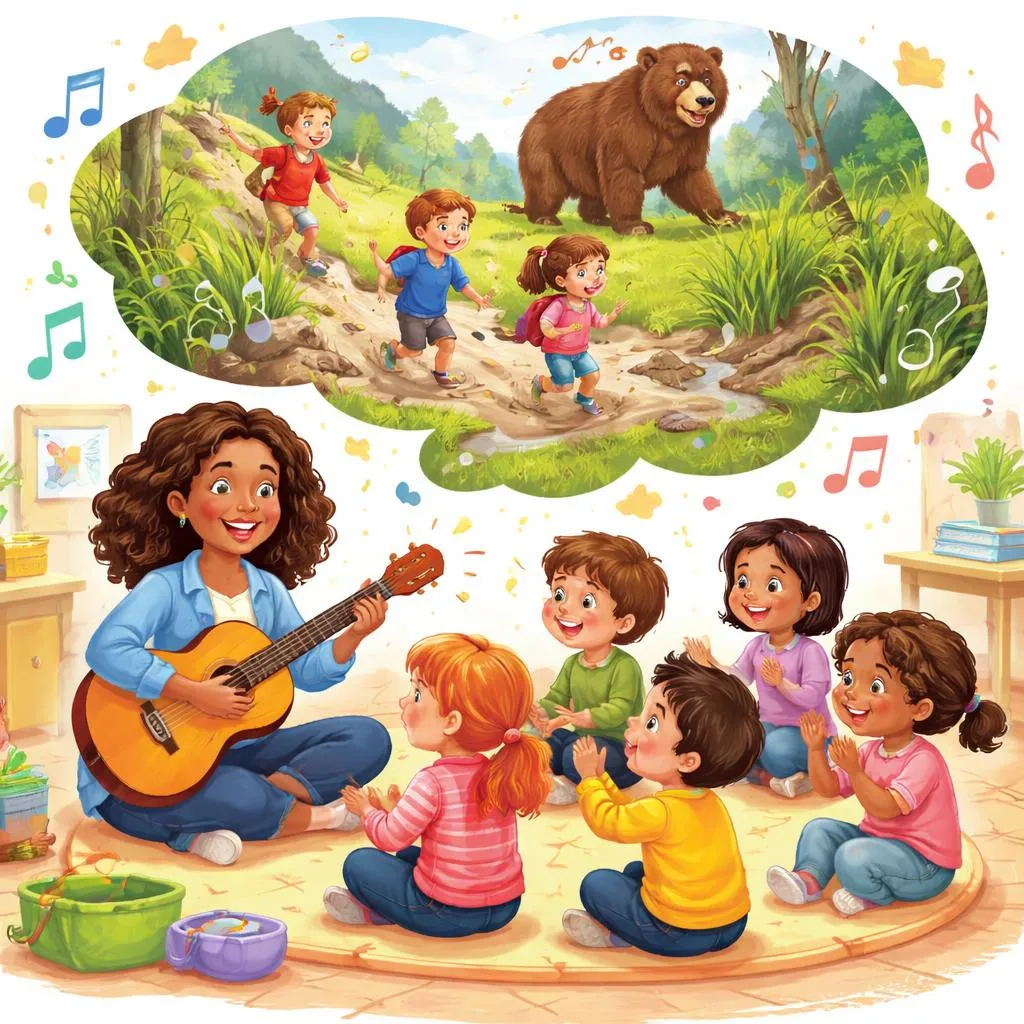
“we're going on a bear hunt song” is a classic rhythmic story and chant. It is based on a popular picture book and traditional oral storytelling style.
The song describes a family adventure through grass, rivers, mud, and forests. Each scene repeats predictable language patterns.
In classroom practice, this story-song supports listening comprehension and rhythm awareness. It also connects language with movement and imagination.
A teacher can use this song during story time or movement sessions. It creates excitement and narrative engagement.
The lyrics of nursery rhymes
The lyrics repeat phrases such as “We’re going on a bear hunt.” Repetition helps internalize sentence patterns and pronunciation.
Each verse introduces a new environment. For example, long grass, a river, thick mud, and a dark cave.
Teachers can read or sing one verse at a time. Echo reading supports listening and speaking accuracy.
Choral chanting builds fluency and confidence. It also helps learners notice rhythm and intonation.
Lyrics can be displayed on big charts or digital boards. Highlighting repeated phrases reinforces structure recognition.
Vocabulary learning
The song introduces rich adventure vocabulary. Key nouns include grass, river, mud, forest, cave, and bear.
These words represent concrete objects and places. Concrete vocabulary supports visual learning and comprehension.
Teachers can show pictures or real-life videos of each environment. Visual input strengthens meaning and memory.
Action verbs appear in the song. For example, go, swim, walk, run, and climb.
Teachers can model simple sentences. For example, “We go through the grass.”
Adjectives like long, thick, and dark enrich descriptive language. This supports expressive speaking and early writing.
Phonics points
The song provides strong phonics practice. Repeated phrases highlight stress and rhythm in English.
Teachers can focus on initial sounds in bear, grass, and river. This supports phonemic awareness.
Vowel sounds appear clearly in words like go, mud, and cave. Teachers can slow down pronunciation for segmentation practice.
Onomatopoeic phrases such as “splash splash” add sound awareness. Sound words support listening discrimination and fun engagement.
Syllable clapping can help decode longer words. For example, ri-ver and for-est have two syllables.
Rhythm chanting strengthens prosody and fluency. Prosody awareness supports natural spoken English.
Grammar patterns
The story-song uses present continuous tense. For example, “We’re going on a bear hunt.”
Teachers can explain that “we’re going” describes an action happening now. This introduces basic progressive aspect.
Prepositions appear frequently. For example, through, over, and under.
These prepositions support spatial language development. Spatial language is important for storytelling and comprehension.
Sentence patterns repeat with predictable structure. Repetition supports syntactic awareness and automaticity.
Teachers can extend patterns with new nouns. For example, “We’re going through the snow.”
Learning activities
A movement-based storytelling activity can start the lesson. Learners act out walking, swimming, and running.
Total Physical Response supports comprehension. Movement links language with physical memory.
A sequencing activity can follow. Teachers provide picture cards of each environment.
Learners arrange the story scenes in order. This builds narrative structure awareness.
A speaking circle can encourage retelling. Sentence frames scaffold storytelling.
A drawing task integrates art and language. Learners draw the adventure path and label places in English.
A listening comprehension task can remove key words from lyrics. Learners fill in missing vocabulary while listening.
Printable materials
Printable story cards can show each scene. These cards support sequencing and retelling practice.
A mini storybook can present one scene per page. Repeated reading builds fluency and comprehension.
Flashcards for nouns and verbs can support drills. Large images help early learners recognize meaning.
A phonics worksheet can highlight initial sounds in story words. Learners match sounds with pictures.
Sentence-building strips can model “We’re going through the ___.” Learners complete and read aloud.
A simple map worksheet can show the adventure route. Learners label grass, river, mud, and cave.
Educational games
A story relay game can promote teamwork. Each learner says the next line of the story.
A picture guessing game can use wh questions. For example, “What is this place?”
A movement command game can integrate verbs. Teachers say “Walk through the grass,” and learners act.
A memory matching game can pair pictures and words. This strengthens vocabulary recall.
A role-play game can assign characters in the story. Learners act and narrate the adventure.
A board game can include story prompts. Landing on a square requires describing the scene.
“we're going on a bear hunt song” combines rhythm, narrative, and adventure. It supports vocabulary, grammar, phonics, and storytelling in one integrated lesson.
In teaching practice, stories with movement create deep engagement. They connect language with imagination and emotion.
Through repeated chanting, acting, and retelling, language patterns become natural. Learners develop listening accuracy, expressive speaking, and narrative confidence through joyful story-based learning.